
Karteikarten
Viruses, Biotechnology, Cellular Respiration, and Photosynthesis
Karten in diesem Stapel (69)
- 1smallest type of microorganismviruses
- 2virusesextremely simple, store genetic information, and are surrounded by proteins or a membrane and glycoproteins
- 3Obligate intracellular parasites (viruses)the only way to reproduce is taking over cell and using cell parts to replicate virus
- 4Viral characteristics that don't follow the rules of "life"have an unusual cell structure, have no metabolic reactions of their own, have no ribosomes and cannot synthesize proteins, cannot reproduce independently
- 5Steps of Lytic cycle in a bacteria cellphage attaches and injects genetic material, the genetic material of the phage circularizes, phage DNA/RNA and proteins are synthesized and assembled in the cell, the cell lyses and releases new phages
- 6Steps of the lysogenic cycle in a bacteria cellphage attaches and injects genetic material, the genetic material of the phage circularizes, the phage DNA/RNA integrates into the bacterial chromosome creating a prophage, prophage is copied when the cell is replicated, cell exits lysogenic cycle
- 7when a host cell undergoes stressorscell exits lysogenic cycle and enters lytic cycle
- 8why do cold sores continue to appear?the virus attacks skin cell, viral DNA gets can attach to nerve DNA and escape the immune system
- 9Retroviruscontains RNA and reverse transcriptase (starting with RNA and synthesizing DNA)
- 10HIVretrovirus that has its genetic information incorporated into the genome and then thus gets passed down
- 11Retroviruses violate ...the central dogma of molecular biology - reverse transcriptase allows for RNA to be synthesized into DNA
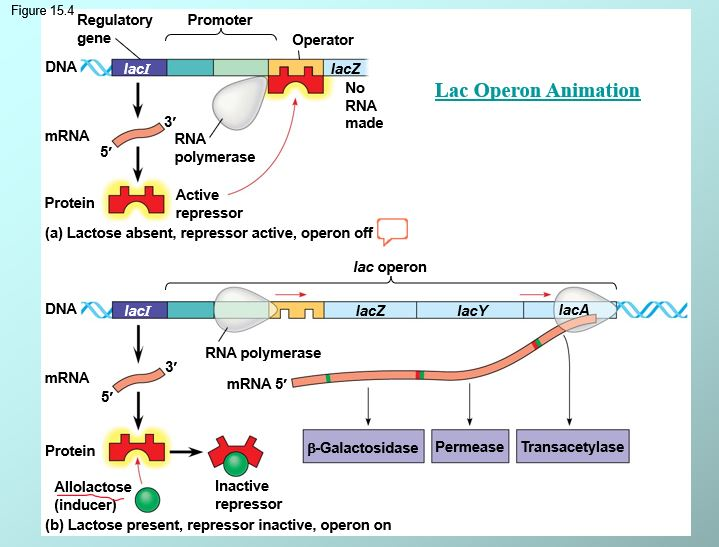
- 12Transcription and Translation in Prokaryotic cellcan take place at same time
- 13Gene expression can be regulated (most efficient to least)1 during transcription
2 during translation
3 after translation - 14Inducible systemturned on by the presence of something in environment – transcription and translation are induced by certain stimuli
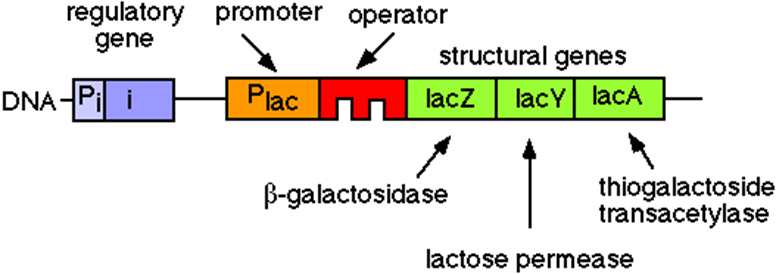
Something is added – inducer - 15Lac operonlacZ, lacY, lacA – structural genes
Promoter where RNA polymerase attaches goes to termination sequence
Operator – controlling weather transcription or translation occurs
Regulatory gene (i) – how system is turned off - 16Lac operon
- 17Biotechnologyis based on restriction endonucleases, which protect bacteria cells from an attack from a phage
- 18Bacterial DNAprotected by methylation of host DNA - helps to distinguish bacterial DNA from viral DNA
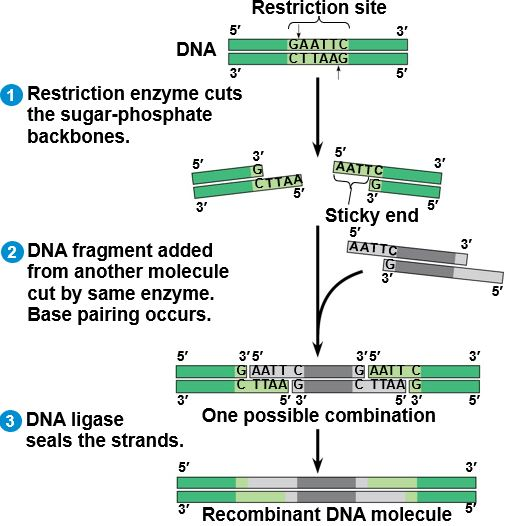
- 19Restriction sitepalindromic sequence; "sticky ends"
- 20Using Restriction Enzymes
- 21two important uses1. analyzing the structure of DNA - DNA fingerprinting
2. creating genetically engineered organisms - 22RFLPRestriction Fragment Length Polymorphism
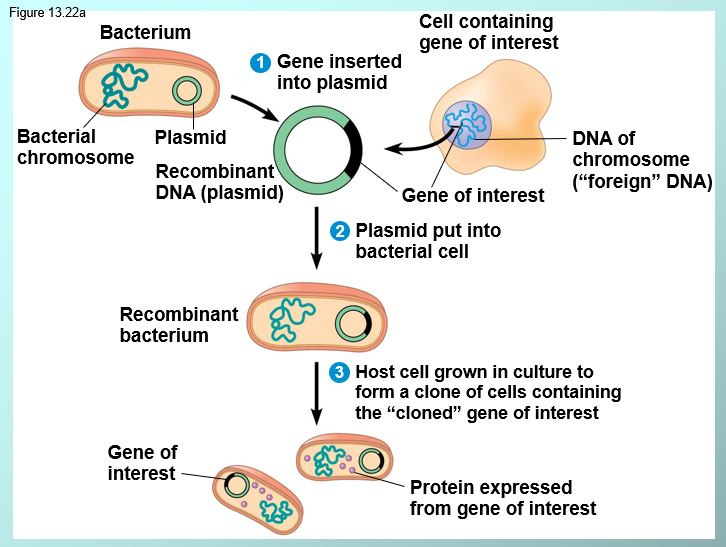
- 23Gene Cloning
- 24Energythe capacity to do work
- 25Chemical transformationchemical reactions involving the breaking and forming of covalent bonds
- 26Energy transformationthe conversion of energy from one form to another
- 27potential energymore free energy (higher G)
less stable
greater work capacity - 28kinetic energyless free energy (lower G)
more stable
less work capacity - 29Exergonic reactionspontaneous
∆G < 0
energy is released - 30Endergonic reactionnonspontaneous
∆G > 0
energy must be provided - 31catabolic reactiontake larger molecules and make smaller molecules – release energy
- 32anabolic reactiontake smaller molecules and make larger molecules – require input of energy
- 33Laws of Thermodynamics1. energy cannot be created nor destroyed
2. any energy transformation results in a loss of usable energy.
3. over time, unusable energy (entropy) increases - 34Oxidationloss of electrons (H+)
coupled with reduction - 35Reductiongain of electrons (H+)
coupled with oxidation - 36Activation energyenergy applied to exergonic reactions to start the process
- 37enzymescatalyze reactions - bind to activation site -> gets converted to products -> gets released
- 38two factors that affect enzymestemperature
pH - 39inhibitorsinhibit enzymatic reactions
competitive and noncompetitive - 40competitive inhibitorsbind to active site and compete over site
- 41noncompetitivebind to enzyme away from active site, change the shape of enzyme so substrate cannot bind to enzyme anymore
- 42ATPadenine, ribose, and 3 phosphate functional groups
- 43ADPadenine, ribose, and 2 phosphate functional groups
- 44Aerobicreaction that requires oxygen
- 45Anaerobicreaction that doesn't require oxygen
- 46Autotrophicproduces own food
- 47Heterotrophicnon-autotroph; must consume energy
- 48substrate-level phosphorylationthe addition of a phosphate group to ADP is coupled to an exergonic reaction
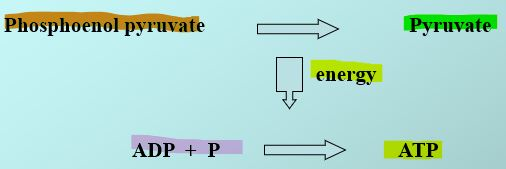
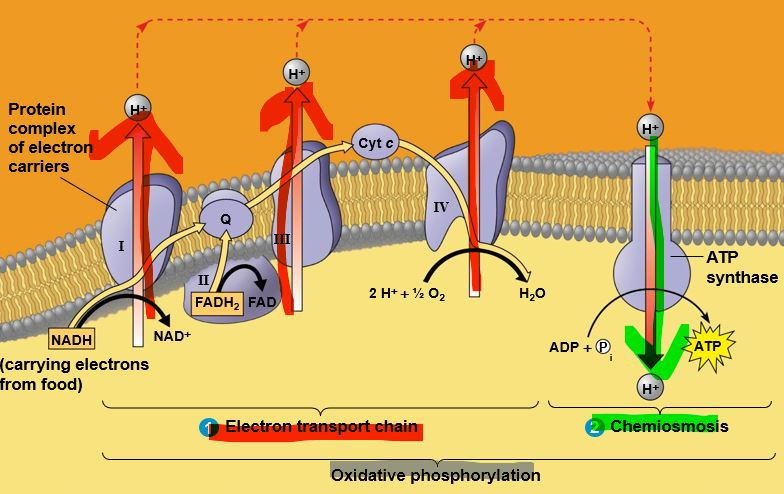
- 49oxidative phosphorylation (chemiosmosis)pump H+ across membrane - creates H+ gradient across membrane
protons diffuse back across membrane through ATP synthase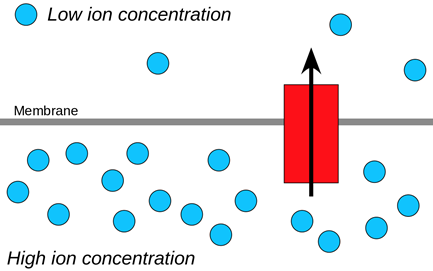
- 50Co-enzymesserve as electron carriers
ex: NAD+ and NADH - 51cellular respirationglycolysis
fermentation (anaerobic)
pyruvate oxidation
citric acid cycle
electron transport/ATP synthesis - 52glycolysistakes place in cytoplasm
glucose to pyruvate
10 reactions - 3 categories
(energy investment reactions, splitting reactions, energy-harvesting reactions) - 53energy investment1-3
attach a phosphate group to glucose - use ATP
creating a molecule that has more free energy than glucose - 54splitting reactions4-5
- 55energy-harvesting6-10
produces pyruvate - 56each glucose molecule that goes through glycolysis yields ...2 pyruvate molecules
2 ATP
2 NADH
2 H+ - 57fermentationanaerobic
humans - pyruvate to lactic acid
yeast - pyruvate to ethanol and CO2
produces NAD+ to continue glycolysis - 58Oxidation of pyruvatepyruvate to Acetyl CoA
takes place in matrix of mitochondria
exergonic reaction - 59Citric Acid CycleAcetyl CoA
2 turns
Each turn releases 1 ATP, 2 C, 3 NADH, and 1 FADH2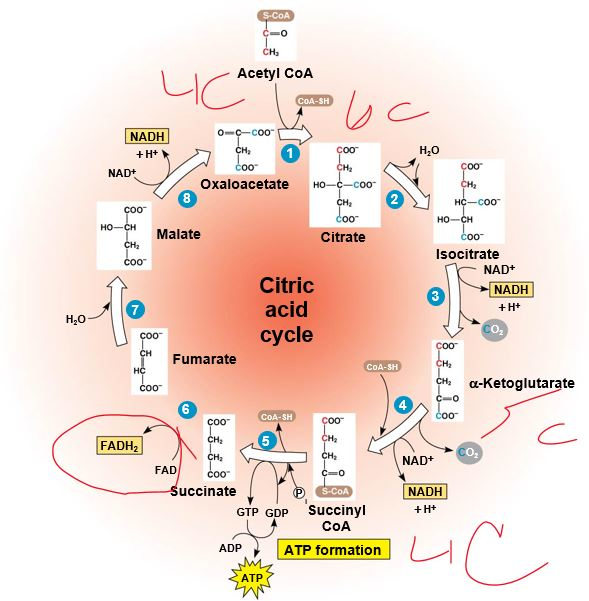
- 60Oxidative Phosphorylation (Electron transport chain & Chemiosmosis)takes place in inner mitochondrial membrane
- 61Cellular Respiration output30 to 32 ATP molecules depending on cellular conditions
2 from glycolysis, 2 from citric acid cycle, 26-28 from oxidative phosphorylation - 62Cellular RespirationC6H12O6 + O2 → CO2 + H2O
- 63PhotosynthesisCO2 + H2O → C6H12O6 + O2
- 64Photosynthesislight energy converted to chemical energy
anabolic
source of oxygen and energy - 65Photosynthesisabsorbs blue and red light
reflects green light
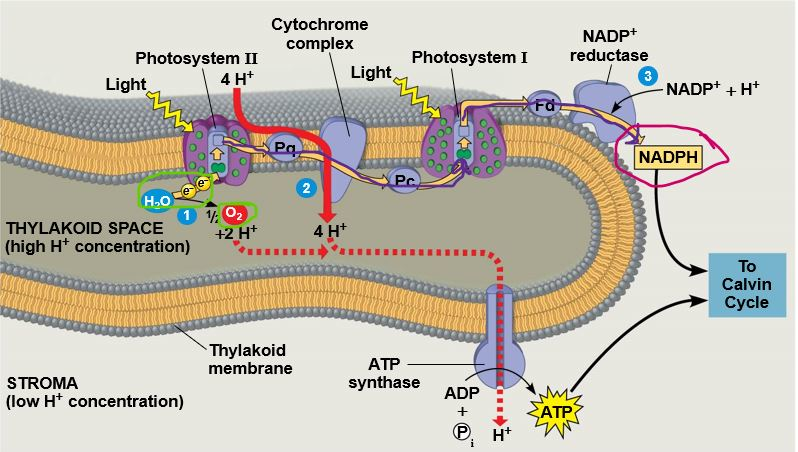
takes place in chloroplasts - 66Light reactionsphotons excite chlorophyll molecules to higher energy state - electron extracted from photosystem II - travels to photosystem I - produces ATP excites molecule - produces NADPH
- 67Light Reactions
- 68Calvin cycle3 phases
(carbon fixation, reduction, regeneration of RuBP)
6 turns to produce 1 sugar molecule
takes place in stroma - 69Carbon fixationTakes an inorganic form of carbon and converts it into an organic form
Informationen
- Beschreibung
- Biology Karteikarten am Viruses, Biotechnology, Cellular Respiration, and Photosynthesis, erstellt von Jillian Wienzek am 10/12/2017.
- Erstellt von
- Jillian Wienzek
- Aufrufe
- 62
- Tags
- Bewertung