
Karteikarten
Unit 1 - ch. 2 Identifies

Karten in diesem Stapel (28)
- 1Federalism-a gov system that divides authority b/w 2 sovereign levels of gov: national & state
-invented by framers to address anti-Fed's concerns of a strong, tyrannical nat. gov.
-strong national gov has enough authority over ppl
-& states have some powers: charter local gov's, edu, public safety, registration & voting.
-+ shared powers: taxation, law enforcement, charter banks, transportation, etc.
-national gov could tax & maintain an adequate army for protection against foreign threats.
-U.S. economy would also benefit b/c it would regulate commerce so no trade wars occurred. - 2Unitarian Government-system of gov that has only one central authority w/ uniform law throughout the country.
-opposite of Federalism.
-e.g. France - 3Full Faith and Credit provision-this provision is part of Federalism
-it's in Article IV
-states that states are required to give full faith & credit (honor) to other states' governments and laws.
-Citizens of all states will be treated equally in all states, even if they don't reside there.
-uncertainty w/ this b/c conflicts w/ Amendment X.
e.g. states like Missouri forced to honor Vermont sanctioning of same-sex marriage. But Missouri, under Amendment X, has the right to define marriage in their own state. - 4Extradition clause-clause in Article IV
-forced states to deliver captured fugitive criminals back tot eh state where they committed the crime.
-said how states should handle runaway slaves (although there's no mention of slaves or slavery) in Constitution - 5Police Powers-powers the states have.
-powers to create & enforce laws regarding health, safety, & morals.
-e.g. state's power to decide which place is smoking banned, funding law enforcement, & funding hospitals. - 6Tenth Amendment-amendment X
-delegates power to the states.
-distinguishes 2 governing spheres
-and states have reserved powers, which are not explicitly written. Any power not mentioned remains w/ state.
-contributes to federalist system of gov.
- 7Delegated Powers-powers specifically stated in Constitution, in Article I, sect. 8.
-Constitution has delegated powers to both states & national gov.
-National gov delegated: creating & maintaining army, coining $$, regulating trade, & declaring war.
-States gov delegated: education, marriage, safety, health. - 8Reserved Powers-given in Tenth Amendment
-powers that are not specifically stated in Constitution & so given to the states.
-also, Congress can't claim national supremacy b/c of these powers. - 9Concurrent Powers-powers held by both the state and national government.
e.g. both the state and the national gov. can collect taxes, define crimes, run court systems, & improve lands.
-picture is a summary
- 10Compact Theory-theory by Thomas Jefferson (as VP to Prez John Adams)
-13 states, by creating a fed gov, had entered a 'compact' regarding its jurisdiction.
-& the states had the authority to decide if the national gov had not abided by the limited authority given.
-context: Prez. Adams passed 'Aliens & Seditions Act', which allowed fed. gov to jail dissenters against the fed gov or deport foreigners who posed a threat to U.S. (more like to Adams).
-^^violated the 1st amendment.
-Jefferson didn't like this & so developed this compact theory.
-also wrote the Kentucky Resolutions calling out the fed. gov.
-Virginia followed suit later.
-this fueled the Jeffersonian movement & anti-Federalist resurgence.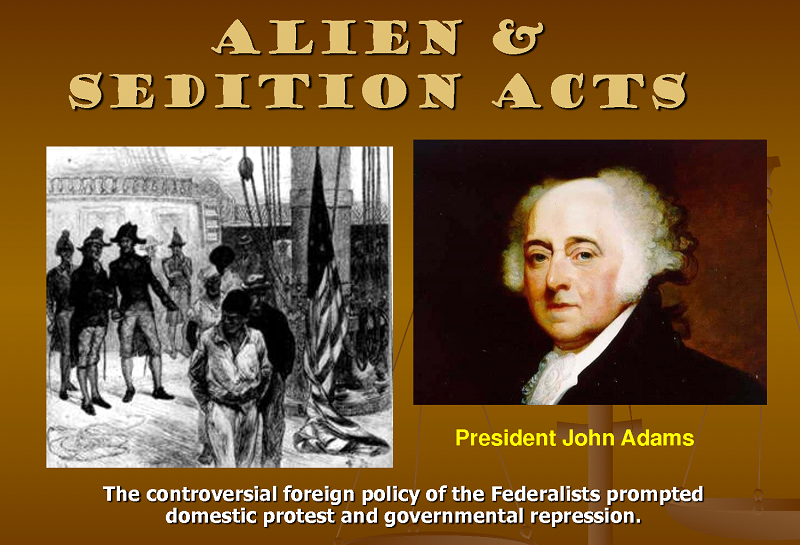
- 11Nullification-included in the VA and Kentucky Resolutions.
-States have a right to declare null and void any federal law if it violates the Constitution.
-This influenced the South later, nearing Civil War
--S. Carolina Senator John Calhoun threatened w/ nullification if the national gov tried to ban slavery.
-^^his ideas led to South's secession during the Civil War.
-Nullification doctrine hasn't appeared in recent time though. - 12McCulloch v. Maryland (1819)-*case details in Cases section*
-case under the Marshall Court.
-Maryland questioned legality of a congressionally established bank in Baltimore b/c it was not explicitly stated that the fed. gov. had the authority to charter a bank.
-& it imposed a tax on all banks not state incorporated. goal = force the U.S. gov bank out of state.
-Sumpreme Court ruled in favor of McCulloch & (in big picture) in favor of the national gov. also.
-Supreme C. ruled that states can't tax fed institutions & that it is implied in the Constitution that Congress has authority over banking issues. So it's allowed to create a bank.
-This case strengthened Congresss's implied powers
-made it possible for a fed law to declare a state law null.
-the "necessary and proper clause" was used
-comic from 'The Funny Times'
- 13Implied Powers-powers not specifically stated in the Constitution
-powers derived from the "necessary and proper" clause (aka elastic clause) - 14Gibbon v. Ogden (1824)-case under the Marshall Court.
-background: a dispute regarding a monopoly granted to a steamboat inventor Robert Fulton in NY
-Fulton had been granted exclusive rights to operate on Hudson River.
-@ same time, Congress had given a Coastal Guard ship authority to sail on the Hudson in order to oversee coastal & inland water ways.
-Decision: Marshall ruled in favor of national gov b/c the fed gov is in charge of commerce.
-This case cemented Congress's authority over most commercial activity.
- 15Dual Federalism-A system in which power is clearly divided between the federal and state governments.
-fed gov was supreme in its sphere
-states are equally equal in their own spheres.
-would exist until the Industrial Revolution came along & Congress legislated business matters.
-e.g. Congress had supreme authority over interstate commerce
--but states have supremacy over commerce that happens within their state borders.
-cake analogy: no layer mixes, clearly defined.
- 16Selective Exclusiveness-a doctrine that states that when the commerce at issue requires national, uniform regulation, only Congress may regulate it.
-case where federalism & selective exclusiveness used:
South Dakota v. Dole (1984)
--Sec. of Transportation Elizabeth Dole
--S. Dakota had a 19 yr-old drinking age, which was slashed with the National Minimum Drinking Age Act (states had to set drinking age to 21 yrs or loose 10% of fed funding for highways)
--Supreme C. ruled in favor of Dole. acknowledged amendment X but also said Dole's Act is protected under Spending Clause. & 10% is small enough to be more of an incentive than force. - 17Cooperative federalism/ Revenue Sharing/ Fiscal Federalism-all names mean the same
-"marble cake federalism" analogy
--the layers mix w/ one another.
-process of Congress collecting fed tax revenues and distributing funds to take care of issues of national concern.
-issues: safety, crime, education, civil rights.
-Congress does this by establishing grants-in-aid programs.
-notable programs: Lyndon's Great Society program - 18Grants-in-Aid-programs that are financial aid from fed gov to these states.
-these grants have different requirements.
-part of cooperative federalism
-e.g. FDR's New Deal programs - 19Categorical Grants-Grants that come w/ particular congressional guidelines/requirements.
-used by gov to address specific issues.
-e.g. under the 1964 Civil Rights Act, fed gov withheld fed funding from schools that didn't completely desegregate its students.
-Under Prez Johnson, categorical grants were also used to address poverty & healthcare.
-*grants (money) in exchange for fulfilling 'categories' of requirements - 20Block Grants-introduced in 1966
-offer states large amounts of money to address an issue, w/out the many specific requirements of a categorical grant.
-done to give more decision-making power to local gov.
-e.g. "Partnership for Health Program" (1966) & "Safe Streets " program (1868) - 21Marble Cake Federalism-a form of Federalism where there is a mixing of powers, resources, and programs between the national, state, and local governments.
-lines are not straight.
-gov got mixed up w/ private sector & nonprofits.
-fed money flows b/w states, private sector, & nonprofits
-this form of federalism arose when Nixon wanted to reform all the federal programs of funding & give states $$ in less restrictive ways
- - 22New Federalism-political philosophy practiced by Nixon & carried w/ Prez. Reagan.
-calls for power to return to the states.
-& to downsize the national government.
-^^advocates devolution
-ppl wanted issues to be on a local level. - 23Mandates-requirement or an order from the national government that all state and local gov must follow.
-meant to incentivize action towards a certain issue & cut finding if they don't do it. - 24Devolution=giving some of the responsibilities that the fed gov has to the states.
-largely supported by Republican Party
-curb "big gov"
-Prez Bill Clinton & w/ bipartisan support, passed 2 bills: the Unfunded Mandate Reform Act, which took away Congress's ability to use unfounded mandates (which were costly for states to maintain) AND the Personal Responsibility Act, which restructured the Welfare system in a way that states had more authority and a say in money distribution for welfare. - 25Social Security-a social welfare policy
-created by Social Security Act of 1935 to create an insurance program that pools in a some of employees' checks.
-These funds are used when they assist in the unemployed and retired people.
-everyone over 65 yrs could benefit
-originally "OASOI"
=SS program run by independent agency called Social Security Administration
-safety net for American citizens - 26Medicare-Medicare law passed in 1965
-helped ease the elderly's burden of medical costs if they were over the age of 65.
-funds come from all employed citizens' payroll tax.
-It's an insurance program and it's a federal program - 27Medicaid-social security program
-provided health insurance to the poorest Americans
-bee citizens, minimum income-household.
-run by local & gov's, but must abide by fed. regulations. - 28Privileges and Immunities Clause-clause is in Article IV
-the citizens from each state are entitled to all privileges and immunities of citizens in several states.
-this will prevent states from discriminating against citizens of other states