
Karteikarten
Native Plants for Wildlife MSU Quiz 1
Karten in diesem Stapel (79)
- 1What are some of the greatest threats to biodiversity?Alteration/Loss of Habitat
Introduction of Non-native Spp
Over-harvest - 2A plant is non-native ifIt wasn't found in the area before European settlement.
- 3A naturalized plantis non-native and reproduces on its' own.
- 4What are some ways non-native species are introduced?Human introduction
Natural Phenomena (Storms, etc.) - 5An endemic speciesoccurs natively in only one area, and lives in a limited range.
- 6Are all non-native species also naturalized or invasive?Non-native species aren't necessarily naturalized or invasive if they don't reproduce after introduction. Most non-natives are this way.
- 7What portion of wild plants in the US are naturalized non-natives?~25%
- 8Problems that can be caused by invasive species: (For example, Autumn Olive- Eleagnus umbellata)Heavy fruit production
Wide dispersal
Competitive vs Natives
Suppresses other native species *plant cover
Adversely impact nutrient cycles - 9Plant Cover isThe relative area covered by different plant species.
- 10Why is plant cover important?Protection from predators and the elements, and for nesting.
- 11Name some advantages to native plants-Adaptation to local ecosystems' abiotic and biotic factors
-Prevent homogenization
-Useful for wildlife (food, cover, proper seed dispersal, etc.)
-Co-evolution - 12Why does all other life depend on plants?Plants produce bio-available energy from sunlight.
- 13Structure of native plants is important becauseanimals use a particular structure for cover or nests in addition to food sources.
- 14What structure does the Yellow Warbler (Setophaga petechia) nest in?Vertical crotches with 3 or more small, spreading branches.
- 15What structure do Red-Eyed Vireos (Vireo olivaceus) nest in?A horizontal "Y" in smaller branches
- 16What structure do cedar waxwings use to nest?Large, horizontal branches or limbs.
- 17What do Red-winged Blackbirds normally use for nests?Cattails
- 18When Purple Loosestrife (Lythrum salicaria) invades cattail stands, why do nests fail more often for RWBB's?Predation rates increase because Purple Loosestrife is easier to navigate through.
- 19How could the invasion of Purple Loosestrife impact the nesting of other species, such as the Marsh Wren (Cistothorus palustris)?It could impact the timing for nesting birds, even preventing viable nesting entirely.
- 20Why do non-native species succeed if they're not superior to the native competition?No natural enemies
Hybridization with native subspecies - 21Bryophytes arenon-vascular plants, like liverworts or mosses.
- 22SVP's areSeedless Vascular Plants, like ferns.
- 23Gemnosperms arevascular, non-flowering seed plants.
- 24Angiosperms arevascular, flowering seed plants.
- 25List the four major plant groups in phylogenetic order (oldest to newest)-Bryophytes
-Seedless Vascular Plants (SVP's)
-Gemnosperms
-Angiosperms - 26Phylogeny of the Angiosperms includes:Basal families, the magnoliid complex, monocots, and eudicots.
- 27Name characteristics of Monocots.-Petals in multiples of 3
-Parallel leaf veins
-One pore per pollen
-Dispersed vascular tissue
-One cotyledon, or embryonic leaf - 28Name characteristics of Eudicots?-Petals in multiples of 4 or 5
-Reticulate (netlike) leaf veins
-3 pores per pollen
-Vascular tissue occurs in a ring
-2 cotyledons, or embryonic leaves - 29HabitGrowth form of a plant. Can be Woody or Herbaceous, though some include Vines/Liannas as a separate habit.
- 30Distinguish between the 3 Life HistoriesAnnual: lives for 1 growing season
Biennial: lives for 2 growing seasons
Perennial: lives for 3 or more growing seasons - 31Difference between opposite and alternate phyllotaxy (leaf arrangement)Opposite = 2 leaves/node
Alternate = 1 leaf/node, usually helical. - 32DecussateType of opposite phyllotaxy where each pair of leaves is at a right angle to the pair below.
- 33DistichousForm of alternate phyllotaxy where the leaf is on the exact opposite side of the stem as the ones above and below. 2-ranked.
- 34Whorled phyllotaxy3 or more leaves per node, often spiral shaped.
- 35Nodeorigin of a leaf from the stem
- 36Leaf BladeFlat part of the leaf, sometimes called lamina
- 37PetioleStalk of the leaf. Sessile=no petiole.
- 38StipulesTriangular, leaf-like structures at the base of some petioles. Some species don't have these.
- 39Difference between simple and compound leavesSimple leaves have one blade, with an axillary bud at the base.
Compound leaves have multiple leaflets which have no axillary bud. Instead, the axillary bud is at the base of the structure. - 40Define the Leaf MarginsSmooth
Toothed
Lobed
Dissected - 41Difference between Pinnate and Palmate compound leaves?Palmate leaves are radial, pinnate leaves are linear.
- 42How do you determine whether a leaf is 1x, 2x, or 3x compound?Start at the base of the leaf, turning at each sub branch. Stop when you reach a leaflet. The number of turns how many times the leaf is compounded.
- 43What is a leaf sheath? And what group are they common in?The base of the leaf blade, which wraps around the stem but doesn't fuse to it.
Common in graminoids and other monocots. - 44Leaf Scars areImpressions on the node of a stem where the petiole of a leaf used to connect. You can often see bundles of vascular tissue here.
- 45Flowers are made ofModified leaves.
- 46PeduncleStalk that holds the receptacle the flower sits in.
- 47SepalsGreen, leafy whorl that forms the Calyx.
- 48PetalsShowy modified leaves that sit above the sepals, forming the Corolla
- 49OvaryContains the ovule, or embryo. Sits on the receptacle, either above or below the petals.
- 50StyleStalk leading up from the ovary.
- 51StigmaPollen collecting tip of the stigma.
- 52FilamentStalk that leads from the receptacle to the anther.
- 53AntherPollen producing structure of the flower, located on the tip of the filament.
- 54CarpelFemale reproductive structure housing the ovary, stigma, and style.
- 55PerianthStructure that includes petals and sepals (corolla and calyx)
- 56StamenStructure including the Filament and the pollen producing Anther
- 57What's the difference between Animal pollinated flowers, and wind pollinated flowers?Animal pollinated flowers are showy, and produce nectar.
Wind pollinated flowers aren't showy, with reduced petals. They produce large amounts of pollen, and have feathery stigma to catch it. - 58Inflorescence areClusters of flowers from the same peduncle.
- 59PedicelStalk to a single flower on the inflorescence.
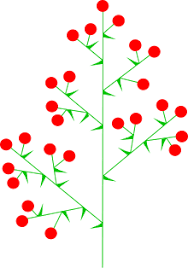
- 60Panicle
- 61Spike
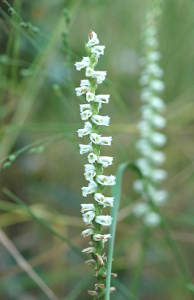
- 62Raceme
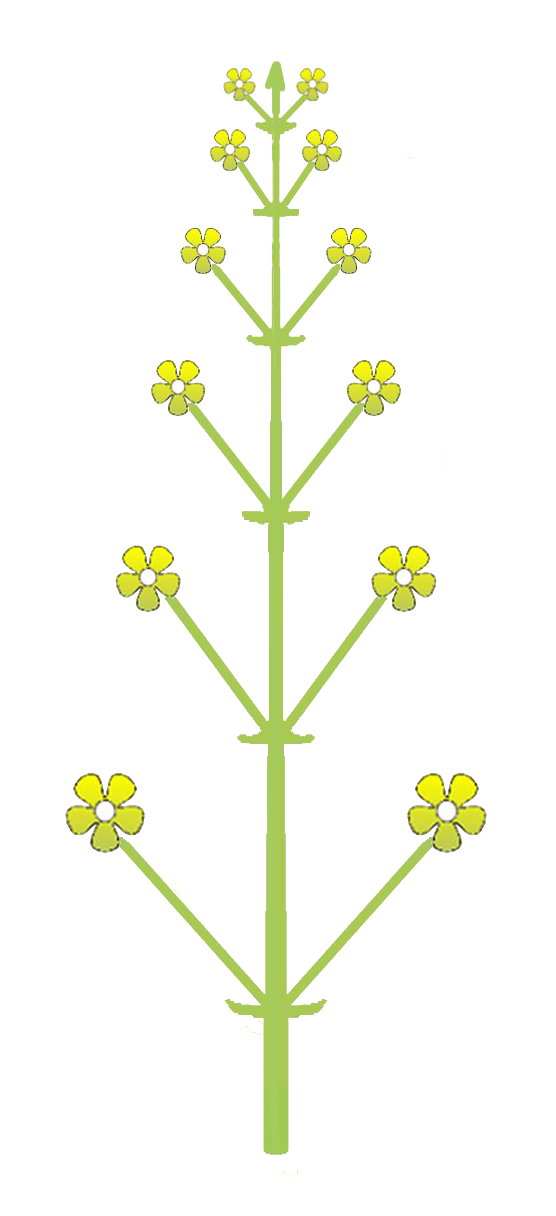
- 63Corymb
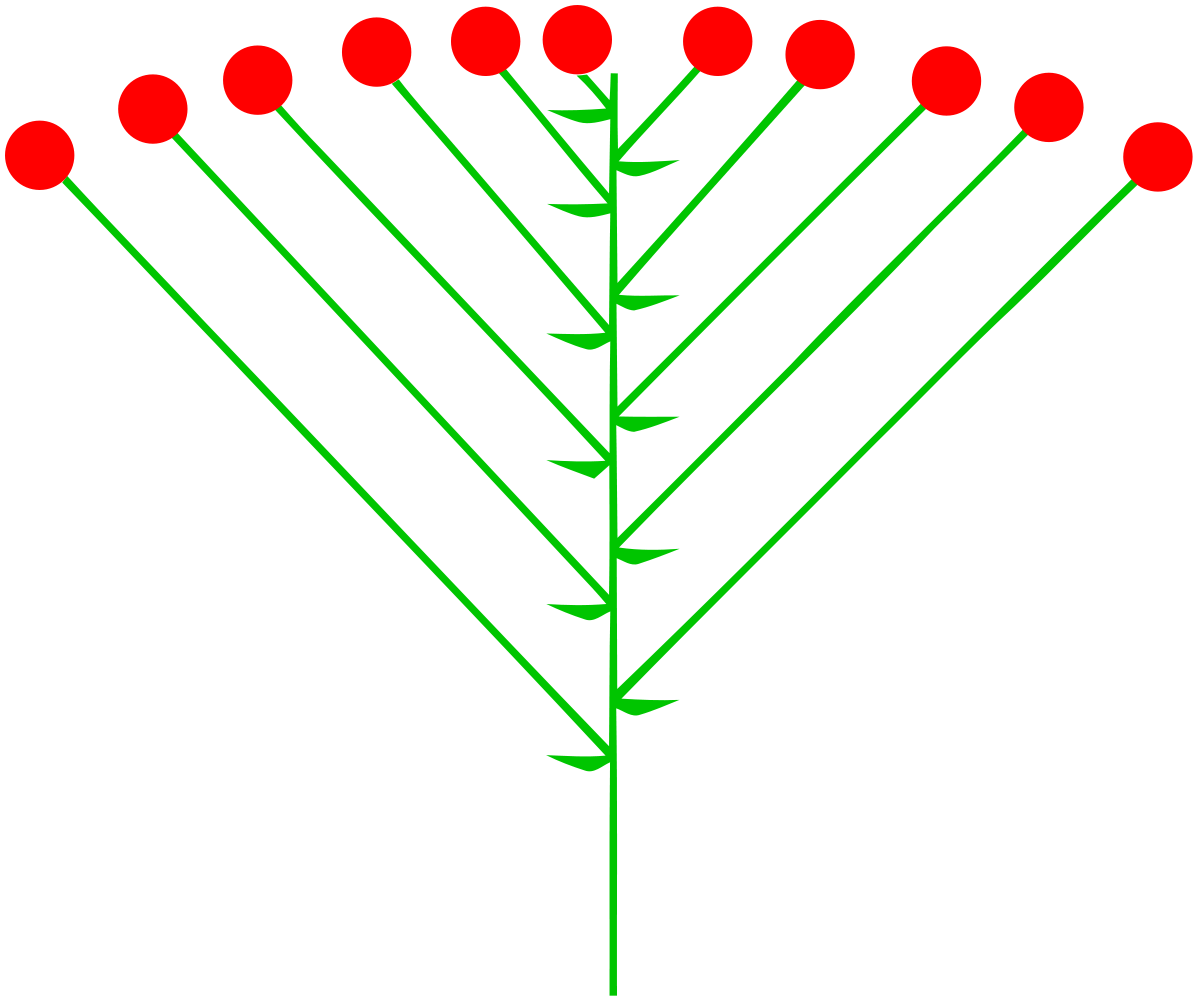
- 64Umbel (simple)
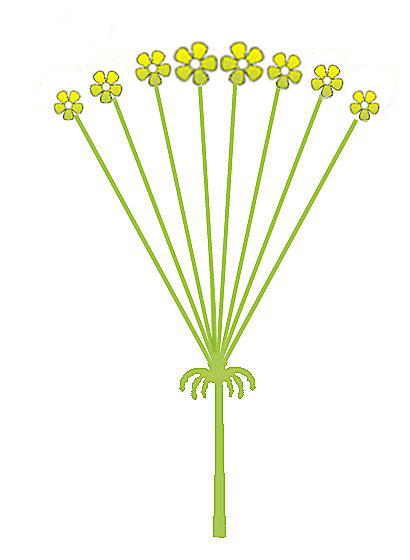
- 65Umbel (compound)
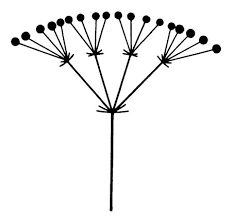
- 66Head
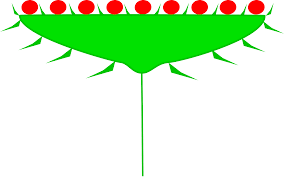
- 67Catkin
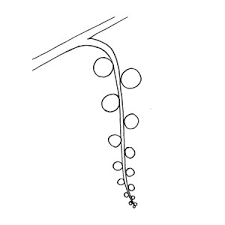
- 68Why are seeds considered fattening foods to humans?They're full of lipids that support growth of an embryo.
- 69What is the purpose of a fruit?It's a mechanism for seed dispersal
- 70Name the layers of a fruitExocarp (skin)
Mesocarp (fleshy midsection)
Endocarp (encloses the seed)
Pericarp (all the layers together) - 71Fruit from a single carpel, or multiple fused carpels:Simple
- 72Fruit from a single flower with multiple, separate carpels:Aggregate
- 73More than one flowers that make a fused fruit:Multiple
- 74Floral parts other than the ovary contribute to fruit production in:Accessory fruits
- 75Nitrogen fixationMakes atmospheric N2 bioavailable
- 76Why is Nitrogen important to life?It's a main component to biological molecules like nucleic acids, or proteins.
- 77What plant process "Fixes" carbon atoms from CO2 to make organic molecules?Photosynthesis (specifically the Calvin cycle)
- 78Taxonomic ranks in orderKingdom, Phylum, Class, Order, Genus, Species
- 79What group isn't commonly identified by taxonomic nomenclature?Birds, because we have standardized their common names.
Informationen
- Beschreibung
- This set covers the first 2 powerpoint presentations in the class, with a focus on big picture lessons and questions that I think might come up. The quality of these flashcard sets should improve once I learn what to expect from a quiz or test.
- Erstellt von
- Wes Smalley
- Aufrufe
- 68
- Tags
- Bewertung