
Karteikarten
RBT Training - Reinforcement
Karten in diesem Stapel (41)
- 1Reinforcementif behavior is followed closely in time by a stimulus event and as a result the future frequency of that type of behavior increases in similar conditions.
- 2Reinforcer (n)a stimulus
e.g. Justin used action figures as reinforcers for child's expressively labeling. - 3Reinforcing (adj)property of stimulus
e.g. the reinforcing stimulus was produced 10x - 4reinforcement (n)operation: delivery of consequences when a response occurs
Process: The increase in responding that results from reinforcement
e.g. the number of labels increased as a result of reinforcement. - 5to reinforce (v)operation: to deliver consequences when a response occurs.
Process: to increase responding through the reinforcement operation.
e.g. the procedure demonstrated tokens would reinforce labels. - 6Positive reinforcementwhen response followed after presentation of stimulus resulting in similar results frequently in future (Pavlove's Dogs).
- 7Positive reinforcerStimulus presented as a consequence and responsible for increase of response (e.g. food, tangible, etc.)
- 8Negative reinforcementoccurrence of response produces the removal, termination, reduction, or postponement of a stimulus which leads to increase in future occurrence of that response. (remove's undesired stimuli)
- 9Negative reinforcerstimuli whose removal strengthens behavior (e.g. breaks, removal of chores)
- 10unconditioned reinforcersstimulus change that can increase the future frequency of behavior without prior pairing with any other form of reinforcement. Sometimes referred as primary. (e.g. food, water, sex)
- 11Conditioned reinforcersa previously neutral reinforcer that can function as reinforcer through stimulus-stimulus pairing with one or more unconditioned or conditioned reinforcers. Called secondary reinforcers (e.g. money, alcohol, sports)
- 12generalized conditioned reinforcersa conditioned reinforcer paired with many unconditioned or conditioned reinforcers that does not depend on current environmental operative (EO) for any particular form of reinforcer for effectiveness (e.g. tokens, money)
- 13Differential Reinforcementof alternate behavior (DRA)
of other behavior (DRO)
of low rates (DRL)
of incompatible behavior (DRI)
of diminishing rates (DRD)
of high rates (DRH) - 14Automatic reinforcementsome behaviors produce their own reinforcement independent of the mediation of others.
- 15Premack Principlehold something contingent on another thing. e.g. Watch TV and don't like homework so do HW then can watch TV.
- 16Continuous Reinforcementreinforcement after every occurance.
- 17intermittencereinforcement targeted response occasionally.
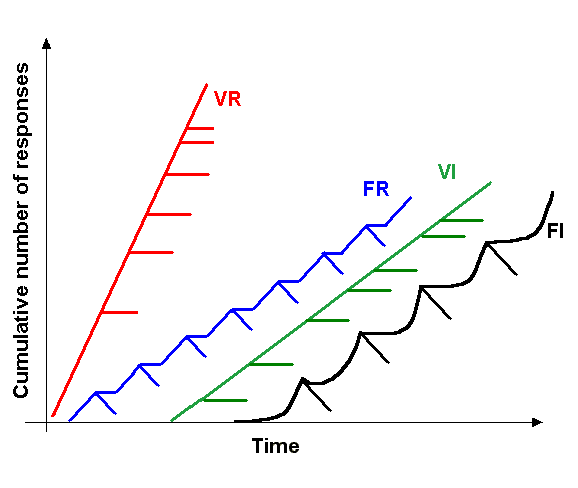
- 184 Basic schedulesfixed interval
variable
fixed-ratio
variable-ratio - 19Fixed-interval scheduletime based.
time period is fixed.
reinforcer delivered contingent upon the first behavior following the time period.
results in a scallop pattern of responding .
More responses as time period elapses.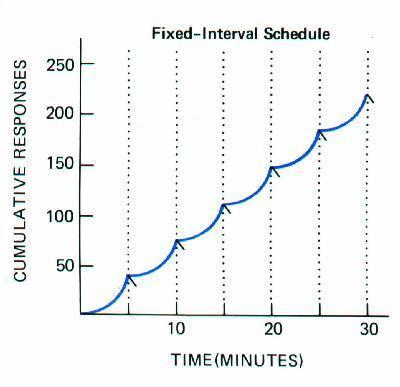
- 20Variable-interval Scheduletime base.
time period is variable.
reinforcement delivered contingent on the first behavior following the time period.
results in a consistent rate of responding.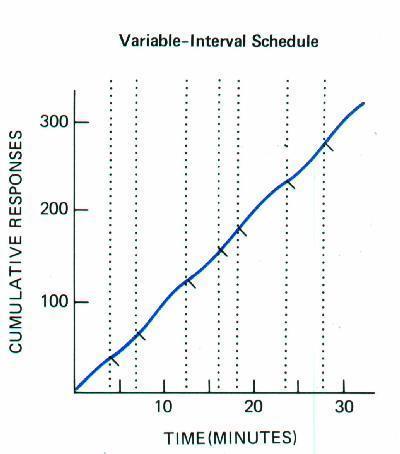
- 21Fixed Ratio scheduleresponse based.
Requires completion of a specified number of responses to produce a reinforcer. Results in rapid reinforcement.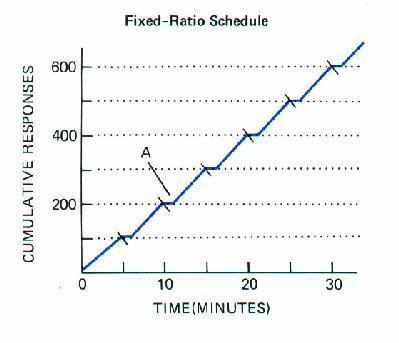
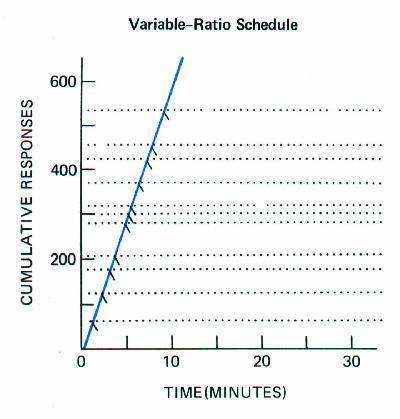
- 22Varible-RatioResponse Based. Requires the completion of a variable number of responses to produce a reinforcer. Result in a rapid rate of responding.
- 23Complex schedule of reinforcementprogressive, concurrent, multiple, mixed, tandem.
- 24informal interviewsinterviewing student, teacher's, or caregivers. Face to face or filling out assessment. Reinforcer assessment for individuals with severe disabilities. School reinforcement survey schedule. Generates a list of potential reinforcers. Provide's choice. Shown to be unreliable (different conditions)
- 25Free operant preference assesmentfree access to a veriety of stimuli for a duration of time.
No stimuli are removed. Record duration of interaction/engagment. Provides a hierarchy/rank of preference. Shoarter than formal, preffereance assessment. results in lower levels of aberrant behavior. - 26multiple stimulus without replacement (MSWO)present a number of stimuli to the student. Pre-exposure to stimuli. Components:
1. arrange full array of stimuli.
2. Instruct student to select only one.
3. student interacts for period od time.
4. stimulus is removed.
5. Repeat steps 1-4 until all stimuli has been selected.
Provide's hierarchy. - 27Multiple Stimulus with replacement (MSW)Present number of stimuli to student. Pre-exposure to stimuli. Components:
1. Arrange full array of stimuli
2. instruct student to select 1
3. Student interacts for period of time.
4. Stimulus replaced
5. repeat
Can create hierarchy - 28Paired Stimulus reference AssessmentA choice between 2 Stimuli. Pre-exposure to stimuli. Components:
1. Present two stimuli
2. Instruct student to select one.
3. Student interacts for period of time.
4. Repeat steps 1-3 until all stimuli paired.
Best to conduct multiple assessments. Make sure equally distant to learner. Randomize placement. Creates a hierarchy. Typically longer than MSW(O). Can result in problem behavior. - 29In the moment reinforcement analysis (IMRA)No formal P.A. Involves in the moment assessment of several variables. Verbal and non verbal behavior. Frequency of delivery. Ability to condition. Looks at data to reevaluate what stimulus to use.
- 30Conditioning Reinforcersconditioning a neutral or non-prefered stimulus to function as reinforcer. Does not require systematic intervention for most individuals. (e.g. money, wine, baseball). Requires systematic intervention for individuals diagnosed with ASD. We must condition reinforcers (expand their horizons).
- 31PairingNeutral stimulus is paired with established reinforcer. e.g. giving icecream at a baseball game to get a child to love baseball.
- 32observational learningwatching others access stimuli contingent upon a response. Other's engage with stimuli in exciting ways. A combination?
- 3310 Commandments of Reinforcement1. You must use it.
2. Preferences do not equal reinfocers.
3. Must be made contingent - must be contingent on target behavior.
4. Reinforcement MAY have to be conditioned.
6. The concept of reinforcement MAY have to be taught. - 3410 Commandment's cont.'d7. Reinforcement is for skill acquisition and more importantly, reduction of aberrant behavior.
8. Reinforcement needs to be thinned (regular to lotto)
9. Reinforcement does not equal bribery (student is exhibiting appropriate behavior and receives reinforcement.
10. Reinforcement must be age appropriate! - 35Token Economiescommonly implemented used. Student earns tokens contingent upon target behavior (s). Tokens are exchanged for terminal reinforcement. e.g. Diminishing field, competitive token economy or level system.
- 36tokenscan take many forms. Goal to be as natural as possible.
- 37terminal reinforcesvary, could be differential. elivering tokens - higher quality = more tokens. Exchange rates - depends upon rate of behavior.
- 38Token Econimies: traditional approachDetermine target behaviors.
Determine criterion of token delivery.
Determine exchange rate.
Ensure quality "time-in"
Must be trained.
Start with fewer tokens.
Move to more tokens. - 39Rainbow TokensA conjugate schedule of reinforcement. Tokens movement toward token board and stops or slows based on student behavior.
- 40magic number system.unknown to how many times behavior must be exhibited. Flexible determination.
- 41level systemwhat behaviors result in up and down. Dependent measure. Synchronous engagement: anytime.
Informationen
- Beschreibung
- this is part of an overview of Reinforcement
- Erstellt von
- Jacqueline Fontenot
- Aufrufe
- 1.239
- Tags
- Bewertung