
Karteikarten
Concept Questions
Karten in diesem Stapel (28)
- 1List the major subdivisions of the human nervous system.- Central and Peripheral Nervous Systems
- Somatic and Autonomic Nervous Systems
- Afferent and Efferent Divisions - 2What two organs make up the central nervous system?Brain and spinal cord (and nerves)
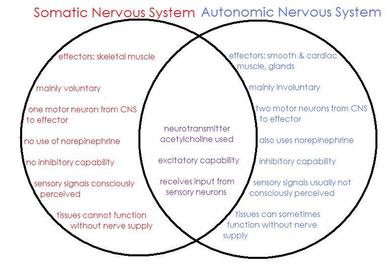
- 3Contrast the somatic nervous system with the autonomic nervous system.
- 4What are the five main types of glia?1. Astrocytes
2. Microglia
3. Ependymal cells
4. Oligodendrocytes
5. Schwann cells (PNS) - 5Describe the myelin sheath found on some nerve fibres.- Formed by oligodendrocytes in CNS and Schwann cells in PNS
- Made up of myelin, a fatty substance
- Nodes of Ranvier are the gaps between adjacent Schwann cells
- Increases conduction speed of nerves - 6What is a neurilemma?The part of the Schwann cell where the nucleus and cytoplasm are pushed to the perimeter of the cell.
Oligodendrocytes in the CNS do not have neurilemma.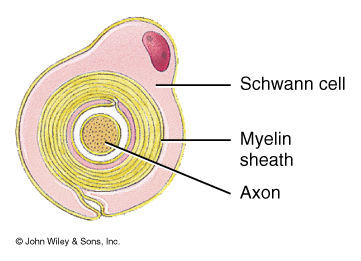
- 7Describe the three different forms of Schwann cells.- Unmyelinated nerve fibres
- Myelinated nerve fibres
- Satellite cells - 8What is the difference between an axon and a dendrite?Dendrite
- Input and output zone
- Receives and conducts electrical or chemical signals
Axon
- Conduction zone
- Sometimes myelinated
- Conducts AP (electrical signals) - 9What are three structural categories of neurons?(Pseudo)Unipolar
Bipolar
Multipolar - 10What are the three main functional categories of neurons?Afferent
Efferent
Interneurons - 11What are the essential components of a reflex arc?- Receptor
- Afferent neuron
- CNS (Interneuron)
- Efferent neuron
- Effector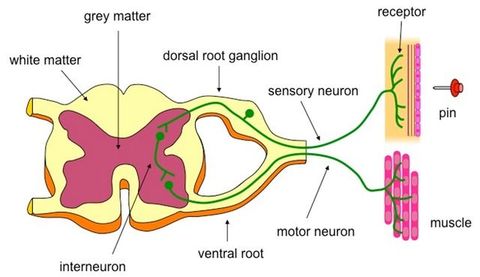
- 12What are the three layers of connective tissues that hold the fibres of a nerve together?- Endoneurium (around axon)
- Perineurium (around fascicle)
- Epineurium (around nerve) - 13What is the difference between a nerve and a tract?- Nerves are bundles of nerve fibres in the PNS. They have the three layers of connective tissue covering them.
- Tracts are bundles of nerve fibres in the CNS. They do not have a connective tissue covering - 14How does white matter differ from grey matter?White matter
- Composed of myelinated tracts and nerves
Grey matter
- Composed of unmyelinated tracts and nerves
- Small, distinct regions usually called nuclei (CNS) or ganglia (PNS) - 15Under what circumstances can a nerve fibre be repaired?- Damage is not extensive
- Cell body and neurilemma are intact
- Scarring has not occurred - 16What mechanisms are involved in producing the resting membrane potential?- Gated protein channels
- Sodium ions
- Potassium ions
- Sodium-potassium pumps - 17In a resting neuron, what positive ion is most abundant inside the plasma membrane?Potassium ions
- 18How does depolarisation of a membrane differ from hyperpolarisation?Depolarisation
- Reduction of membrane potential
- Membrane potential value moves toward zero
- Excitatory
Hyperpolarisation
- Increase of membrane potential
- Membrane potential value moves away from zero
- Inhibitory - 19List the events that lead to the initiation of an action potential.1. Stimulus-gated sodium channels open. Membrane depolarises.
2. As threshold potential is reached, voltage-gated sodium channels open.
3. Membrane depolarises further.
4. AP magnitude peaks at +30mV when voltage-gated sodium channels close.
5. Voltage-gated potassium channels open. Repolarisation begins.
6. Brief period of hyperpolarisation, then RMP restored by sodium-potassium pump and ion channels returning to resting state. - 20What is meant by the term threshold potential?The potential (voltage) that needs to be reached in order for voltage-gated sodium channels to open, and therefore conduct the AP.
- 21How does impulse conduction in an unmyelinated fibre differ from impulse conduction in a myelinated fibre?Myelinated fibres conduct AP faster than unmyelinated fibres.
- 22What are the three structural components of a synapse?1. Synaptic knob (presynaptic neuron)
2. Synaptic cleft
3. Plasma membrane of postsynaptic neuron - 23List the steps of synaptic transmission.1. AP reaches synaptic knob, calcium ion channels open.
2. Calcium ions trigger neurotransmitter release across synaptic cleft.
3. Neurotransmitters bind to receptors on postsynaptic membrane, causing certain ion channels to open.
4. If the excitatory postsynaptic potential (EPSP) reaches threshold potential, AP is initiated. - 24What is an EPSP? What is an IPSP?EPSP
- Excitatory Postsynaptic Potential
- Excitatory neurotransmitters cause sodium and potassium ion channels to open
- Temporary depolarisation
IPSP
- Inhibitory Postsynaptic Potential
- Inhibitory neurotransmitters cause cause potassium and/or chloride ion channels ot open
- Temporary hyperpolaristion - 25How does temporal summation differ from spatial summation?Temporal summation
- High frequency of APs in presynaptic neuron causes postsynaptic potentials to overlap and add together
Spatial summation
- When multiple presynaptic neurons provide input that add together - 26How do excitatory neurotransmitters differ from inhibitory neurotransmitters?Excitatory neurotransmitters
- Increase probability that target cell will fire an AP
Inhibitory neurotransmitters
- Decrease probability that target cell will fire an AP - 27What are the four chemical classes of neurotransmitters?Class I Acetylcholine
Class II Amines
Class III Amino acids
Class IV Other small molecules - 28What are neuromodulators?A co-transmitter that regulates or modulates the effects of the neurotransmitter(s) released with it
Informationen
- Beschreibung
- University HUBS191 (Nervous System) Karteikarten am Concept Questions, erstellt von Kyra Bingham am 12/05/2015.
- Erstellt von
- Kyra Bingham
- Aufrufe
- 44
- Tags
- Bewertung