
Karteikarten
Concentrated Markets. The theory of oligopoly
Karten in diesem Stapel (41)
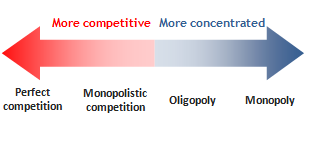
- 1—Oligopoly is a market structure where a few large firms have the majority of the market share. For example, Banks, supermarkets or energy suppliers.
- 2Concentration ratioIs the proportion of the market share held by the dominant firms
- 3CartelsIs the collusion of firms that manipulate the market by reducing output or raising prices
- 4CollusionIs the action of working together to manipulate the output and price in the market
- 5Barriers to entry in an oligopolistic marketLimit and predatory pricing
Advertising
Multiplicity of brands
Integration
Non-price competition
Branding
R&D - 6Limit and predatory pricing (Barriers to entry)Setting a price that may bankrupt a competitor firm in order to try to take it over. This is where the firm lowers its prices to a level where other firms are unable to compete and therefore drive them out of the industry
- 7Advertising (Barriers to entry)Large firms can spread fixed costs over a larger amount of units which therefore reduced the cost of advertising.
This means that new entrants will have to match the level of advertising expenditure but without the volume of output. This is a good explanation for the detergent industry in the UK - 8Integration (Barriers to entry)Combining with other firms
As oligopolists grow in size they can integrate, both horizontally and vertically to control the supply of resources and distribution. They can therefore use predatory pricing as they benefit from economies of scale and lower prices. - 9Non Price competition (Barriers to entry)These are techniques used to persuade customers to buy the goods without having to change the price. An example is supermarkets that offer loyalty cards or the marketing mix that firms employ
- 10Branding (Barriers to entry)Firms that make their brands unique make the demand for their goods more inelastic because customers are more likely to stay with that brand regardless a change in price
- 11Research and Development (Barriers to entry)Firms can come up with products that make them more competitive against the other firms in the market so they can charge higher prices than competitors
- 12Competitive OligopolyThis is where firms follow independent strategies to compete with each other but they are interdependent. Therefore the action of one firm will provoke a reaction from another competitor firm
- 13InterdependentWhere actions by one firm will have an effect on the sales and revenue of other large firms in the market
- 14Competitive oligopoly (2)If one firm increases their prices they are going to lose market share because competitors will maintain untouched prices. However, if one firm reduces its prices then competitors are likely to lower theirs too to provoke a price war where all firms will lose revenue.
- 15How are oligopolies characterised?Oligopolies are characterised by reactive behaviour. This is the action taken by firms in response to a change in behaviour of a competitor. For example, interdependence from other firms affecting pricing and output decisions
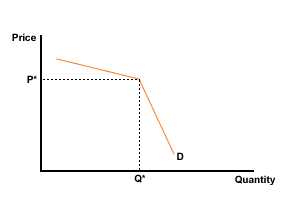
- 16The kinked demand curve theoryIs a theoretical approach that attempts to analyse the reasons for price stability in oligopoly
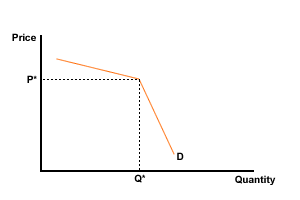
- 17—Theory suggests that if firm raises price above 0P* the firm's market share will drop as others retain price level. However this depends on the degree of brand loyalty, (Demand elastic). If firm lowers price below 0P* then demand becomes inelastic because other firms will follow (price war) so they lose out on revenue
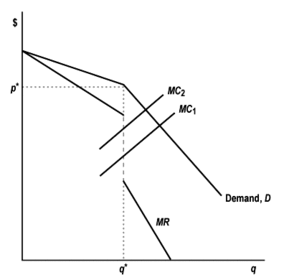
- 18Discontinuous marginal revenue curve Showing price stabilityRegion over which a change in MC doesn't lead to a change in price or output. If MC increased the firm would absorb the whole of the cost by cutting profit and if it decreased profits would increase. Techniques to reduce MC are likely to be employed. E.g. reducing costs of production
- 19Problems with the Kinked demand curve theoryNo explanation of how the original price was determined
Theory only deals with price competition and ignores non price competition (Extremely important feature of oligopoly)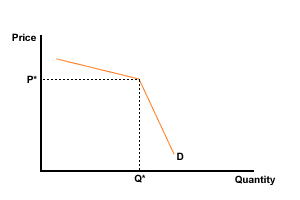
- 20Problems with the Kinked demand curve theory (2)Model assumes a particular reaction by competing firms and there is not guarantee they will always reach in the same way.
Firm may decide that it could benefit from price competition and force its rivals out - 21Non-price competitionOligopolists may decide to compete using non-price competition. It's likely to increase expenditure for the firm but it helps distinguish the product/service from competitors. E.g. BA has high costs but it enables the firm to avoid changing prices and provoke a price war
- 22Non price competition (2)Firms may also decide to use non price competition at the same time as reducing its price to increase demand.
These include loyalty cards, home delivery, 24 hour opening time, advertising. - 23Game TheoryAn analysis of how games players react to changing circumstances and plan their response
- 24—As a consequence of interdependence firms have to predict what rivals are likely to initiate and what they have to do. They must also be ready to take further action. The players are the firms the game is played in the market and their strategies are the price/output decisions and payoff is the profit
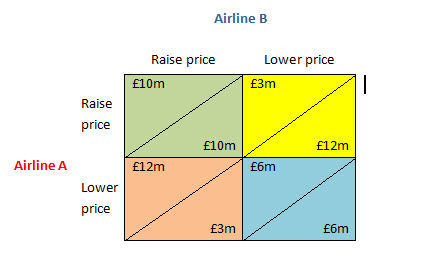
- 25—For example if Airline A raises their price and Airline B follows they will both win because the payoff is £10m. However if Airline B doesn't follow and instead lower its prices it will have a payoff of £12m but if both decide to lower their prices both lose on revenue at £6m
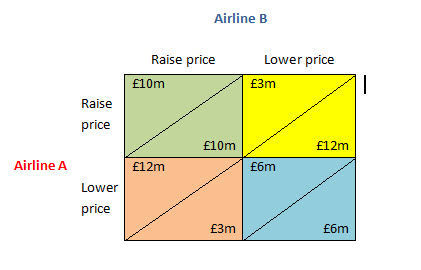
- 26Competing or ColludingIn an oligopolistic market firms can respond to their actions by either competing or colluding. For example, both firms can lower/raise their prices or each take one. If both firms opt for the non-cooperative equilibrium this is whats known as the Nash equilibrium
- 27Why is there often interdependence in oligopolistic markets? (GAME THEORY)Because a firms strategy will definitely affect the market share/revenue of competitive firms. Firms have to compete or collude
- 28Collusive Oligopoly (Formal Collusion)This is where firms have an agreement to manipulate price and output to maximise the level of joint profits at the consumers' expense. Restrictive agreements are often used where they collude to indulge in anticompetitive policy
- 29Formal CollusionCollusion can be seen as a way of removing the uncertainty of competing when firms have a high degree of interdependence.
Under competitive oligopolies firms never have certainty of behaviour - 30What is needed to operate a cartel successfully?All major producers should be part of the cartel and follow the rules
Market being supplied should be isolated from outsiders (firms)
High entry barriers are necessary
The more homogeneous the product the greater the chance of success - 31Colluding oligopolies can produce where MC equals MR What is the outcome for producers?Increase in sales revenue and profit assuming demand is inelastic and a rise in price leads to a rise in revenue
Increased likelihood that producers will compete by non price method to increase market share
Increased profits = Increased investment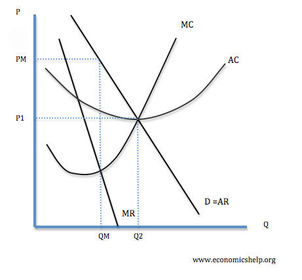
- 32What is the outcome for consumers from oligopolies colluding?There may be an increase in the price of the product. This is probably the main reason why the firms colluded
Consumers could benefit in the long term if they reinvest their profits in R&D - 33Collusive oligopoly Informal collusionThis is were one firm acts as a price leader and signals changes in prices to other firms in the cartel so they follow all the movements. E.g. if the price leader raises its prices all firms in the cartel will too
- 34Price leaderA firm that establishes the market price that all other firms in the agreement follow
- 35What forms does price leadership take?Price leader may be the dominant firm.
Barometric price leadership, where the role is taken by a smaller firm that is more sensitive to changes.
Parallel pricing where identical prices are maintained.
Tacit collusion is where firms prices change in terms of costs. - 36Transfer pricingA technique where multinationals can change costs and prices to benefit from different levels of tax in different countries. E.g. making components in a country with low tax rates to minimise taxation and increase profits
- 37Cost plus pricingThis is where the firm calculates the average cost of producing a given level of output and adds a mark up to make it the selling price. Firms may find it easier because they don't have to constantly change prices which carries menu costs (Time and money spent changing prices in line with inflation.
- 38What are the benefits of collusion in oligopolistic markets?Better use of resources. For example, firms may undertake R&D
Profit maximising MC=MR
Firms are more likely to engage in non price competition - 39What are the drawbacks of collusion in oligopolistic markets?There are high barriers to entry
It is illegal if it was formal
Reduction of consumer surplus than in a competitive market - 40What are the advantages of oligopolies over competitive markets?One of the advantages of oligopolies is that stable prices can be maintained because changes in prices leads to negative outcomes such as price wars.
Dynamic efficiency.
Allocative and Productive efficient if market is contestable. - 41Disadvantages of oligopolies over competitive markets?Could be collusive which could lead to high prices and restricted output
Reduction of consumer surplus if MC=MR
Allocative and Productive inefficient if MC=MR
Informationen
- Beschreibung
- Concentrated Markets. The theory of oligopoly
- Erstellt von
- Alvaro Ferreira6626
- Aufrufe
- 136
- Tags
- Bewertung