
Karteikarten
Flashcards

Karten in diesem Stapel (37)
- 1AcidA substance that releases hydrogen ions when it dissolves in water.

- 2AcidicIf the concentration of H+ exceeds the concentration of H-.

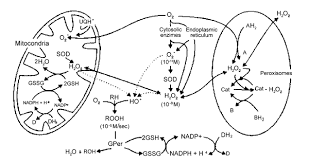
- 3AntioxidantMolecules that react with free radicals and render them harmless.

- 4AtomThe smallest unit of an element.

- 5Atomic nucleusProtons and neutrons clustered together in the center of the atom.

- 6Atomic numberThe number of protons in the nucleus.
- 7BaseA substance that combines with hydrogen ions, reducing their number.

- 8BasicIf the concentration of H- is greater than the concentration of H+.

- 9BufferA type of molecule that tends to maintain a solution at a constant pH by accepting or realeasing H+ in response to small changes in H+ concentration.

- 10Chemical bondAttractive forces that hold atoms together in molecules.

- 11CohesionThe tendency for molecules of a single type to stick together.

- 12Covalent bondAtoms sharing electrons with one another, filling both of their outer shells.
- 13DissolveA solvent completely surrounds and disperses the individual atoms or molecules of another substance.

- 14ElectronSubatomic particles which can carry a single negative charge.

- 15Electron shellComplex three-dimensional regions.

- 16ElementA substance that cannot be separated into simpler substances, and cannot be converted into another substance by ordinary chemical reactions.

- 17Free radicalAmong atoms and molecules with unfilled outer shells.
- 18Heat of vaporizationThe amount of heat needed to cause a substance to evaporate.

- 19Hydrogen bondThe attraction between a slightly positive hydrogen and a slightly negative oxygen or nitrogen.

- 20HydrophilicInteractions with water and other polar substances.

- 21HydrophobicDo not dissolve easily in water, and are usually non-polar.

- 22Hydrophobic interactionDescribes the relations between water and hydrophobes.

- 23ionA particle that is electrically charged, an atom or molecule or group that has lost or gained one or more electrons.

- 24ionic bondA chemical bond formed between two ions with opposite charges.

- 25isotopeEach of two or more forms of the same element contain equal numbers and f protons but different numbers of neutrons in their nuclei, and he se differ in relative atomic mass but not in chemical properties.

- 26mass numberThe total number of protons and neutrons in a nucleus.

- 27moleculeTwo or more atoms bonded together to form a single chemical entity.

- 28neutronAn elementary atomic particle that has no charge and a mass that is approximately the same as that of protons.

- 29nonpolar covalent bondA bond between two nonmetal atoms that have the same electronegativity and therefore have equal sharing electrons of the bonding electron pair.

- 30pH scaleIs a measure of how acid/basic water is. Ranges go from 0-14, 7 being neutral.

- 31polar covalent bondA covalent bond in which the atoms have an unequal attraction for electrons and so the sharing is unequal.

- 32protonA positively charged particle that resides in the nucleus of an atom and has a mass of 1 and a charge of +1.

- 33radioactiveThe spontaneous emission of radiation in the form of particles or high energy photons resulting from a nuclear reaction.

- 34solutionA homogeneous mixture of solvent and solute molecules. A solvent is a substance that dissolves another substance by pulling the molecules apart through electrochemical interactions.

- 35solventIs a molecule that has the ability to dissolve other molecules known as solutes.

- 36specific heatThe amount of heat one gram of a substance must absorb or lose to change its temperature by one degree Celsius.

- 37surface tensionThe expression of intermolecular attraction at the surface of a liquid, in contact with air or another gas, a solid, or another immiscible liquid, tending to pull the molecules of the liquid inward from the surface.
