
Biochemistry
386 resources created by 338 users
This Biochemistry page on GoConqr gathers community-made quizzes, mind maps, flashcards and notes on the chemistry of life, from elements, atoms and bonding to amino acids, enzymes, carbohydrates and lipids. It's built for school students, university students and professional candidates revising a topic or filling gaps, and for teachers after ready-made material. There are over 300 resources here, including more than 30 quizzes, more than 100 mind maps and more than 120 flashcard decks, with A-level and GCSE material alongside university study. Pick a topic, try a quiz, then make your own set.
Top Biochemistry resources
-
Mind map Elements Of Life Mindmap for AS level topic Elements Of Life
-
20 questionsBiochem quiz Maggio Stuyvesant (study guide) What is atomic mass?
-
30 questionsOCR B A Level Chemistry Elements of Life
-
35 questionsAP Bio Chapter 3 How many molecules of water are needed to completely hydrolyze a polymer that is 9 monomers long?
-
Mind map Enzymes in the Fashion Industry
-
Mind map Elements of life First unit for Chemistry specification OCR Salters B.
-
95 cardsCell Biology Chapter 2 Flashcards for Cell Biology Chapter 2
-
200 cardsChemistry Exam Preperation What is the function of an enzyme?
Quizzes
See all 35 quizzes-
20 questionsBiochem quiz Maggio Stuyvesant (study guide) What is atomic mass?
-
30 questionsOCR B A Level Chemistry Elements of Life
-
35 questionsAP Bio Chapter 3 How many molecules of water are needed to completely hydrolyze a polymer that is 9 monomers long?
-
8 questionsUntitled
-
122 questionsSci Chap 2 The basic unit of matter is called a(an)
-
51 questionsCHEMISTRY MCQS Name theheterocyclic ring. Which vitamins contain this ring in their structure?
-
21 questionsModule 5: Summary Quiz Use the lesson to complete the quiz until you don't need the lesson anymore. You can check your answers as ...
-
41 questionsChemistry and the Molecules of Life quiz The smallest part of an element that can exist is a molecule
Mind maps
See all 165 mind maps-
Elements Of Life Mindmap for AS level topic Elements Of Life
-
Enzymes in the Fashion Industry
-
Elements of life First unit for Chemistry specification OCR Salters B.
-
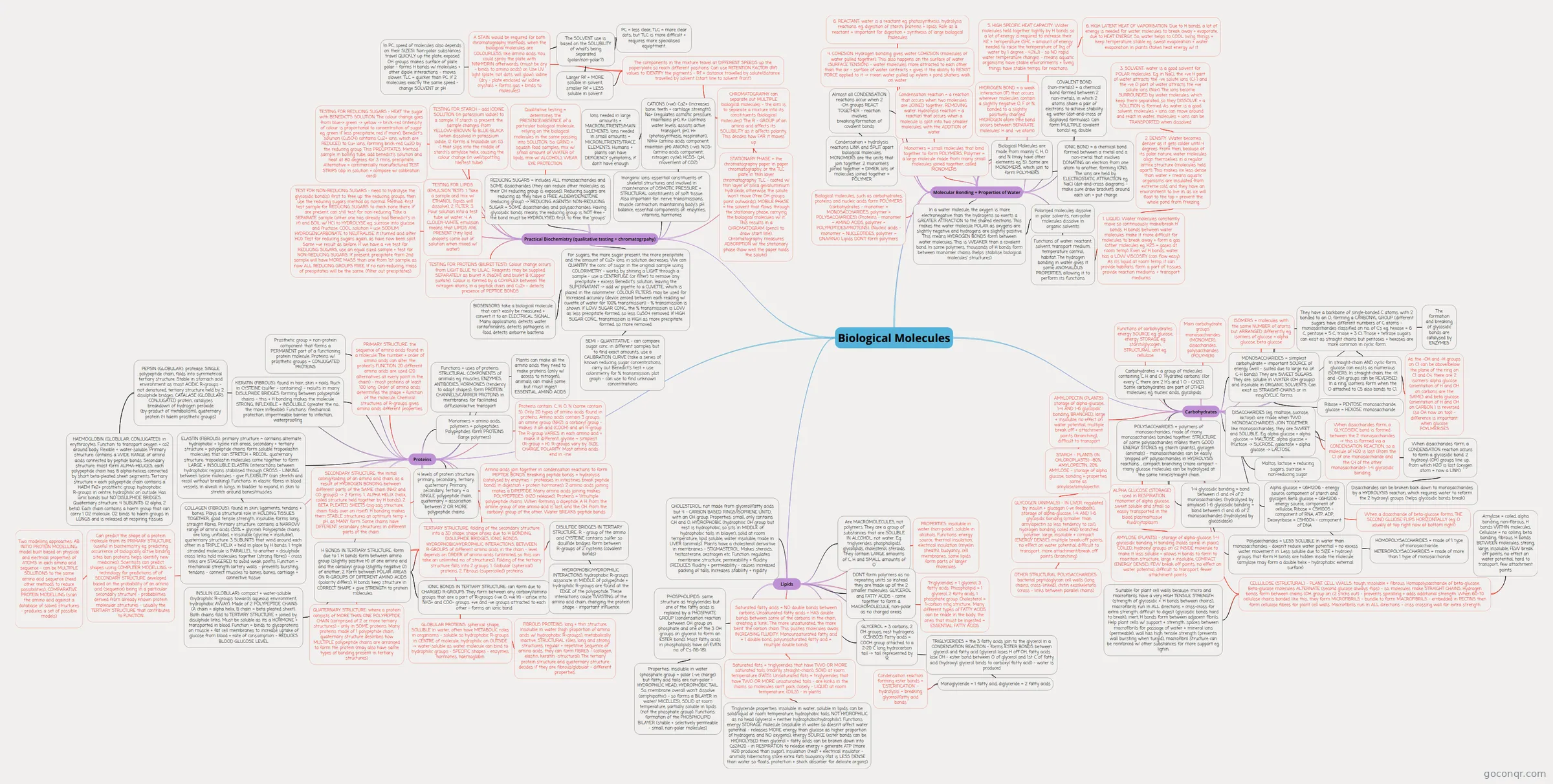 Biological Molecules
-
2.2.14 Practical biochemistry 3: Chromatography
-
Elements Of Life Mindmap for AS level topic Elements Of Life
-
Proteins
-
ENZYMES AND THEIR APPLICATIONS
Flashcards
See all 131 flashcards-
95 cardsCell Biology Chapter 2 Flashcards for Cell Biology Chapter 2
-
200 cardsChemistry Exam Preperation What is the function of an enzyme?
-
71 cardsThread of Life What is the general structure for All α-amino acids.
-
63 cardsFC 5D- Biological Molecules
-
73 cardsElements of Life OCR B Chemistry What is the most common element in the universe?
-
45 cardsEnzymes Why enzyme used?
-
43 cards1.4 Starch, glycogen and cellulose What is the general formula of carbohydrates?
-
156 cardsElements of life new and developing fuels Describe the simple model of an atom
Flowcharts
See all 25 flowcharts-
Comparative Table- Starch, Cellulose, Glycogen Apri 5, 2021
-
Comparative chart glucose, sucrose,maltose,fructose and galactose
-
Comparative Chart - Cellulose Starch Glycogen
-
Alcoholic fermentation
-
Glucose, Fructose, Galactose, Sucrose, Maltose comparative chart
-
Cellulose, Starch and Glycogen comparative chart
-
Comparative table for Glucose, Fructose, Galactose, Sucrose, Maltose
-
Comparative Table of Cellulose, Starch, Glycogen, and chitin
Notes
See all 22 notes-
19 Biomolecules: Amino Acids, Peptides, and Proteins 19.2 Amino Acids and The Henderson-Hasselbalch Equation: Isoelectric Points In acid solution an amino acid is protonated, and exist primarily as a cation.In basic solution an amino acid is deprotonated, and exist prim...
-
Carbohydrates Carbohydrates Compose of the ELEMENTS C H & O MONOSACCHARIDESBasic monomers of which carbohydrates are made up of Are soluble and sweet eg) Glucose GLUCOSE is a HEXOSE SUGAR - has 6 carbons C6H1206 Other monosaccharid...
-
FOUNDATIONAL CHEMISTRY THE CHEMISTRY OF LIFE Topic 1 Review of Important Chemistry Concepts Matter Matter refers to anything that has mass and takes up space (has volume). Matter exists in three states: solid, liquid, and gas. All matter...
-
B.2- Proteins and Enzymes Proteins- Biopolymers made up of monomers (amino acids) Amino acids undergo a condensation reaction to form a long polymer chain. Proteins are used to form structural components of an organism, such as hai...
-
1.2 Relevance of atoms, their structure, and bonding The Chemical Basis of Life: ATOMS & ATOMIC BONDS: Everything on Earth, whether it's a liquid, a solid, or a gas, is considered matter. All matter is composed of elements, which are substances that ...
-
Enzymes in Cleaning Industry - created from Mind Map 5. Enzymes that usually seen in cleaning industry. 4. The common uses in the society. 3. THe conditions for the enzymes to work.
-
Untitled What is a carbohydrate? A carbohydrate is an organic molecule made of carbon (C), hydrogen (H), and oxygen (O) in a 1:2:1 ratio. It serves as a primary energy source for living organisms. What is the monomer of a carb...
-
Important Geochemical organic compounds
Slides
Topics in Biochemistry
More Chemistry topics
About Biochemistry
GoConqr OriginalWhat this unit covers
The listed resources move from the basics of chemistry to the molecules of living things. Early material looks at atoms and bonding. The mind map Elements Of Life runs through spectroscopy, electron structure, periodicity, covalent bonding, moles, Group 1 and Group 2 and salts. Further along you find proteins, enzymes, carbohydrates and lipids.
Where to start
If you are new to the topic, begin with the quiz OCR B A Level Chemistry Elements of Life, which tests isotopes and relative mass with fill-in-the-blank questions. Then open the mind map Biochemistry or Biological Molecules for an overview.
- Atoms and bonding: the Atoms mind map and Elements of Life flashcards.
- Building blocks: the Amino Acids flashcards and mind maps, and Saccharides.
- Large molecules: Proteins, Lipids and the starch, glycogen and cellulose comparison charts.
- Enzymes: Enzyme kinetics, Basics of Enzymes and the slide set on cofactors, enzymes and prosthetic groups.
Using quizzes and maps together
Read a mind map first, then close it and take a quiz on the same topic. Quizzes such as AP Bio Chapter 3 ask how polymers are hydrolysed, and the Biomolecules: Hydrolysis and Polymerization quiz covers similar ground. Wrong answers show you which branch of the map to reread. Flashcards then help you fix key terms, such as the structure of an α-amino acid.
Practical and applied topics
Some resources look at lab and real-world use. The mind map on chromatography explains stationary and mobile phases, while Biochemical Tests and the slide set Biological Molecule Tests cover identifying biomolecules. Enzymes in the Fashion Industry shows enzymes at work in industry.
Where it fits
This unit sits in the Organic Chemistry strand of Chemistry. Some resources mention A-level Chemistry, A-level Biology and GCSE Biology, so it suits those studying across both subjects. Choose a topic, test yourself, and add your own notes or flashcards where you see a gap.
Frequently asked questions
Which quiz should I try first?
Try OCR B A Level Chemistry Elements of Life if you want a gentle start on atoms, isotopes and relative mass. If you are more interested in biological molecules, AP Bio Chapter 3 asks about polymers, hydrolysis and the bonding of amino acids.
What do the mind maps cover?
The mind maps run from elements, atomic models and bonding to amino acids, protein structure, carbohydrates and enzymes. There are also applied ones, such as chromatography, enzyme immobilisation and enzymes in the fashion industry. Start with Biochemistry or Biological Molecules for an overview.
Are the resources free to use?
Yes. Every resource on this page is free to open, study and take, with no account needed. A free account also saves your quiz scores and lets you make your own quizzes, mind maps, flashcards and notes.
Which levels and exams do they suit?
The resources suit school students, university students and professional candidates. Some mention A-level Chemistry, A-level Biology and GCSE Biology. Others follow university textbook chapters, such as notes on amino acids, peptides and proteins, so check the title and excerpt to find the right depth.
Who made these resources?
They were made by GoConqr users, not by GoConqr itself. That means styles and depth vary, from short flashcard decks to longer notes. Teachers can use them as ready-made material, and students can compare several versions of a topic such as enzymes or carbohydrates.
What if I can't find my topic?
Look at related titles first. Carbohydrates, for example, appear as mind maps, flashcards, notes, quizzes and comparison charts. If something is still missing, you can make your own flashcards, mind map or quiz and use it for revision.