
Karteikarten
Performance of a Computer - OCR Computer Science A Level
Karten in diesem Stapel (8)
- 1What is Clock Speed and How does it affect CPU Performance?> The number of cycles that a single processor core can carry out per second (measured in Hertz, Hz)
> A faster clock speed means that more instructions are fetched, decoded, and executed in a second - 2What is the Cache and How does it affect CPU Performance?> Temporary storage that is extremely fast for the CPU - slower than registers but much faster than requests to / from RAM
- It does not require instructions to be fetched via slow buses
> Stores frequently used data - the CPU checks the cache first, then the RAM
> Too much cache can be detrimental, as there's more data to search through every time data is required
> L1 - on the CPU chip, smallest and fastest, most expensive (also known as primary or internal cache)
> L2 - on the motherboard or CPU, larger but slower
> L3 - on the motherboard, larger again, but slowest - 3What are Cores and How do they affect CPU Performance?> Each core can process data independently from the rest, allowing for simultaneous processing
> It allows for parallel processing and multitasking
> Software must be designed to use multiple cores, otherwise there is no performance benefit - 4What is a GPU and How does it affect Performance?> Graphics processing unit
> Contains specialised circuits for handling graphics and image processing
> Relieves the processing load on the CPU, freeing it to do other things
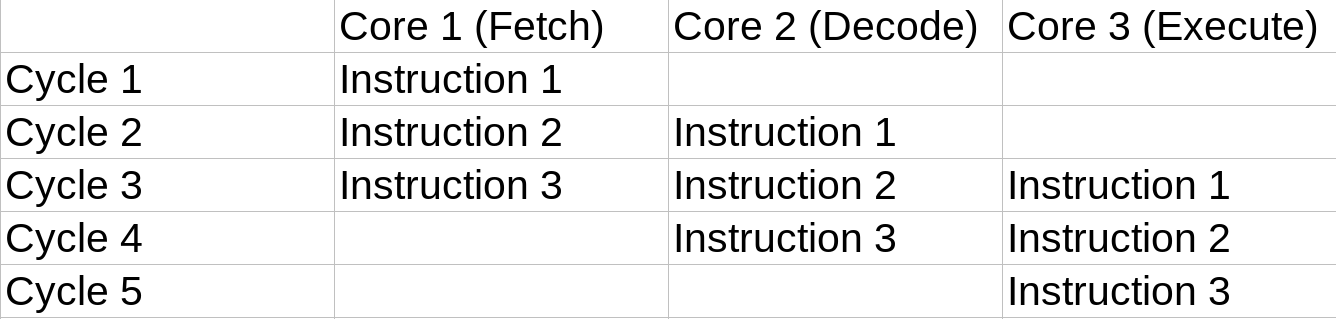
> Using high-end cards can vastly speed up software that renders graphics, i.e., 3D Design software (CAD) and games - 5What is Pipelining and How does it affect CPU Performance?> Each core performs one part of the fetch, decode, execute cycle for each instruction, which speeds up performance as it doesn't have to switch operations
> Branching can cause issues with pipelining since it may end up processing an instruction that will be skipped after an if statement - 6What is Word Size and How does it affect Performance?> Number of bits a CPU can process in one cycle (i.e., 8-bit, 16-bit, 32-bit, 64-bit)
> Modern systems have 64-bit architectures, although sometimes have backwards-compatibility - 7What are the Two Types of Parallel Processing and their Differences?> SIMD - Single Instruction, Multiple Data
> Same program can be executed on different data sets at the same time
> One Control Unit handles multiple ALUs
> MIMD - Multiple Instruction, Multiple Data
> Different programs can be executed on different processors at the same time
> Multiple Control Units each handle their own ALUs - 8What is Distributed Computing?> Alternative to Parallel Processing
> Uses the Internet to process a large problem
> Each node takes on a small part of the problem
> Each node has their own memory, unlike Parallel Processing, where it is shared
Informationen
- Beschreibung
- A level Computer Science (Structure, Function, and Types of the Processor) Karteikarten am Performance of a Computer - OCR Computer Science A Level, erstellt von Malachy Moran-Tun am 18/05/2022.
- Erstellt von
- Malachy Moran-Tun
- Aufrufe
- 9
- Verlauf
-
- Erstellt von Malachy Moran-Tun · 4 Apr 2022
- Kopiert von Malachy Moran-Tun · 18 Mai 2022
- Bewertung