
Karteikarten
MODES OF TRANSPORT
Karten in diesem Stapel (24)
- 1Economics of Transportation Transportation -Pervasive element of daily life -Impacts citizens?Economic well being
Safety
Social interaction
Quality of physical environment
Quality of daily life - 2Demand for TransportationRegions or areas tend to specialize in
certain economic activities
This specialization creates physical
gap between markets and areas of
production for a given good
This gap creates a demand for
transport
Fundamental economic role of
transport is to bridge this supply-
demand gap - 3Typical measurement units-Ton-miles (freight) and passenger-miles
(people) - 4Price Elasticity of DemandSensitivity of demand to price change
Relative measure between price change
and quantity change. Measured as:
% change in quantity DIVIDED % change in
price - 5-Price elastic:demand is sensitive to price
- 6-Price inelastic:demand is insensitive to
price change - 7If % change in quantity < % change in price, then demand isprice inelastic
(insensitive to price change)
-Price increase leads to revenue increase
-Price reduction leads to revenue
reduction - 8If % change in quantity > % change in price, then demand isprice elastic
-Price increase leads to revenue reduction
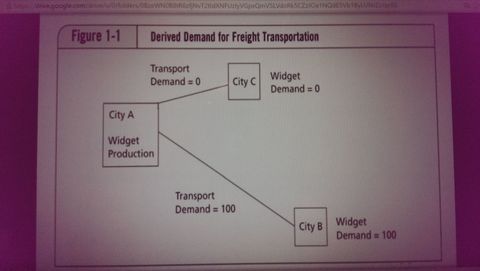
-Price reduction leads to revenue increase - 9Definition of derived demandDemand for transport service to move a product to a given location depends upon
the existence of demand to consume (use) that product at that location
Remember, demand is a relationship between price and quantity demanded
Aggregate demand for freight transport cannot be easily affected by individual
carrier actions - 10Derived Demand for Freight Transportation Diagram
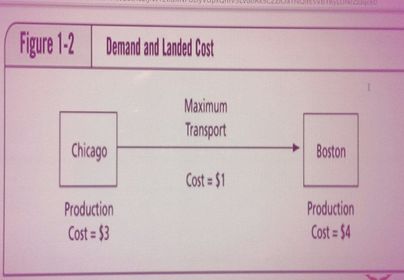
- 11Landed Costis the cost of the product at
the source plus the cost to transport the product to its destination. - 12Transport cost is a component of landed cost Landed cost includes:Cost of production
Transport cost from production point to market - 13Demand and landed cost diagram
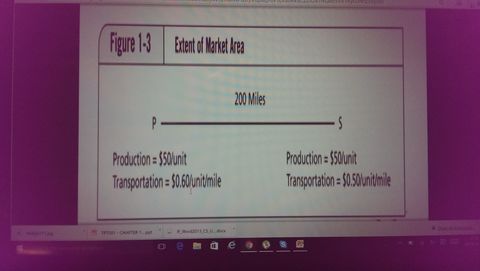
- 14Extent of market area diagram
- 15Service Components of Freight Demand Critical service characteristics and related supply chain cost impacts Transit timeVolume and cost of holding inventory
Potential stockout &or safety stock costs
Reliability or consistency of transit time
Safety stock and/or stockout costs
Accessibility:impacts transport cost&time
Capability: "special" service requirements
Security: safety stocks&or stockout costs - 16Location of Economic ActivityHistorically, transportation influences location of cities, particularly ports
For firms, transport influences the location of manufacturing plants and distribution
facilities
Influences very pronounced for firms producing or marketing globally
Influences are dynamic
As economic activity locations shift, the pattern of transport demand also shifts and vice versa - 17Development of the ConceptConcept evolves in three phases
- 18Concept evolves in three phases1960s: physical distribution concept
1980s: business logistics or integrated logistics
1990s: supply chain management concept
A systems approach to analysis and decision-making is common to all three phases - 19Physical distribution conceptFocuses on physical distribution system costs and tradeoffs
Objective was to find lowest total physical distribution system cost
Example: transportation mode or carrier selection
Involves tradeoffs between transport, inventory, materials handling, and
packaging costs - 20Business logistics conceptAdds analysis of inbound or sourcing side to the outbound physical distribution
side
Development facilitated by
Economic deregulation of transport in U.S.
Rising degree of international or global sourcing
Both create additional opportunities for cost savings through integrated
management and coordination
Notion that logistics contributes to customer service and revenue generation
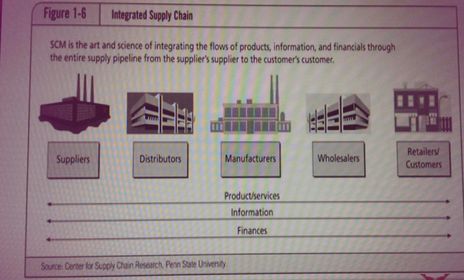
begins to emerge - 21Supply chain management conceptKey underlying principles
Systems analysis and management
3 key flows: product, information, and cash
Integrated management of extended enterprise
Focus on ultimate consumer of end product
Transport: most direct influence on product flow
Product flow is two way
Growing importance of reverse logistics systems - 22Integrated Supply Chain Diagram
- 23Information flowSales trigger replenishment orders flowing upstream
Traditionally, replenishment orders used by upstream supply chain members to
forecast downstream demand
Long intervals between orders create demand uncertainty
Safety stocks used to buffer against uncertainty
Magnitude of uncertainty and safety stocks amplify upstream in a
phenomenon known as the bullwhip effect
SC compression via improved two-way information flow reduces uncertainty and
cost impact of bullwhip effect
Transport carriers contribute to uncertainty reduction (reliable and fast
deliveries) and improved two-way info flow (advanced shipment notices,
bar codes, radio frequency tags) - 24Financial or cash flowPayments flowing upstream for goods ordered
If order and replenishment cycles shorten (orders and product flow faster) then
cash flows faster
Faster cash flow reduces working capital requirements for financing operations
and processes and contributes to improved profitability
"free" cash flow cycle
High transport service levels contribute to improved customer service and
faster cash flow