
Karteikarten
digisol cramming
Karten in diesem Stapel (33)
- 1COMPARISON JSON vs XMLJSON
– human–readable
– key/values separated by :
– more efficient
– can use arrays
XML
– human–readable
– end tags, therefore bulky
– much more difficult to parse - 2DEFINITION XMLeXtensible Markup Language
– designed to store & transport data
– markup language like HTML
– "self–describing" - 3DEFINITION JSONJavaScript Object Notation
– lightweight format for storing & transporting data
– "self–describing", easy to understand; human–readable - 4DEFINITION APIApplication Programming Interface
– provides programming language-specific functions to interact with hard/software, or data created by someone else - 5RULE/ETC CARPContrast, Alignment, Repetition, Proximity
- 6RULE/ETC Usability Principles (acronym)U SEAL!
(Utility, Safety, Effectiveness, Accessibility and Learnability) - 7DEFINITION RESTREpresentational State Transfer
– an architectural style for data exchange, providing standards between computer systems on the web, making it easier for systems to communicate
– stateless, so the server doesn't need to know anything about what state client is in and vice versa
– data is cached - 8COMPARISON Synchronous vs Asynchronous communicationSynchronous:
– sender and receiver of data are synchronised, and timing is organised
– happens in real time
Asynchronous:
– parties don't actively listen for messages
– doesn't happen in real time - 9DEFINITION HTTP/HTTPSHyperText Transfer Protocol/Secure
– stateless request/response protocol
– HTTPS is more secure version, as it uses TLS or SSL to encrypt transmission - 10RULE/ETC The 'CIA Triad'3 main security risks for data exchange:
– Confidentiality (some non–intended recipient might see data)
– Integrity (someone could intercept and modify data message)
– Availability (someone could interfere with data) - 11DEFINITION Encryptionthe process of converting data into a secure and unreadable format using cryptography
(helps with confidentiality and integrity) - 12DEFINITION Authenticationthe process of verifying the identity of a user, system, or entity to grant or deny access to data
(helps with confidentiality and integrity) - 13DEFINITION Checksums– value derived from data to verify its integrity and detect errors/corruption during process
– generated using algorithms like CRC or MD5
– often applied to files, network packets, and data blocks - 14DEFINITION Hashing– process that converts input data of any size into a fixed–size string of characters using a hash function
– detects unauthorised changes during data exchange
– one–way: can't go back to figure out message - 15DEFINITION Digital Signature– cryptographic mechanism created by signer's key, and verified with the signer's public key
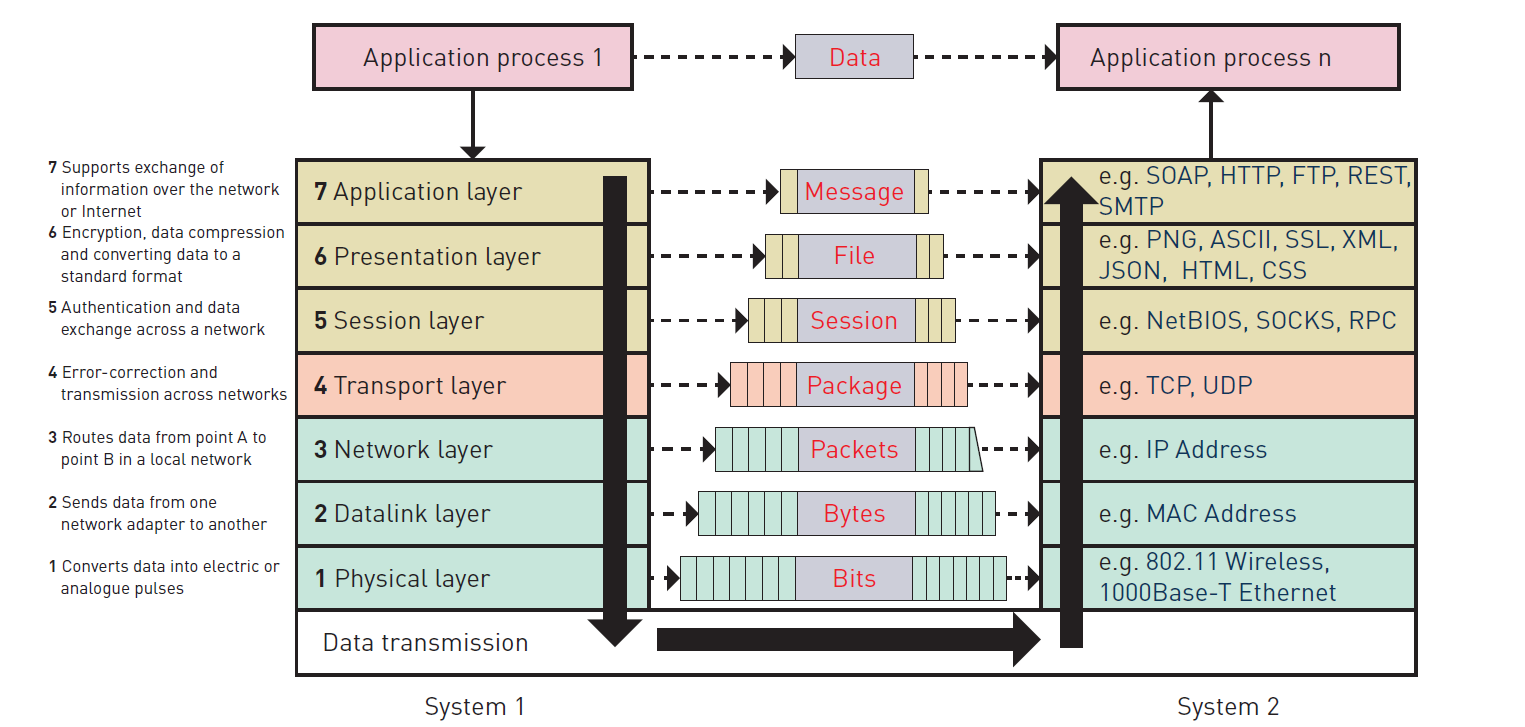
- authenticates electronic documents and transactions - 16DIAGRAM OSI Model
- 17DEFINITION Jitter- aka packet delay variance
- is the irregular latency in data exchanges caused by electronic noise or clock timing errors - 18DEFINITION Latency- delay between when an application requests and receives data
- influenced by: Serialisation, Propagation, Switching and Queuing - 19DEFINITION FTPFile Transfer Protocol
a network protocol for transmitting files between computers over the internet - 20DEFINITION AJAX- Allows web pages to be updated asynchronously, by exchanging data with a web server behind the scenes
- can update part of a page without having to reload - 21PROCESS Caesar CipherTo encrypt: for each letter in plaintext, shift the letter forward by same key shift; this is then ciphertext
To decrypt: for each letter in ciphertext, shift the letter backward by the same key shift; this gives you plaintext - 22PROCESS Polyalphabetic Cipher1. Pick keyWORD, the longer the better
2. Convert each letter to number of their position in alphabet
3. Each letter of plaintext is shifted by corresponding letter (using mod in case it goes over 26) in repeating keyword - 23PROCESS One–time Pad Cipher- a randomly generated list of letters the same length as the message is generated
- works like polyalphabetic, but no repeating pattern, so much harder to crack - 24LIST Common encryption algos and differentiationsTripleDES (3DES) - symmetric, applies DES 3 times
Blowfish, Twofish - symmetric block cipher, simple
PGP - symmetric + public key, open-source
RSA - asymmetric, uses public/private key pairs - 25COMPARISON Symmetric vs Asymmetric EncryptionSymmetric: uses a single key for both en/decryption of data, which is shared between sender & recipient
Asymmetric: uses public key for anyone to encrypt, secret private key to decrypt (helps confidentiality, authentication) - 26DEFINITION VPNVirtual Private Network
an encrypted connection (like a tunnel) over the internet from a device to a network - 27LIST Most important APPs (privacy principles)Australian Privacy Principle 1 - open and transparent management of personal information
Australian Privacy Principle 6 - use or disclosure of personal information
Australian Privacy Principle 11 - security of personal information - 28LIST Internet ProtocolsHTTP
HTTPS
FTP
VPN
(they all have a p) - 29LIST Common Hashing algosMD5 - widely used, 128-bit
SHA - family of cryptographic hash functions, inc. SHA-1, SHA-256, SHA-512 - 30PROCESS Normalisation1NF - Each record within a table is atomic in nature, separate records are different
2NF - Each attribute is fully dependant on the primary key(s) within the record
3NF - Each record within a table must not have any other data dependencies other than the primary keys - 31DEFINITION Australian Privacy Principle 1open and transparent management of personal information
- 32DEFINITION Australian Privacy Principle 6Use or disclosure of personal information
- 33DEFINITION Australian Privacy Principle 11Security of personal information
Informationen
- Beschreibung
- This is made the night before my mock exam so please no judgement
- Erstellt von
- Ciara GLYNN
- Aufrufe
- 23
- Tags
- Bewertung