
Karteikarten
DMUU
Karten in diesem Stapel (69)
- 1Response vs Explanatory VariableResponse is the possible expected outcomes (dependent), Explanatory is the variable we try to see if it affects the response (independent).
- 2How far away from the IQR must an observation be in order for it to be considered an outlier (hint: box plots)3/2
- 3For a symmetric distribution, are robust or non-robust measurements better?Non-robust
- 4Robust MeasurementsMedian, IQR (not as influenced by outliers)
- 5Non-Robust MeasurementsMean, Std. Dev., Variance (Influenced by outliers)
- 6When mean < median, then your graph skews which way?Left
- 7If P(a * b) = P(a) * P(b), that tells us what?the probability of event a and the probability of event b are INDEPENDENT
- 8The general addition rule states that P(A or B) =P(A) + P(B) - P(A & B)
- 9P(A|B) is read as ___ in plain English"Probability of A, given that B has already happened"
- 10How would you find P(A & B) =P(A|B) * P(B)
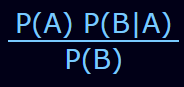
- 11If we know what P(B|A), P(A), and P(B) is, then we can find P(A|B) with this formula:
- 12When given P(A|X), P(A|Y), and P(A|Z), the probability of A is...(P(A|X) * P(X)) + (P(A|Y) * P(Y)) + (P(A|Z) * P(Z))
- 13The General Variance Formula States...Var = Sum of all (probability of outcome) * (probability of outcome - mean)^2
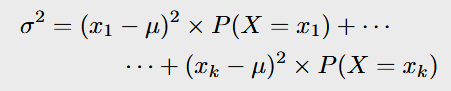
- 14For some random variable (numerical and discrete) with unknown distribution, E(x) =Sum of all (outcome * probability of outcome)
- 15For some random variable (numerical and discrete) with an unknown distribution, std. deviation =the square root of (the general variance formula * sample size)
- 16What is the shorthand for Normal Distribution?N(μ, σ)
- 17What does a Z-Score describe?How many standard deviations away an observation is from the mean
- 18normalcdf or pnorm does what (technical/mathematical aspect)?Returns the area to the left of a given value x in the normal distribution. (1-pnorm for right tail)
- 19Write a pnorm command using the following data: mean = 50, std dev = 20, lower bounds = Bpnorm(B, 50, 20)
- 20What does Pnorm find?The percentage/percentile of observations that are worse than some given observation.
- 21Qnorm / Invnorm finds what?The inverse of the normalcdf / Pnorm function. Instead of inputting an observation to find percentile, you input a percentile to find observation.
- 22E(x) of a standard Bernoulli Distribution is what?P
- 23Std. Deviation of a standard Bernoulli Distribution is what?SQRT(P * (1-P))
- 24For a Bernoulli variable, what the probability of a "hit"? The probability of a "no hit"? (respectively).P; 1-P
- 25A geometric distribution is used to find what?Describes the chances of the first "hit" being on the nth observation.
- 26E(x) of a geometric distribution is what?1/P
- 27The std. dev of a geometric distribution is what?

- 28A Binomial Distribution is used to find what?To find the probability that k# of "hits" will happen within n# of trials.
- 29For a Binomial Distribution to be appropriate for a study, what requirements must the data qualify?Each trial must be: Independent, Have fixed number of trials, Outcome can only be "hit" or "no hit", and probability of "hit" is the same for each observation
- 30The mean and std. dev of a Binomal distribution is what? (respectively).np; SQRT(np * (1 - p)
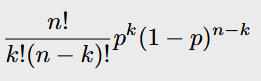
(n = # of trials, p = probability of "hit") - 31The probability of observing k# of "hits" in n# of trials is given by this formula:
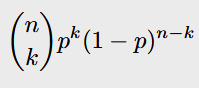
- 32is equal to...
- 33Pbinom gives what (mathematically)?Returns the area to the left of a given value q in the binomial distribution
- 34pbinom(k, n, p). What is k, n, and p respectively?k = total # of "hits", n = total # of observations, p = probability of a "hit"
- 35If in a binomial distribution, both np and n(1-p) are over 10, what does that mean?You can approximate the distribution using the normal distribution. I.e. you can use methods for the normal distribution (pnorm, qnorm, etc).
- 36A Negative Binomial Distribution describes what?The probability of observing the kth success on the nth observation.
- 37P(kth success on nth observation) = ?
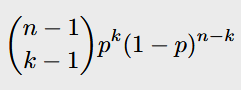
- 38A Poisson Distribution is used to find what?The chances of a certain # of "hits" occurring in a large population over a certain unit of time.
- 39What variable is λPoisson parameter
- 40λ = ?λ is mean of a Poisson dist.
- 41How would you find the expected result of a Poisson parameter, given λ and number of "hits"

- 42Std. Dev of a Poisson Distribution is what?SQRT(λ)
- 43ppois finds what?The chance that a given number of "hits" will happen in a time frame, given the typical mean number of "hits"
- 44ppois(x, y). What should x equal? y? (respectively).x = number of "hits"; y = λ
- 45Z-Score is calculated as:
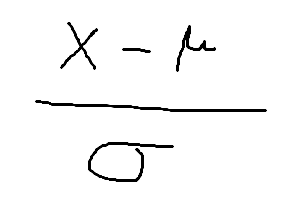
- 46What is Standard Error? (not formula)The standard deviation of a sample; Measures uncertainty of point estimate
- 47What is the equation for Standard Error?
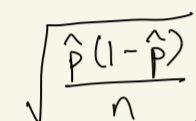
- 48What is a sampling distribution?It is a normal distribution where each observation is actually the mean value of a sample. I.e., what if we took the means of many samples and made that into a normal distribution.
- 49What is the z* value for a 99% confidence interval?2.58
- 50What is the z* value for a 95% confidence interval?1.96
- 51What is the formula for a confidence interval?
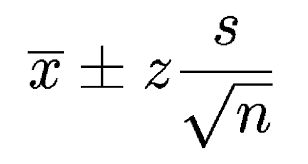
- 52What is a type I error?Rejecting the Null Hypothesis when there isn't actually enough evidence to reject it.
- 53What is a type II error?Failing to reject the null hypothesis when we have enough evidence to reject it.
- 54What is a P-Value?A P-Value represents how likely it is that our study resulted the way it did, given we assume that the null hypothesis is true.
- 55If we have two numerical statistics that we want to compare, we can use:Poole Proportion
- 56In a Poole proportion, what is the "center" of phat1 - phat2?0
- 57What distribution do we use when we want to compare categorical data?Chi-Square Distribution
- 58How do we find P-Value of normal distribution?2*(1-Pnorm(phat, mean, SE))
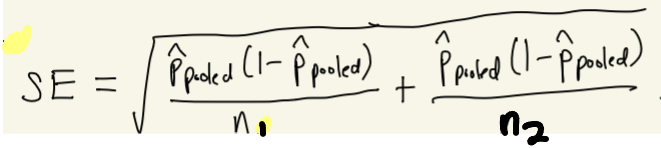
- 59What is the standard error of phat1-phat2?
- 60How do we find p-value of a chi-square?1-Pchisq(test stat, df)
- 61How do you find the df of a chi-square distribution?n-1
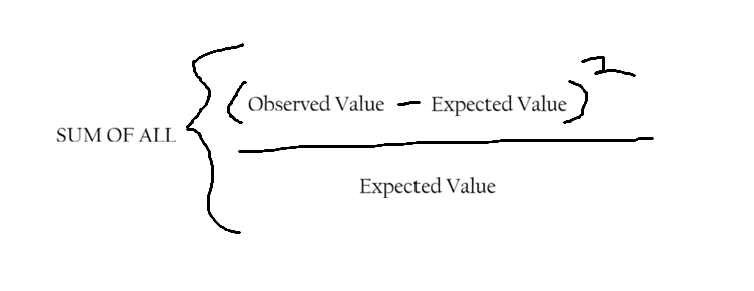
- 62How do you find test statistic of chi-square distribution?
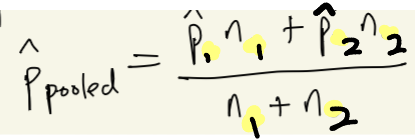
- 63how is the poole proportion between 2 phat values calculated?
- 64How do we find p-value when working with a poole proportion?2*pnorm(phat1-phat2, 0, SE)
- 65What is the df in a t-distribution?n-1
- 66To find p-value of a t-distribution, what do you do?2*pt(test statistic, df)
- 67The test statistic of a t-distribution is calculated as what?(mean1-mean2)/SE
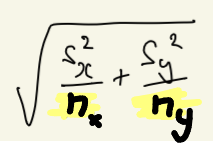
- 68SE of a t-distribution is calculated as what?
- 69—
Informationen
- Beschreibung
- Study guide for Discrete Structures Under Uncertainty class (statistics). Does not include answer key or practice questions.
- Erstellt von
- Katie Rader
- Aufrufe
- 1
- Bewertung