
Karteikarten
Renal System A&P
Karten in diesem Stapel (17)
- 1List the parts of the renal systemKidneys
Ureters
Bladder
Urethra - 2Explain what the kidneys doFilter 200l of blood a day
allows toxins and metabolic waste to leave the body
Regulates volume and concentration of blood
maintains homeostasis
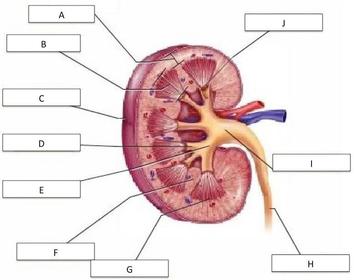
produces renin to regulate BP and erythropoietin to stimulate production of blood cells - 3—A) Renal Cortex
B) Renal Medulla
C) Renal Capsule
D) Minor Calyx
E) Major Calyx
F) Renal Column
G) Renal Pyramid
H) Ureter
I) Renal Pelvis
J) Renal Papilla - 4—From top left - counter clockwise
Glomerulus
Proximal Convoluted Tubule
Loop of Henle
Collecting duct
Capillary network
Bowman's Capsule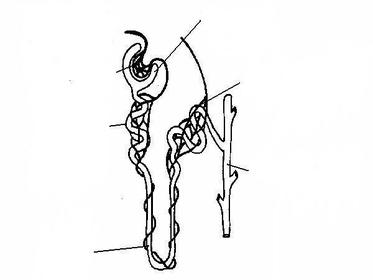
- 5Name and give the direction of blood flow of both arterioles in the glomerulusAfferent arteriole is wider, and so brings blood into the glomerulus
The efferent arteriole is narrower and takes the blood cells out of the glomerulus.
Efferent = Exit - 6Name the cells around the arterioles and describe their purposeJuxtaglomerular cells - the JGC contract, restricting the flow of blood if the blood pressure becomes raised. This is to prevent damage to the membrane between the glomerulus and Bowman's capsule.
- 7What do the Juxtaglomerular cells release, and why?The Juxtaglomerular cells release Renin if they register a drop in blood pressure and this increases blood pressure by instructing the kidneys to retain more water.
- 8What does the Macula Densa do and where is it?Situated between the afferent and efferent arterioles. It is sensitive to the level of sodium chloride in the blood, affecting reabsorption.
- 9What does the glomerulus do?Filters blood through the membrane, into the Bowman's capsule
- 10What does the Proximal Convoluted Tubule do?recovers up to 65% of water
Vitamins recovered
regulates electrolytes
reabsorbs glucose and small amino acids
Hydrogen secreted into the PCT from drugs and alcohol. - 11What does the Loop of Henle do?Descending: reabsorbs 15% of water
Ascending: Regulates electrolytes - 12What does the Distal Convoluted Tubule do?Antidiuretic hormone released
Aldosterone released
19% of water reclaimed
Hydrogen enters by secretion
More secretion than absorption - 13What does the collecting duct do?Removes water, waste products and electrolytes. Drains into the minor calyx
- 14Name the 3 purposes of the kidneys.Filtration
Selective reabsorption
Secretion - 15Explain FiltrationTakes place in the glomerulus. Nearly everything except blood cells enter the Bowmans capsule from here.
- 16Explain selective reabsorptionAny substance such as potassium that is needed by the body is reabsorbed into the blood by osmosis or diffusion
- 17Explain SecretionAnything not removed by glomerular filtration such as hydrogen ions from drugs are secreted into the tubules from the network of surrounding capillaries.
Informationen
- Beschreibung
- Revision flash cards for undergraduate nursing degree first year exam
- Erstellt von
- Kirsty Jayne Buckley
- Aufrufe
- 1.216
- Tags
- Bewertung