
Karteikarten
Local Anaesthetics
Karten in diesem Stapel (49)
- 1What is the mechanism for Local Anaesthetics?Block the conduction of action potentials in nerve axons
- 2Which pathway carries pain and temperature information?Lateral spinothalamic tract
- 3How is the strength of a pain signal encoded?Frequency of action potentials
- 4What determines how easily a LA blocks the transmission of an AP?Diameter of the nerve fibre.
- 5What type of information is carried in a: 1) Aa 2)Ab 3)Ad 4) C1) Proprioception
2) Touch
3) Pain (mechanical and thermal)
4) Pain (mechanical, thermal and chemical) - 6Which of the four classes of nerve fibres isn't myelinated?C fibres
- 7What is the order of size of nerve fibres? (LARGEST TO SMALLEST)1) Aa 13-20uM
2) Ab 6-12uM
3)Ad 1-5uM
4)C 0.2-1.15uM - 8Which nerve fibres are most sensitive to block by LAsAd and C fibres
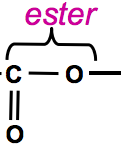
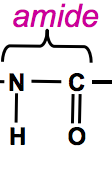
- 9Describe the 3 main parts of a LA1) Aromatic group (lipophilic, hydrophobic)
2) Ester or Amide
3) Amino Group - 10Describe the structure of an Ester
- 11Describe the structure of an Amide
- 12What determines the percentage of an LA which is ionised?1) pH of solution
2) pKa of LA - 13What do pH and pKa equate to?pH = -log10[H+]
pKa = -logtoKa
(acid dissociation constant) - 14When does pKa = pH (or Ka = [H+])when LA + H+ >>>>>> LAH+
<<<<<<
Are both at 50% - 15What happens to the percentage of ionised LA as the pH decreases (becomes more acidic)?Percentage of ionised LA increases
- 16HENDERSON-HASSLEBATCH EQUATIONpKa - pH = log [LAH+]/[LA]
- 17What happens to the acidity of an inflamed tissue?Acidity increases
- 18What are the two pathways LAs can take to block sodium channels?Hydrophobic and Hyrdophilic
- 19Which pathway is most prevalent?Hydrophilic
- 20Describe the Hydrophobic (Lipophilic) pathway.Unionised LA molecules enter the membrane and interact with membrane proteins (sodium channels) preventing them from functioning.
- 21Describe the Hydrophilic pathwayMost hydrophobic (10-20%) molecules pass through the membrane and enter the cytoplasm. Majority become ionised (80-90%) because pH cytoplasm = 7.4. Block sodium channel at intracellular side.
- 22Where do LAs bind in sodium channels?Bind at the S6 segment in domain IV of a subunit.
- 23Which states do LAH+ have high affinity for?Open and inactive
- 24Why don't LAs affect normal channel APs?LAs are use-dependent >> the more active the channel the more they bind (as in high frequency of pain APs)
- 25What is the pKa of procaine?8.98
- 26Why is procain hardly used?1) poor tissue penetration
2) short plasma half life
3) readily hydrolysed by non-specific esterases in plasma - 27What is the pKa of Lidocain (Lignocaine)pKa=8.0
- 28What is the plasma half life of lidocaine?2hr
- 29How is lidocaine removed from the system?Metabolised by the liver
- 30What is the time taken for onset?5-10 minutes
- 31What can be injected to prolong the effect of LAs? Give two examples of thisVasoconstrictors
1) Adrenaline
2) Felypressin - 32Why do vasoconstrictors prolong the action of LAs?Circulation terminates action of LAs. Constricting blood vessels keeps LA active at site for longer.
- 33Give an example of two other LAs containing an ester grouptetracaine (amethocaine)
cocaine - 34Give an example of another two LAs containing an amide groupBupivacaine
Prilocaine - 35What are the two Atypical LAs? (NUMBER 1)
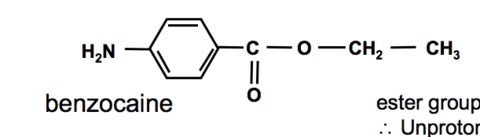
- 36NUMBER 2
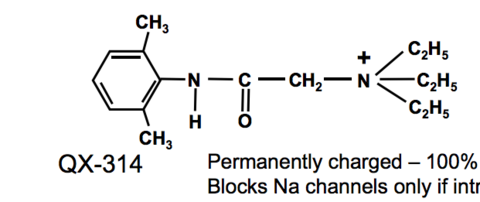
- 37Why is benzocaine an Atypical LA?No amine group >> always unprotonated
Can only take hydrophobic pathway - 38Why is QX-314 an Atypical LA?Permanently 100% ionised.
Has to be introduced into cytoplasm of cells experimentally (via pipette). - 39Which LAs are used as surface anaesthetics and in what form?Lidocaine-Spray (nose, mouth, upper RT)
Lidocaine & Tetracaine - Solution (cornea of eye)
Cocaine: solution/spray (ear/nose/throat)
Lidocaine, tetracaine - gel/ointment (urethra/skin) - 40What is infiltration anaesthesia used for? (And which LAs?)Most LAs, injected into tissues to block conduction in fine nerve terminals for minor surgery. Never toes or fingers (ischaemic damage)
- 41What is intravenous regional anaesthesia used for? And which LAs are used?Limb surgery - lidocaine or prilocaine
Injected distal to pressure cuff. - 42What is nerve-block anaesthesia used for? Where is it injected?Dentistry, surgery and analgesia. Injected close to nerve trunk
- 43Where is a spinal anaesthesia injected? What is it used for and which LAs are used?Injected into subarachnoid space between 2 & 5 lumbar vertebrae (inhibit nerves innervating lower body)
Used for surgery on abdomen, pelvis or leg
Lidocaine or bupivicaine. - 44Where is an epidural injected? What is it used for? Which LAs are injected?Epidural space of spinal cord. Childbirth. lidocaine, bupivacaine and ropivacaine.
- 45How would you treat neuropathic pain?With I.V lidocaine
- 46What are the 3 Adverse effects of LAs? *NUMBER 1High plasma conc (accidental injection into artery or vein)
CNS: Stimulation>>confusion>convulsions> respiratory depression
CVS: DECREASE blood pressure due to:
i) decrease heart contractility
ii)Vasodilatio - 47*NUMBER 2Hypersensitivity (allergic reaction)
- 48*NUMBER 3Methaemoglobinaemia - due to toxic metabolite produced from prilocaine
- 49What are the other clinical uses of LAs?Treatment of ventricular dysrhythmias
Potentially treatment of epilepsy
Informationen
- Beschreibung
- Degree Neuropharmacology Karteikarten am Local Anaesthetics, erstellt von Anna mph am 14/12/2015.
- Erstellt von
- Anna mph
- Aufrufe
- 145
- Bewertung