
Karteikarten
General Anaesthetics Part 2 - Steve Fitzjohn
Karten in diesem Stapel (43)
- 1What are the two most common injectable General anaesthetics?Propofol
Thiopental - 2How is propofol introduced to the system? What are its benefits?By IV
non-irritant
Rapid metabolism and distribution - very little time spent in excitement phase. - 3What are the 2 cons of propofol?Expensive
Cardiovascular depressant - 4What is propofol usually used for?Used for induction into surgery
- 5Through which receptors does propofol work?GABAa and GlyR potentiation
- 6What class of drugs is Thiopental?Barbiturate
- 7Where/how does thiopental act?GABAa Receptors
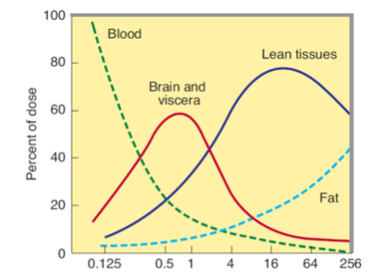
- 8What is the lipid solubility of thiopental and what does this mean in terms of plasma concentration?High lipid solubility - plasma solubility rapidly declines as drug is stored in body fats
- 9What are the four main sites of action of barbiturates and in what order are the most rapidly distributed?1) Brain
2)Heart, lungs, liver & kidney
3)Muscle and fat (stored)
4)Liver metabolism - 10Explain these graphs1) Blood plasma levels rapidly decrease due to absorption of drug by tissues
2) Brain and viscera levels rapidly rise and decrease due to being well vascularised
3)Levels in lean tissue stay high
4) Drug stored in fat - 11Explain the 'hangover' effect of drugs such as thiopentalAnaesthetic is stored in fat and slowly released - not enough to cause general anaesthesia but enough to make patient feel groggy
- 12How can thiopental cause death?If the metabolism becomes saturated - if another dose is then given this can further activate GABAa receptors without the presence of GABA (thiopental is a barbiturate)
- 13What are 'dissociative' anaesthetics?Anaesthetics which cause a dissociation between mind and body
- 14Give an example of dissociative anaestheticKetamine
- 15What are the advantages of dissociative anaesthetics? (4)1) High therapeutic index
2) No cardiovascular or respiratory depression
3)Non-cumulative effect
4)Analgesic - 16What are the disadvantages of dissociative anaesthetics? (2)1) Psychic disturbances
2) Involuntary movements - 17Which part of the population is ketamine most used in as an anaesthetic?Children
- 18What flows in through an NMDA receptor and what flows out?Ca2+ and Na+ flow in
K+ flows out - 19How does ketamine affect the NMDA receptor? What class of anatgonist is it?Binds to the inside of the pore - non-competitive antagonist
- 20Where does Etomidiate act and what is it's main side effect?GABAa potentiator, high incidence of nausea
- 21What type of drug is Midazolam? What is it used for?Benzodiazepine - used as a pre operative sedative or if full anaesthetic not required
- 22What type of drug is Alfaxalone? Where does it act and what is it used for?Neurosteroid, GABAa potentiator, vet anaesthetic
- 23What are the advantages of injectable anaesthetics? (2)1) Easy to administer
2) Rapid induction - 24What are the three disadvantages of injectable anaesthetics?1) Complex pharmacokinetics
2) Slow elimination
3) Side effect - 25What are the two subtypes of inhalation anaesthetics?Gases
Volatile liquid - 26Give an example of a gas and volatile liquid anaestheticN20
Desflurane - 27What is the route inhalation anaesthetics take to reach the brain? Why is induction slower than with injectable anaesthetics?Air>lungs>blood>brain
Injectable goes straight to blood. - 28What are the four things which determine the induction rate of an inhalation anaesthetic?1) Blood:gas partition coefficient
2) Oil:gas partition coefficient
3) Alveolar ventilation rate
4) Cardiac out out - 29What does the blood:gas partition coefficient determine?How quickly/well a gas dissolves into the blood.
- 30What is and what does the oil:gas partition coefficient determine?1) solubility of gas in fat
2) how long the anaesthetic takes to have an effect - 31What does the alveolar ventilation rate determine?How quickly the gas gets into the blood and round the body
- 32Why are the factor that govern the induction rate the same as those which govern the recovery rate for inhalation anaesthetics?Gases are breathed out - not metabolised
- 33Which 3 factors govern only the speed of induction?1) blood volume >> alveolar air space
2) Conc of anaesthetic in alveolae initially << inspired air
3)Brain in rapid equilibrium with blood - 34What is more desirable: A high blood:gas coefficient (rapid absorption) or a low blood:gas coefficient? Why?Low - allows build up of anaesthetic in lungs, blood passing receives continual anaesthetic >>> steady state. Otherwise small volumes of blood receive all anaesthetic and remove it from lungs.
- 35What are the blood:gas coefficients of: Ether Halothane Nitrous Oxide Desflurane1) 12
2) 2.4
3) 0.5
4) 0.4 - 36Do you want the oil:gas coefficient to be low or high?High. Determines strength of anaesthetic.
- 37Which anaesthetic has the best relationship between oil:gas partition coefficient and blood:gas coefficient?Desflurane. (O:G = 23, B:G = 0.4)
- 38What would you use for... rapid induction? (2)Propofol, Thiopental
- 39Maintenence of anaesthetia? (3)Desflurane, isoflurane, nitrous oxide
- 40Analgesic supplement?Opioid
- 41Muscle relaxantNMJ blocking agent - eg atracurium
- 42Muscarinic antagonistAtropine
- 43Antiemetic (anti-nausea)Ondasetron
Informationen
- Beschreibung
- Degree Neuropharmacology Karteikarten am General Anaesthetics Part 2 - Steve Fitzjohn, erstellt von Anna mph am 16/12/2015.
- Erstellt von
- Anna mph
- Aufrufe
- 84
- Bewertung