
Karteikarten
Economic development
Karten in diesem Stapel (20)
- 1Economic developmentincludes economic growth in addition to qualitative determinants of quality of life
e.g. reduction in: poverty, gender inequality , income inequality, political oppression, unemployment
- L/R mostly requires economic growth as well - 2Sources of economic growth and development in LEDCs (Less economically developed country)- increase in quality and quantity of physical capital through FDI
- increase in quality and quantity of human capital (education and healthcare)
- development and adoption of appropriate technology for country
- institutional changes in banking, legal and political systems (easy economic transactions ➝ attract FDI, boost consumer, business confidence) - 3Common characteristics of LEDCs- low GDP/capita
- high level of (extreme) poverty
- relatively large agricultural sectors (YED for those goods is low ➝ difficult to develop)
- large urban informal sectors
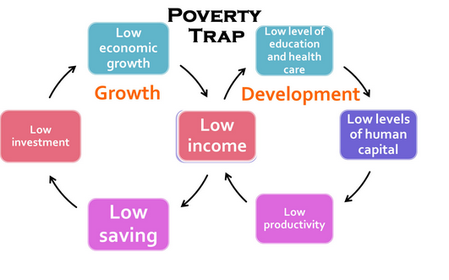
- high birth rates - 4Poverty trap/cycle
- 5Diversity among LEDCs- resource endowment
- history (colonial) - resources extracted
- political systems (North Korea, Peru-democracy)
- political stability
- climate
- population (fast growing Ethiopia, slow growing Mali) - 6Millennium Development Goals (MDGs) (2000-2015)1. Eradicate extreme poverty (halved)
2. Achieve Universal Primary Education
3. Promote Gender equality/empower women
4. Reduce child mortality
5. improve maternal health
6. combat HIV/AIDS, Malaria and other diseases
7. Ensure environmental sustainability
8. Global partnership for development - 7New Sustainable development goals- 17 goals
- improving on old goals and adjusting according to experience - 8single indicatorrefers to a statistical measure of economic development that uses one particular measurement e.g. literacy rate, income per capita, life expectancy
- 9real GDP per capitacalculates the blue of national output (GDP) of a country divided by its population
- 10real GNI per capitareal GDP per person + earnings from overseas investment
- 11purchasing power parity (PPP)exchange rate that equates the price of a basket of the same traded goods and services in different countries
➝ enables comparison of GDP, GNI figures between countries - 12Composite indicatora statistical method that combines single indicators of economic development into a combined index such as the Human Development Index (HDI)
- 13Human Development Index (HDI)- composite indicator (life expectancy, educational attainment and income)
- Measures:
- Healthcare - life expectancy at birth
- Education - mean years of schooling/expected years of schooling
- Income levels - higher national income (using PPP) - 14Limits of HDIDoes not account for:
- Qualitative factors (gender inequality and human rights)
- Income distribution
- Environmental issues
- Cultural differences in standard of living
- Sustainable development - 15Domestic factors and economic development- education and healthcare
- use of appropriate technology
- access to credit and micro-credit
- empowerment of women
- income distribution
➝ all positive externalities of production and consumption for LEDC - 16Education and health- increase labour productivity (output per worker)
- shifts LRAS right/PPC outwards - 17Use of appropriate technology- capital-intensive technology
- labour-intensive technologies
➝ LEDCs rely on labour-intensive technologies to create jobs and income for those in extreme poverty
- development interrupted if foreign currencies required and lack of infrastructure also harmful - 18Access to credit/microcredit- credit schemes (essential for investment in physical, human or natural capital)
- micro-credit schemes (for very poor):
➝ self-employed projects
➝ get classes in financial management
Arguments against:
➝ only small scale
➝ high interest rates by banks, lower by NGOs
➝ vulnerable to external shocks
➝ limited qualifications (business failure)
➝ unstable incomes therefore factory jobs preferred - 19Empowerment of women- increases labour productivity and national output
- improves self-esteem and productivity ➝ improved maternal health and reduced child mortality
- Priorities to promote gender equality:
➝ excess female mortality/education gaps
➝ economic opportunities
➝ women's voice in household/society
➝ limiting reproduction across generations - 20Income distribution- implement an effective progressive tax system
Difficulties:
1. only small population pay income tax (low income/parallel markets)
2. Low official economic activity
3. Low incomes and lack of international trade limit tax revenue from tariffs.
Informationen
- Beschreibung
- International Baccalaureate Economics (Development Economics) Karteikarten am Economic development, erstellt von Jonas Schlicht am 24/04/2016.
- Erstellt von
- Jonas Schlicht
- Aufrufe
- 1
- Bewertung