
Karteikarten
Business Studies - Unit 1 - Key Terms
Karten in diesem Stapel (71)
- 1Business StudiesUnit 1
- 2EntrepreneurSomeone willing to take the risks involved in setting up a business. Entrepreneurs believe that the rewards of starting a business are worth the risks and costs involved
- 3Social EnterpriseA business set up to help society rather than make a profit
- 4Marketing ResearchThe process of gathering, analysing and presenting data relevant to marketing
- 5Primary Market ResearchGathering and analysing marketing data that has not been collected before
- 6Secondary Market ResearchGathering and analysing data that has already been collected
- 7Market ShareIndicated by the sales of one product compared to the total market sales
- 8FranchiseOccurs when a franchisor sells an existing business idea to a franchisee
- 9FranchisorThe seller of a franchise
- 10FranchiseeThe buyer of a franchise
- 11Objective/aimA target that is set for a business to achieve
- 12Public Sector OrganisationsOwned by the government
- 13Private Sector OrganisationsOwned by individuals
- 14StakeholdersIndividuals and organisations that are affected by and affect the activities of a business
- 15Business PlanA document setting out what the business does at present, plus what it intends to achieve in the future and how this will be accomplished. Includes marketing and financial plans
- 16Business PlanningThe process of producing a business plan
- 17A RiskThe possibility of something going wrong
- 18Sole TraderAn individual who sets up in business on his or her own
- 19Unlimited LiabilityWhen the personal possessions of the owners of the business are at risk if there are any problems. There is no limit to the amount of money the owners may have to pay out
- 20PartnershipFormed when two or more people set up in business together
- 21Deed of PartnershipAn agreement between partners that sets out the rules of the partnership, such as how profits will be divided and how the partnership will be valued if someone wants to leave
- 22CompanyA business with its own legal identity. It can own items, owe money, sue and be sued
- 23ShareholderThe owner of a company. Each shareholder owns a 'share' of the business
- 24StakeholderAn individual or organisation that affects or is affected by the activities of a business. Shareholders are stakeholders but so are suppliers, employees, the distributors, the government and the community
- 25Private Limited Companies - what are they?- has ltd after its name
- owned by shareholders
- cannot advertise its shares to the general public
- can limit who the shares are sold to - 26Market SegmentA group of similar needs within the overall market
- 27Marketing MixRefers to all the activities influencing whether or not a customer buys a product. The elements of the mix can be analysed using the four Ps - price, place, product and promotion
- 28Owners fundsMoney put into a business by its owner or owners
- 29InterestA payment made in order to borrow money. It means a business pays back more than it borrows
- 30OverdraftsGive entrepreneurs and businesses the right to borrow variable amounts of money up to an agreed limit
- 31MortgagesLoans from banks and building societies that are used to buy land and buildings such as offices and shops
- 32Hire purchaseA method of purchasing assets and paying in instalments
It's a special form of loan
Can be an expensive way of buying something and the business will not own the item until it is completely paid for - 33PriceThe amount a business asks a customer to pay for a single product
- 34SalesNumber of products sold by a business over some time period
- 35RevenueThe income that a firm receives from selling its goods or services
- 36CostsThe spending that is necessary to set up and run a business
- 37Fixed CostsThese do not alter when a business changes its output
- 38Variable CostsThey vary directly with the business's level of output and sales
- 39ProfitThe amount by which a business's revenue from all its sales exceeds its costs
- 40A lossThe amount by which a business's costs are larger than its revenue for all sales
- 41Cash flowThe money that flows in and out of a business on a day to day basis
- 42Cash flow forecastA plan of the expected inflows and outflows to and from a business over a period of time
- 43Cash flow statementA historical record of the cash inflows and outflows that have taken place over a period of time
- 44InsolvencyOccurs when a business is not able to meet its financial commitments when they are due
- 45A receiverA person who takes responsibility for an insolvent business and makes arrangements to pay its debts
- 46RecruitmentThe process of finding and appointing new employees
- 47Internal recruitmentTakes place when a job vacancy is filled from within the existing workforce
- 48External recruitmentFilling a job vacancy from any suitable person not already employed by the business
- 49TrainingThe giving of job-related knowledge and skills to an employee - e.g. teaching a new employee to drive a fork-lift truck
- 50RemunerationA term that means the payment of employees
- 51WagesMoneys paid by businesses to employees in return for work and are normally paid each week
- 52SalariesMoneys paid by businesses to employees in return for work and are normally paid monthly
- 53Monetary benefitsAdditional payments made to employees on top of their wages or salaries, such as bonuses
- 54Non-monetary benefitsRewards given to employees that are not in a monetary form, such as free lunches
- 55MotivationThe range of factors that influence people to behave certain ways
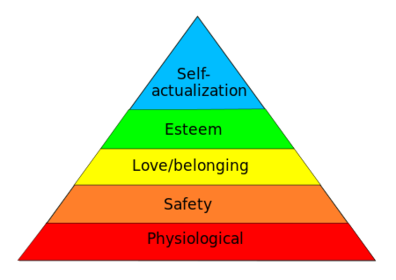
- 56Maslow's Hierarchy of Needs
- 57Job enrichmentDesigning a job to give interesting and challenging tasks
- 58AuthorityMeans having power or control over something
- 59LegislationA set of rules that governs the way society operates. Another term for 'laws'
- 60Piece-rate payA system under which employees are paid a fixed amount for each unit of output that is produced
- 61Trade UnionA group of workers who act together to improve their pay and working conditions
- 62Contract of employmentA legal document stating the hours, rates of pay, duties and other conditions under which a person is employed
- 63ProductionThe process of changing inputs such as labour services into goods and services that can be sold
- 64Job productionA method of production in which a product is supplied to meet the exact requirements of a customer
- 65Batch productionA method of production in which a group of similar products are produced at the same time
- 66Efficient productionUsing a minimum amount of resources to produce goods and services
- 67QualityThe extent to which a consumer is satisfied with a product
- 68Customer serviceThe part of a business's activities that is concerned with meeting customers' needs as fully as possible
- 69After-sales serviceThe meeting of customers needs after they have purchased a product
- 70E-commerceThe act of selling a product using the internet
- 71Global marketsMade up of customers from across the world
Informationen
- Beschreibung
- All the key words associated with AQA GCSE Business Studies Unit 1
- Erstellt von
- Anna Freer · Mai 2016
- Aktualisiert
- 26 Apr 2017
- Aufrufe
- 36
- Bewertung