
Karteikarten
Chapter 3 - Design Development
Karten in diesem Stapel (87)
- 13-1 What are the six elements of design?Form, scale, color, texture, pattern and light
- 23-2 What basic form is the intersection of a wall and a ceiling perceived as?A line
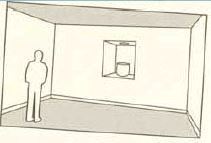
- 33-3 What types of forms are represented by the niche and vase shown?The former is a volumetric form, defined by five enclosing planes. It is a void,
or negative space, because the perceived volume is not solid and is defined
by other objects. In contrast, the latter is a solid volume, or positive space. - 43-4 In design, what is scale?The relative size of an object or element in comparison to another element of
known size. - 53-5 What are the true primary colors of pigment?Yellow, magenta, and cyan (not yellow, red and blue as often thought).
- 63-6 What is hue?The most basic color classification. For example, it is what distinguishes
yellow from blue. - 73-7 In terms of color, what is intensity or chroma?The degree of purity of a hue when compared to a neutral gray of the same
value. - 83-8 What are the two names by which this diagram is known?The Brewster, or Prang, color system, often simply known as the color wheel.
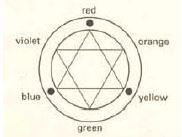
- 93-9 What three terms does the Munsell color system use to define color?hue, value, chroma
- 103-10 What is simultaneous contrast?The phenomenon in which a color seems to change when placed against
differently colored backgrounds. - 113-11 What is an analogous color scheme?A color scheme using hues that are close to each other on the color wheel.
- 123-12 Which design element can be perceived through the senses of both touch and sight?Texture
- 133-13 What is a pattern?The repetition of a decorative motif on a surface
- 143-14 What are the three primary colors of light?Red, green and blue
- 153-15 What are the six principles of design?1. Balance
2. Harmony
3. Rhythm
4. Emphasis and focus
5. Contrast and variety
6. Proportion - 163-16 What is asymmetrical balance?The arrangement of dissimilar elements within a visual field such that the
composition appears balanced, even thought the elements are not grouped
around a common axis. - 173-17 What is visual weight?The perception that some objects are heavier than others by nature of their
size, shape, complexity, color, texture, or location in space. - 183-18 What is radial balance?The uniform arrangement of elements about a central point
- 193-19 In regard to interior design, what is harmony?A characteristic of a composition in which all the elements of the interior seem
to belong together and to reinforce the overall design theme - 203-20 What is gradation, and what design principle is it derived from?A variation of rhythm. It describes cases where the size, color or value of a
design element is slightly modified. - 213-21 What design principle is often achieved by placing an element in a prominent position or by using special lighting?Emphasis and focus in a design can be achieved by these methods
- 223-22 In regard to interior design, what is contrast?Intentional juxtaposition of dissimilar elements within a design to create
emphasis - 233-23 How does proportion differ from scale?The former is the size relationship between objects or elements in a space.
The latter is the relative size of an object or element in comparison to another
element of known size (often the human body). - 243-24 What does this diagram represent?Golden scale
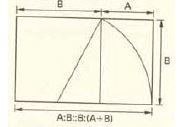
- 253-25 What is the value of the golden ratio?Approximately 1.618- see illustration as well
- 263-26 What is the Fibonacci sequence?Series of numbers in which the first two terms are 0 and 1 and each number
that follows is the sum of the previous two. 0, 1, 1, 2, 3, 5, 8, 13, 21, …. - 273-27 In terms of wallboard partitions, what are the common differences between residential and commercial construction?3-27 In terms of wallboard partitions, what are the common differences
between residential and commercial construction?
The first typically use 2 x 4 wood studs with ½” wallboard, while the second
typically uses metal studs with 5/8” wallboard. - 283-28 What are the standard depths of metal studs?1-5/8”, 2-1/2”, 3-5/8”, 4” and 6”
- 293-29 What is the generic name for fire-rated gypsum wallboard?Type X is the generic name of this material.
- 303-30 What are four advantages of using portland cement plaster as a finish material?1. hard and abrasion-resistant
2. water resistant
3. easily formed into curved and ornate surfaces
4. a good base for wall tile - 313-31 What are four disadvantages of using portland cement plaster as a finish material?1. more expensive than gypsum wallboard
2. slower to construct with than gypsum wallboard
3. wet and messy to work with
4. challenging to work with, thus requiring more-skilled labor - 323-32 In this diagram of a door opening, what are the components labeled A, B and C?A- head, B- jamb, C- threshold or sill
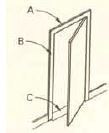
- 333-33 What type of construction element is shown, and what are the components labeled A, B and C?A section of a standard wood door frame in a wood stud partition, including Athe
stop, B- the casing trim, C- the shim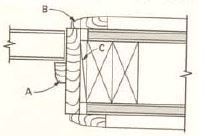
- 343-34 What is a pivot?Type of hardware used to hang door. It consists of a rotating bottom pin and
a corresponding pin at the top of the door. - 353-35 What are the components of a fire-rated door assembly?The door itself, the frame, and the hardware
- 363-36 What are two types of glazing that can be used in hazardous locations, and what test must they pass?Tempered glass and laminated glass, but only if they pass the testing
requirements of 16 CFR 1201, Category II. - 373-37 What are the three most common types of interior glazing?Float, tempered, laminated
- 383-38 What type of construction element is shown, and what are the components labeled A and B?A suspended gypsum wallboard ceiling, including A- a cold-rolled steel
channel, sometimes called a black iron and B- a furring channel, sometimes
called a hat channel.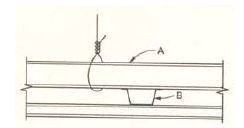
- 393-39 What four characteristics distinguish a fire-rated, suspended acoustical ceiling form a non-rated standard ceiling?1. it is only part of an entire fire-rated floor/ceiling assembly
2. its tiles must be rated mineral tiles
3. it uses hold-down clips
4. it must have expansion slots in the grid - 403-40 In regards to construction, what is a plenum?In commercial construction, this is the space between the building structural
roof or floor and the suspended ceiling. - 413-41 What effect does an acoustical ceiling have on sound?This construction element mainly absorbs sound
- 423-42 Stainless steel is primarily an alloy of steel and an additional element. Which one?Chromium is added to steel to create this material
- 433-43 What are the primary elements used to make bronze?Copper and tin are used to make this material
- 443-44 What process occurs when dissimilar metals are in contact in the presence of water?Galvanic action- a form of electrochemical corrosion in which one metal gives
up electrons to the other, corroding quickly while slowing the other metal’s
corrosion - 453-45 What two materials have largely supplanted plywood in interior construction applications?Particleboard and medium-density fiberboard
- 463-46 What is quarter sawing?A method of sawing lumber in which the saw cut line is mostly perpendicular
to the tree rings in a quarter section of the log - 473-47 Which method of sawing or slicing veneers produces a characteristic cathedral grain pattern in most species of wood?Plain sawing, or plain slicing
- 483-48 What is a flitch?Collection of veneers that have been sliced off the same log
- 493-49 What is used to fit a cabinet tightly to an irregular wall?A scribe piece
- 503-50 What type of cabinet framing is shown?Reveal Ovelay
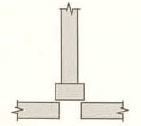
- 513-51 What is bookmatching?Method of assembling veneers in which every other piece sliced off the log is
turned over - 523-52 What is blueprint matching?The most exacting method of matching veneer panels in a room, such that
grain continuity is maintained across doors, cabinets, and other obstructions. - 533-53 What is another term for raised panel construction?Stile and rail paneling
- 543-54 What is high-pressure decorative laminate (HPDL)?A common finishing material used with millwork, made from kraft paper
overlaid with a patterned or colored sheet and a layer of melamine resin - 553-55 What is running trim?This type of molding is installed end to end
- 563-56 What finish material for woodwork provides the hardest, most durable surface?When used as a finish material for woodwork, polyester has these
characteristics - 573-57 What is lacquer?A coating material with a high nitrocellulose content that has been modified
with resins and plasticizers dissolved in a volatile solvent - 583-58 What is solid surfacing?A homogeneous, polymer-based surfacing material
- 593-59 Under what conditions would a wood veneer not have to adhere to flame spread requirements?When a wood veneer is less than .036” thick and applied to a noncombustible
material - 603-60 What is composite wood veneer?A sustainable product manufactured by laminating veneers from commonly
available trees onto an artificial log, which is then sliced to produce the final
veneers - 613-61 What are the four basic types of wood flooring?1. strip
2. plank
3. block
4. end-grain block - 623-62 What are two sustainable types of wood flooring?Bamboo and palm wood
- 633-63 What is marble?A metamorphic rock formed by layers of shells that, under heat and pressure,
form into a composition of crystalline grains of calcite and/or dolomite - 643-64 What is the thin-set method of installing stone flooring?Uses either a special mortar about 1/8” thick or an adhesive
- 653-65 What are four disadvantages of using a thick-set application for stone flooring?1. added weight to the subfloor
2. longer installation time
3. additional thickness
4. additional cost - 663-66 In this terrazzo floor section, what are the components labeled A, B and C?A- divider strip, B- welded wire fabric reinforcing, C- cleavage
membrane on top of the sand cushion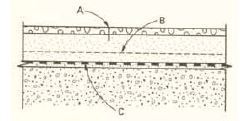
- 673-67 What are five common types of resilient flooring?1. Vinyl
2. Vinyl composition
3. Rubber
4. Cork
5. Linoleum - 683-68 What is velvet carpet?Carpet made by a simple weaving method that places all the pile yarn on the
face of the carpet - 693-69 Why would a designer want to use a Wilton carpet?To produce a complex pattern with different surface textures
- 703-70 What are four reasons why carpet cushions are used?1. provide support for the pile yarn
2. increase dimensional stability
3. provide added strength
4. give a softer feel underfoot - 713-71 What are considered a minimum coefficient of friction for safety?For safety, .5 is minimum
- 723-72 What are the two broad classifications of paint?Water based and solvent based
- 733-73 In terms of paint, what is the vehicle and how does it work?liquid portion of paint, composed of a nonvolatile binder and a
volatile part called the solvent. The binder combines with the body to form
the final film, while the solvent dissolves the binder to allow for application
and later either evaporates or dries. - 743-74 What is the primary concern related to indoor air quality and paint?The level of volatile organic compounds (VOCs)
- 753-75 What two paint types are often used to achieve a very durable surface?Epoxy and urethane paints
- 763-76 In terms of wallpaper installation, what is a drop match?Used when one piece must be raised or lowered in relation to adjacent pieces
to continue the pattern - 773-77 What are the three grades of vinyl wallcovering?1. Type I, light duty
2. Type II, medium duty
3. Type III, heavy duty - 783-78 What are four common ways to install fabric wallcovering?1. applied directly, using an adhesive
2. using custom fabric panels
3. using a proprietary stretch-wall system
4. using acoustic panels - 793-79 What is the primary benefit of using a hydrophobic fabric wallcovering?It does not absorb and hold moisture, so it does not sag or distort
- 803-80 What is tackable acoustic fiberglass?A noncombustible fibrous glass mat bonded with a resinous binder and
formed into a rigid board with a finish of thin, rigid fiberglass mesh - 813-81 What are Roman shades?This type of shade pulls up with a cord into accordion folds
- 823-82 What is a jalousie window?Consists of individual horizontal pieces of glass that all pivot outward at once
for ventilation - 833-83 In regard to interior design, what is detailing?The process of determining a design’s technical requirement- that is, how the
individual components will fit together and exactly how they will look - 843-84 In regard to selecting construction materials and detailing, what three safety factors must be considered?Structural, fire and human contact
- 853-85 What are five causes of building movement that must be considered when detailing?1. dead-load deflection
2. lateral loading from wind or seismic activity
3. water absorption
4. live-load deflection
5. temperature changes - 863-86 What is a tolerance?The amount of allowable variation from a given line, dimension or size
- 873-87 What is a material safety data sheet (MSDS)?A document provided by a manufacturer containing information about the
physical makeup of a substance, proper storage and handling procedures, and
other safety issues
Informationen
- Beschreibung
- IDFX NCIDQ Karteikarten am Chapter 3 - Design Development, erstellt von Rianna Straw am 19/06/2016.
- Erstellt von
- Rianna Straw
- Aufrufe
- 6
- Bewertung