
Karteikarten
A2 AQA Chemistry full course
Karten in diesem Stapel (18)
- 1hellohello
∆ - 2Rate = k[C][D]^dquestions will usually be around finding K given [C] and [D] (concentrations)
- 3(rate equations) k only changes as what changes? concentration? pressure? temperature? molarity?k = Ae^(–Ea/RT)
k only changes due to ∆Temperature - 4You'll be asked to use graphs to deduce order of reaction of a reagent. there are two main types: Rate/[conc.] and [conc.]/time turn over plz.Rate/[conc.] are easy; change in conc can either cause no change in rate (0th order), linear change in rate (1st order), or quadratic change (2nd order).
[conc.]/time are a bit more tricky; as time goes on, concentration will either decrease in linear fashion (0th order), bit bent (1st order) or really bent (2nd order) - 5Rate equation contains reactants which are present in (slowest) rate limiting step. (recall mechanisms and how improbable they can be)Using [reagents] present in rate equation you can comment on whether their addition will speed up the reaction by much.
- 6Each temperature has it's very own Kc,which must stay constant for the given temperature no matter what.If you are having trouble with Kc, dedicate a day to learning it really well. Please avoid confusion at all costs.
- 7what affects Kc? catalyst? amount of products? temperature? pressure? nothing?only temperature,
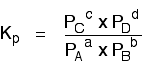
since each temperature value has its own dedicated Kc value. - 8Kp is used for gas systems. you can't use concentrations for gases easily, so partial pressure is used instead. what's the equation of Kp then?Where (Pc)^c is partial pressure of (product) C to the power of mols of C.
- 9Partial pressure of [A] is equivalent to fraction of total pressure which A is responsible for. {(Total pressure)x(Mol(A)/total.Mol)}we assume that any gas (big or small) molecule exerts the same pressure as any other gas molecule in the same quantity.
- 10Brønsted–Lowry theory acid is anything that gives out H+ base is anything that accepts H+Salt of what-used-to-be-weak-acid can act as a base and accept protons
similarly, what-used-to-be-base can release the H+ and act as an acid - 11pH (Power of hydrogen [H+]x10^pH) -log[H+] = pHwater can dissociate into H+ and OH-
we are only concerned about the H+
usual concentration of H+ in pure water is 0.0000001 mol/dm^3
(thats 1x10^7, which is pH=7) - 12what's the pH of the following [H+] concentrations? 0.000001 0.00001 0.001 0.1 1.0 10.0 .6
5
3
1
0
-1
-log(weight of the protons/their volume dm^3) - 13temprfgssggs
- 14The last peak in TOF Spectrometer of a molecule shows what?Last M/Z number IS the total relative mass for the molecule.
- 15You'll need to know the reactions of Nitrotuolene. This is mostly for organic reactions section, but it is a common conversion.Tin metal Sn donates electrons and HCl donates protons. Reacting these with -NO2 group changes it to -NH2 group. This reaction requires 7e- and 6H+. Mechanism not required, imagine it like a porridge reacting- a mess.
- 16Get to know Organic reactions, make reactants your friends, and you'll ace organic test questions.Carbonate- test for acid (CO2)
Tollens silver mirror for aldehydes - 17I hope you remember ∆H you'll need some strength if you don't. Define ∆Hf∆Hf - enthalpy change when 1mol of compound is made from its elements in their standard states.
there are more of these... - 18∆H -general change of energy stored in bonds ∆Hc - when 1mol of [x] is completely burnt in excess O2 ∆Hf - when 1mol of [x] is made from its elements in their standard states ∆Hat - when 1 mol standard state [x] is converted to 1mol geseous [x] ∆Hd - when 1mol worth of covalent bonds is broken∆Hi - when 1mol of e- is made from 1mol of gaseous [x]
∆Hea - when 1mol gaseous [x] becomes 1mol gaseous [x]1- (by absorbing electrons)
∆Hl (formation) - when 1mol of ion lattice is made from its charged gaseous components.
∆Hhyd - 1mol of gaseous [x] is completely hydrated by water (link to metal complex ions)
∆Hsol - 1mol of solid dissolved completely in water
Informationen
- Beschreibung
- Selection of A2 flashcards for AQA Chemistry including concepts, questions, key words etc. Work in progress until 2017 exams.
- Erstellt von
- Maxim Korvatskyy
- Aufrufe
- 39
- Tags
- Bewertung