
Karteikarten
3.4.5: Managing inventory and supply chains
Karten in diesem Stapel (14)
- 1Factors Affecting Choice of Supplier:-costs (low price but be wary of poor quality)
-payment terms (cash flow)
-quality
-capacity
-reliability
-frequency of supply
-flexibility - 2Causes of Sale Level Fluctuations:-health/product publicity
-trends
-income levels
-reputation/brand
-legislation
-advertising/marketing
-interest rates
-pricing
-competition
-external conditions e.g. weather/environmental issues - 3If Demand is Less Than Supply:business has spare capacity as they are producing too much and no one is buying
-sell assets
-change to shorter working weeks or days
-lay off workers
-transfer resources to another area
-increase demand - 4If Demand is More Than Supply:the business is unable to produce enough to meet customer demand
-extend factories
-use overtime/longer hours
-hire new/more staff
-flexible workforce
-part time or temporary staff (e.g. Christmas jobs) - 5Other Methods of Matching Supply With Demand:-subcontracting/outsourcing
-producing to order/mass customisation - 6Subcontracting/Outsourcing:*when a business asks another to make all/part of its product
-allows reduction of costs and capacity without reducing supply
-allow the other business to increase capacity - 7Subcontracting/Outsourcing: (Advantages/Disadvantages)Advantages:
-businesses can react to change in demand quickly
-specialiation could be applicable
-easier to achieve non-standard orders as it doesn't disrupt production line
Disadvantages:
-no direct control over quality
-too much of it could damage operations base
-profit margins may be affected as producers also have to make a profit
-patents may have to be shared with subcontractor - 8Producing to Order & Mass Customisation:-producing to order: decide whether to take on non-standard orders e.g. Katie Price's pink Land Rover
-mass customisation: matching the product to customers needs/wants but on a mass scale e.g. Land Rover Evoque (mass making reduces costs as there are large quantities -> lower unit cost) - 9Producing to Order & Mass Customisation: (Factors affecting choice)-effect on production
-flexibility of organisation
-impact on costs
-effect on staff - 10Producing to Order & Mass Customisation: (Advantages/Disadvantages)Advantages:
-keeping up with competition
-flexible to change
-expand customer base
-expand product range
-USP
Disadvantages:
-unit cost might increase
-customers may go elsewhere if cheaper
-productivity might lower if production takes longer
-brand value/image issues - 11Influences on Amount of Stock Held:-demand
-type of business
-nature of product
-price of final product
-cash flow
-flexibility of supplier
-bulk purchasing deals being available
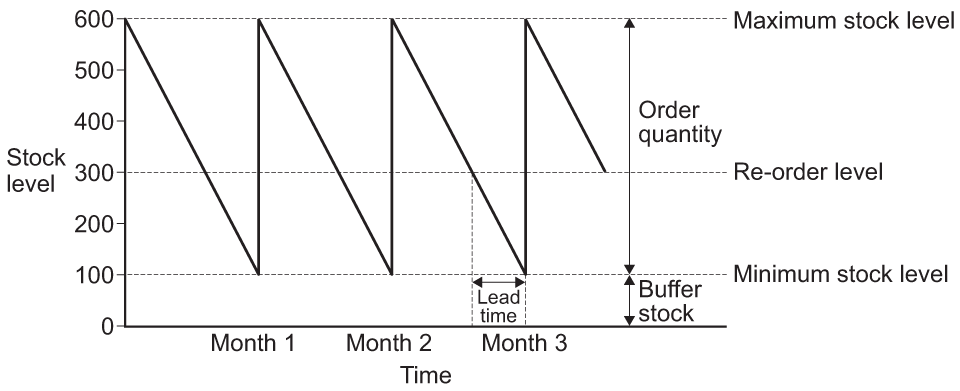
-production method - 12Inventory Stock Control Charts:-lead times: as short as possible
-buffer stock: as close to zero to avoid warehousing costs
-re-order level: almost at zero to reduce stock costs and only re-order what is needed - 13Inventory Stock Control Charts:*a chart that shows:
-lead times (time taken between order and delivery to factory)
-re-order levels (the point at which stock is re-ordered)
-buffer level of inventory (minimum stock level as a just in case)
-maximum stock level (maximum the firm will hold)
-re-order quantities (how much stock is re-ordered) - 14JIT: (Advantages/Disadvantages)Advantages:
-less wastage
-minimal storage costs
-cash flow advantage (as not buying stock before it is used)
-fresher produce (quality)
Disadvantages:
-supplier dependent
-waste of resources if production is idle
-bad reputation if cannot supply customer
-inflexibility to match demand
-lack of ability to bulk buy (cost saving)
-frequent deliveries
Informationen
- Beschreibung
- A level Business Studies (3.4: Decision making to improve operational performance) Karteikarten am 3.4.5: Managing inventory and supply chains, erstellt von Ashleigh-Jade Jones am 24/05/2017.
- Erstellt von
- Ashleigh-Jade Jones
- Aufrufe
- 20
- Bewertung