
Flussdiagramm
CRIM PRO Search
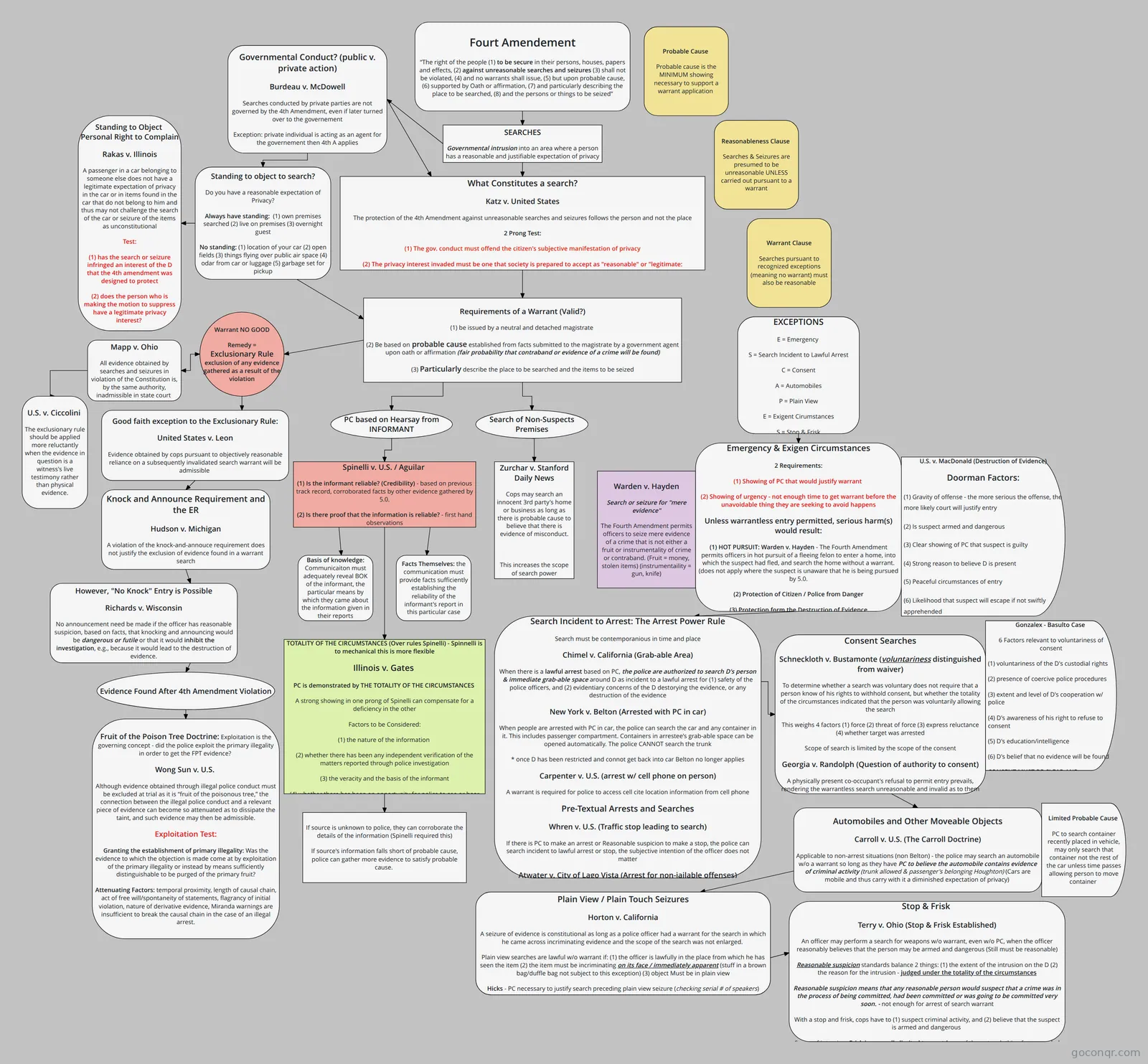
Flowchart: Fourth Amendment search and probable cause
Inhalt des Flussdiagramms
Fourt Amendement
“The right of the people (1) to be secure in their persons, houses, papers and effects, (2) against unreasonable searches and seizures (3) shall not be violated, (4) and no warrants shall issue, (5) but upon probable cause, (6) supported by Oath or affirmation, (7) and particularly describing the place to be searched, (8) and the persons or things to be seized”
Reasonableness Clause
Searches & Seizures are presumed to be unreasonable UNLESS carried out pursuant to a warrant
Warrant Clause
Searches pursuant to recognized exceptions (meaning no warrant) must also be reasonable
Probable Cause
Probable cause is the MINIMUM showing necessary to support a warrant application
SEARCHES
Governmental intrusion into an area where a person has a reasonable and justifiable expectation of privacy
What Constitutes a search?
Katz v. United States
The protection of the 4th Amendment against unreasonable searches and seizures follows the person and not the place
2 Prong Test:
(1) The gov. conduct must offend the citizen's subjective manifestation of privacy
(2) The privacy interest invaded must be one that society is prepared to accept as "reasonable" or "legitimate:
Spinelli v. U.S. / Aguilar
(1) Is the informant reliable? (Credibility) - based on previous track record, corroborated facts by other evidence gathered by 5.0.
(2) Is there proof that the information is reliable? - first hand observations
Basis of knowledge: Communicaiton must adequately reveal BOK of the informant, the particular means by which they came about the information given in their reports
Facts Themselves: the communication must provide facts sufficiently establishing the reliability of the informant's report in this particular case
TOTALITY OF THE CIRCUMSTANCES (Over rules Spinelli) - Spinnelli is to mechanical this is more flexible
Illinois v. Gates
PC is demonstrated by THE TOTALITY OF THE CIRCUMSTANCES
A strong showing in one prong of Spinelli can compensate for a deficiency in the other
Factors to be Considered:
(1) the nature of the information
(2) whether there has been any independent verification of the matters reported through police investigation
(3) the veracity and the basis of the informant
(4) whether there has been an opportunity for police to see or hear the matter reported
Warden v. Hayden
Search or seizure for "mere evidence"
The Fourth Amendment permits officers to seize mere evidence of a crime that is not either a fruit or instrumentality of crime or contraband. (Fruit = money, stolen items) (instrumentaility = gun, knife)
PC based on Hearsay from INFORMANT
Search of Non-Suspects Premises
Zurchar v. Stanford Daily News
Cops may search an innocent 3rd party's home or business as long as there is probable cause to believe that there is evidence of misconduct.
This increases the scope of search power
Requirements of a Warrant (Valid?)
(1) be issued by a neutral and detached magistrate
(2) Be based on probable cause established from facts submitted to the magistrate by a government agent upon oath or affirmation (fair probability that contraband or evidence of a crime will be found)
(3) Particularly describe the place to be searched and the items to be seized
EXCEPTIONS
E = Emergency
S = Search Incident to Lawful Arrest
C = Consent
A = Automobiles
P = Plain View
E = Exigent Cirumstances
S = Stop & Frisk
Emergency & Exigen Circumstances
2 Requirements:
(1) Showing of PC that would justify warrant
(2) Showing of urgency - not enough time to get warrant before the unavoidable thing they are seeking to avoid happens
Unless warrantless entry permitted, serious harm(s) would result:
(1) HOT PURSUIT: Warden v. Hayden - The Fourth Amendment permits officers in hot pursuit of a fleeing felon to enter a home, into which the suspect had fled, and search the home without a warrant. (does not apply where the suspect is unaware that he is being pursued by 5.0.
(2) Protection of Citizen / Police from Danger
(3) Protection form the Destruction of Evidence
U.S. v. MacDonald (Destruction of Evidence)
Doorman Factors:
(1) Gravity of offense - the more serious the offense, the more likely court will justify entry
(2) Is suspect armed and dangerous
(3) Clear showing of PC that suspect is guilty
(4) Strong reason to believe D is present
(5) Peaceful circumstances of entry
(6) Likelihood that suspect will escape if not swiftly apprehended
Search Incident to Arrest: The Arrest Power Rule
Search must be contemporanious in time and place
Chimel v. California (Grab-able Area)
When there is a lawful arrest based on PC, the police are authorized to search D's person & immediate grab-able space around D as incident to a lawful arrest for (1) safety of the police officers, and (2) evidentiary concerns of the D destorying the evidence, or any destruction of the evidence
New York v. Belton (Arrested with PC in car)
When people are arrested with PC in car, the police can search the car and any container in it. This includes passenger compartment. Containers in arrestee's grab-able space can be opened automatically. The police CANNOT search the trunk
* once D has been restricted and connot get back into car Belton no longer applies
Carpenter v. U.S. (arrest w/ cell phone on person)
A warrant is required for police to access cell cite location information from cell phone
Pre-Textual Arrests and Searches
Whren v. U.S. (Traffic stop leading to search)
If there is PC to make an arrest or Reasonable suspicion to make a stop, the police can search incident to lawful arrest or stop, the subjective intention of the officer does not matter
Atwater v. City of Lago Vista (Arrest for non-jailable offenses)
The probable cause standard applies to all arrests, without a need to balance the interests and circumstances involved in particular situations.
Consent Searches
Schneckloth v. Bustamonte (voluntariness distinguished from waiver)
To determine whether a search was voluntary does not require that a person know of his rights to withhold consent, but whether the totality of the circumstances indicated that the person was voluntarily allowing the search
This weighs 4 factors (1) force (2) threat of force (3) express reluctance (4) whether target was arrested
Scope of search is limited by the scope of the consent
Georgia v. Randolph (Question of authority to consent)
A physically present co-occupant's refusal to permit entry prevails, rendering the warrantless search unreasonable and invalid as to them
Gonzalex - Basulto Case
6 Factors relevant to voluntariness of consent
(1) voluntariness of the D's custodial rights
(2) presence of coercive police procedures
(3) extent and level of D's cooperation w/ police
(4) D's awareness of his right to refuse to consent
(5) D's education/intelligence
(6) D's belief that no evidence will be found
CONSENT MUST BE CLEAR AND UNEQUIOCAL
Automobiles and Other Moveable Objects
Carroll v. U.S. (The Carroll Doctrine)
Applicable to non-arrest situations (non Belton) - the police may search an automobile w/o a warrant so long as they have PC to believe the automobile contains evidence of criminal activity (trunk allowed & passenger's belonging Houghton) (Cars are mobile and thus carry with it a diminished expectation of privacy)
Plain View / Plain Touch Seizures
Horton v. California
A seizure of evidence is constitutional as long as a police officer had a warrant for the search in which he came across incriminating evidence and the scope of the search was not enlarged.
Plain view searches are lawful w/o warrant if: (1) the officer is lawfully in the place from which he has seen the item (2) the item must be incriminating on its face / immediately apparent (stuff in a brown bag/duffle bag not subject to this exception) (3) object Must be in plain view
Hicks - PC necessary to justify search preceding plain view seizure (checking serial # of speakers)
Governmental Conduct? (public v. private action)
Burdeau v. McDowell
Searches conducted by private parties are not governed by the 4th Amendment, even if later turned over to the governement
Exception: private individual is acting as an agent for the governement then 4th A applies
Standing to object to search?
Do you have a reasonable expectation of Privacy?
Always have standing: (1) own premises searched (2) live on premises (3) overnight guest
No standing: (1) location of your car (2) open fields (3) things flying over public air space (4) odar from car or luggage (5) garbage set for pickup
Good faith exception to the Exclusionary Rule:
United States v. Leon
Evidence obtained by cops pursuant to objectively reasonable reliance on a subsequently invalidated search warrant will be admissible
Warrant NO GOOD
Remedy = Exclusionary Rule exclusion of any evidence gathered as a result of the violation
Stop & Frisk
Terry v. Ohio (Stop & Frisk Established)
An officer may perform a search for weapons w/o warrant, even w/o PC, when the officer reasonably believes that the person may be armed and dangerous (Still must be reasonable)
Reasonable suspicion standards balance 2 things: (1) the extent of the intrusion on the D (2) the reason for the intrusion - judged under the totality of the circumstances
Reasonable suspicion means that any reasonable person would suspect that a crime was in the process of being committed, had been committed or was going to be committed very soon. - not enough for arrest of search warrant
With a stop and frisk, cops have to (1) suspect criminal activity, and (2) believe that the suspect is armed and dangerous
Scope of intrusion: Frisk is generally limited to a patdown of the outer clothing for concealed instruments of assault. Police officer cannot manipulate feeling - outside exception
Mapp v. Ohio
All evidence obtained by searches and seizures in violation of the Constitution is, by the same authority, inadmissible in state court
Knock and Announce Requirement and the ER
Hudson v. Michigan
A violation of the knock-and-annouce requirement does not justify the exclusion of evidence found in a warrant search
Standing to Object
Personal Right to Complain
Rakas v. Illinois
A passenger in a car belonging to someone else does not have a legitimate expectation of privacy in the car or in items found in the car that do not belong to him and thus may not challenge the search of the car or seizure of the items as unconstitutional
Test:
(1) has the search or seizure infringed an interest of the D that the 4th amendment was designed to protect
(2) does the person who is making the motion to suppress have a legitimate privacy interest?
Evidence Found After 4th Amendment Violation
Fruit of the Poison Tree Doctrine: Exploitation is the governing concept - did the police exploit the primary illegality in order to get the FPT evidence?
Wong Sun v. U.S.
Although evidence obtained through illegal police conduct must be excluded at trial as it is “fruit of the poisonous tree,” the connection between the illegal police conduct and a relevant piece of evidence can become so attenuated as to dissipate the taint, and such evidence may then be admissible.
Exploitation Test:
Granting the establishment of primary illegality: Was the evidence to which the objection is made come at by exploitation of the primary illegality or instead by means sufficiently distinguishable to be purged of the primary fruit?
Attenuating Factors: temporal proximity, length of causal chain, act of free will/spontaneity of statements, flagrancy of initial violation, nature of derivative evidence, Miranda warnings are insufficient to break the causal chain in the case of an illegal arrest.
However, "No Knock" Entry is Possible
Richards v. Wisconsin
No announcement need be made if the officer has reasonable suspicion, based on facts, that knocking and announcing would be dangerous or futile or that it would inhibit the investigation, e.g., because it would lead to the destruction of evidence.
If source is unknown to police, they can corroborate the details of the information (Spinelli required this)
If source's information falls short of probable cause, police can gather more evidence to satisfy probable cause.
U.S. v. Ciccolini
The exclusionary rule should be applied more reluctantly when the evidence in question is a witness's live testimony rather than physical evidence.
Limited Probable Cause
PC to search container recently placed in vehicle, may only search that container not the rest of the car unless time passes allowing person to move container
Informationen
- Beschreibung
- Law Flussdiagramm am CRIM PRO Search, erstellt von Matthew Nunez am 05/12/2020.
- Erstellt von
- Matthew Nunez
- Aufrufe
- 0
- Bewertung