
Mindmap
Narrative
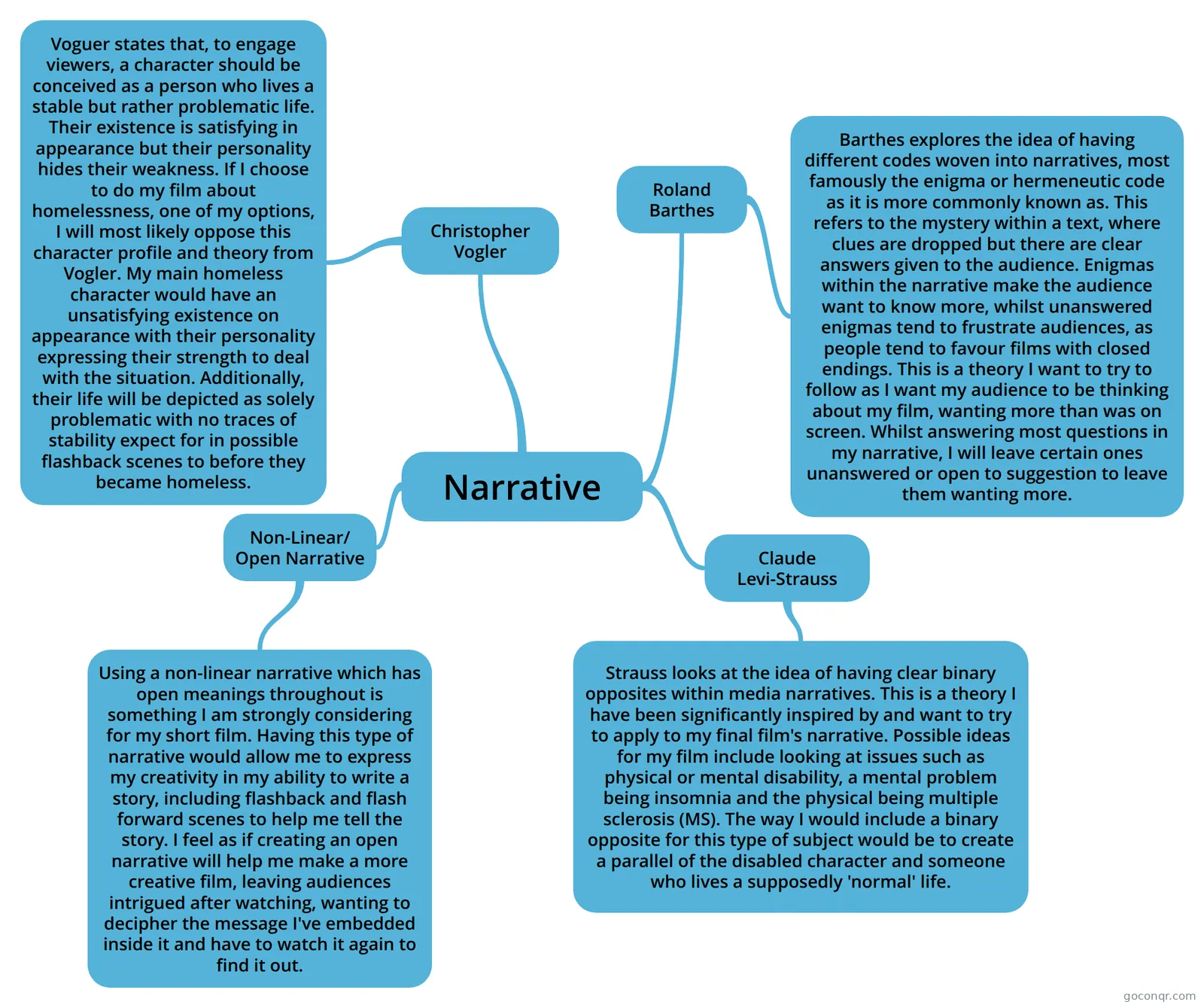
Mind map: Narrative theory for film
Inhalt der Mindmap
Narrative
Claude Levi-Strauss
- Strauss looks at the idea of having clear binary opposites within media narratives. This is a theory I have been significantly inspired by and want to try to apply to my final film's narrative. Possible ideas for my film include looking at issues such as physical or mental disability, a mental problem being insomnia and the physical being multiple sclerosis (MS). The way I would include a binary opposite for this type of subject would be to create a parallel of the disabled character and someone who lives a supposedly 'normal' life.
Non-Linear/ Open Narrative
- Using a non-linear narrative which has open meanings throughout is something I am strongly considering for my short film. Having this type of narrative would allow me to express my creativity in my ability to write a story, including flashback and flash forward scenes to help me tell the story. I feel as if creating an open narrative will help me make a more creative film, leaving audiences intrigued after watching, wanting to decipher the message I've embedded inside it and have to watch it again to find it out.
Roland Barthes
- Barthes explores the idea of having different codes woven into narratives, most famously the enigma or hermeneutic code as it is more commonly known as. This refers to the mystery within a text, where clues are dropped but there are clear answers given to the audience. Enigmas within the narrative make the audience want to know more, whilst unanswered enigmas tend to frustrate audiences, as people tend to favour films with closed endings. This is a theory I want to try to follow as I want my audience to be thinking about my film, wanting more than was on screen. Whilst answering most questions in my narrative, I will leave certain ones unanswered or open to suggestion to leave them wanting more.
Christopher Vogler
- Voguer states that, to engage viewers, a character should be conceived as a person who lives a stable but rather problematic life. Their existence is satisfying in appearance but their personality hides their weakness. If I choose to do my film about homelessness, one of my options, I will most likely oppose this character profile and theory from Vogler. My main homeless character would have an unsatisfying existence on appearance with their personality expressing their strength to deal with the situation. Additionally, their life will be depicted as solely problematic with no traces of stability expect for in possible flashback scenes to before they became homeless.
Informationen
- Beschreibung
- Digital Media Mindmap am Narrative, erstellt von Eoin O'Hagan am 22/09/2017.
- Erstellt von
- Eoin O'Hagan
- Aufrufe
- 3
- Bewertung