
Mindmap
C2.2 How Structure Influences The Properties And Uses Of Substances
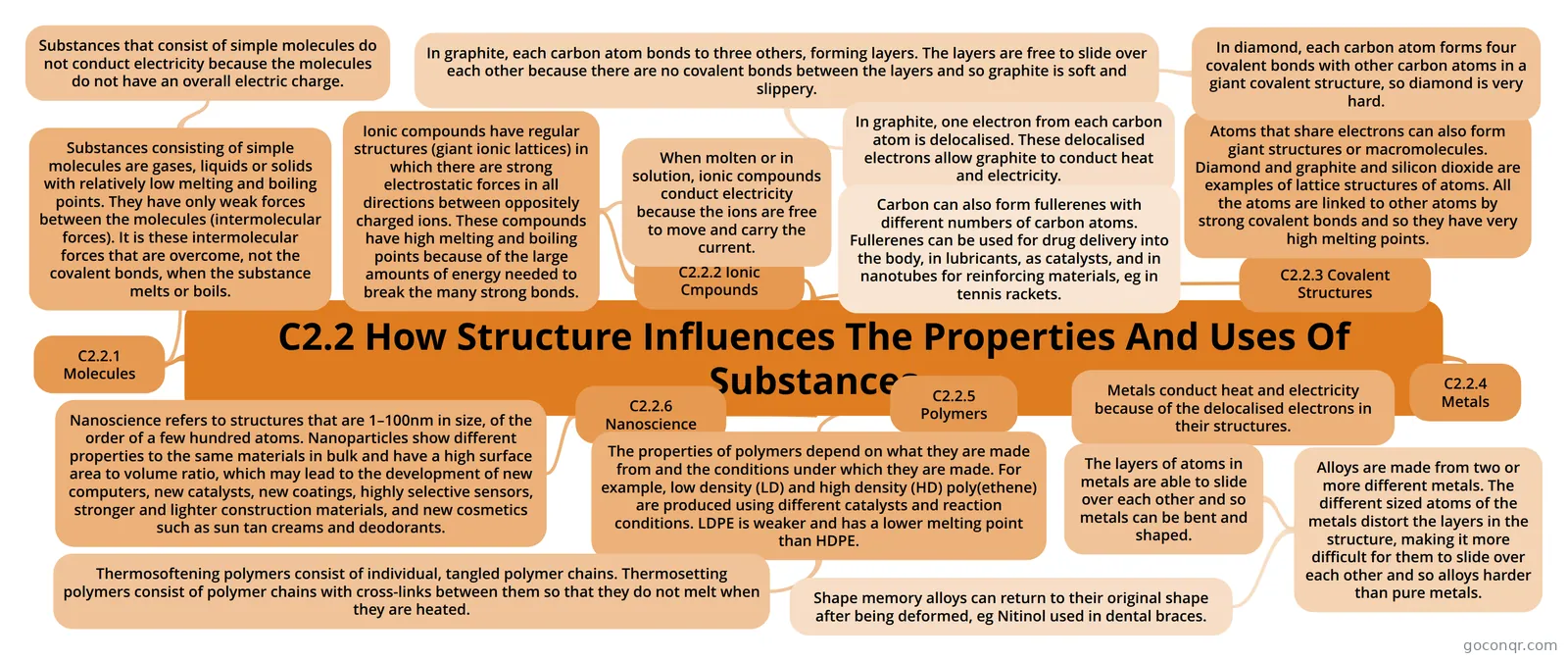
Mind map: how structure influences properties and uses of substances
Inhalt der Mindmap
C2.2 How Structure Influences The Properties And Uses Of Substances
C2.2.1 Molecules
- Substances consisting of simple molecules are gases, liquids or solids with relatively low melting and boiling points. They have only weak forces between the molecules (intermolecular forces). It is these intermolecular forces that are overcome, not the covalent bonds, when the substance melts or boils.
- Substances that consist of simple molecules do not conduct electricity because the molecules do not have an overall electric charge.
- Substances consisting of simple molecules are gases, liquids or solids with relatively low melting and boiling points. They have only weak forces between the molecules (intermolecular forces). It is these intermolecular forces that are overcome, not the covalent bonds, when the substance melts or boils.
C2.2.2 Ionic Cmpounds
- Ionic compounds have regular structures (giant ionic lattices) in which there are strong electrostatic forces in all directions between oppositely charged ions. These compounds have high melting and boiling points because of the large amounts of energy needed to break the many strong bonds.
- When molten or in solution, ionic compounds conduct electricity because the ions are free to move and carry the current.
- Ionic compounds have regular structures (giant ionic lattices) in which there are strong electrostatic forces in all directions between oppositely charged ions. These compounds have high melting and boiling points because of the large amounts of energy needed to break the many strong bonds.
C2.2.3 Covalent Structures
- Atoms that share electrons can also form giant structures or macromolecules. Diamond and graphite and silicon dioxide are examples of lattice structures of atoms. All the atoms are linked to other atoms by strong covalent bonds and so they have very high melting points.
- In diamond, each carbon atom forms four covalent bonds with other carbon atoms in a giant covalent structure, so diamond is very hard.
- In graphite, each carbon atom bonds to three others, forming layers. The layers are free to slide over each other because there are no covalent bonds between the layers and so graphite is soft and slippery.
- In graphite, one electron from each carbon atom is delocalised. These delocalised electrons allow graphite to conduct heat and electricity.
- Carbon can also form fullerenes with different numbers of carbon atoms. Fullerenes can be used for drug delivery into the body, in lubricants, as catalysts, and in nanotubes for reinforcing materials, eg in tennis rackets.
- In graphite, one electron from each carbon atom is delocalised. These delocalised electrons allow graphite to conduct heat and electricity.
- In graphite, each carbon atom bonds to three others, forming layers. The layers are free to slide over each other because there are no covalent bonds between the layers and so graphite is soft and slippery.
- In diamond, each carbon atom forms four covalent bonds with other carbon atoms in a giant covalent structure, so diamond is very hard.
- Atoms that share electrons can also form giant structures or macromolecules. Diamond and graphite and silicon dioxide are examples of lattice structures of atoms. All the atoms are linked to other atoms by strong covalent bonds and so they have very high melting points.
C2.2.4 Metals
- Metals conduct heat and electricity because of the delocalised electrons in their structures.
- The layers of atoms in metals are able to slide over each other and so metals can be bent and shaped.
- Alloys are made from two or more different metals. The different sized atoms of the metals distort the layers in the structure, making it more difficult for them to slide over each other and so alloys harder than pure metals.
- Shape memory alloys can return to their original shape after being deformed, eg Nitinol used in dental braces.
- Alloys are made from two or more different metals. The different sized atoms of the metals distort the layers in the structure, making it more difficult for them to slide over each other and so alloys harder than pure metals.
- The layers of atoms in metals are able to slide over each other and so metals can be bent and shaped.
- Metals conduct heat and electricity because of the delocalised electrons in their structures.
C2.2.5 Polymers
- The properties of polymers depend on what they are made from and the conditions under which they are made. For example, low density (LD) and high density (HD) poly(ethene) are produced using different catalysts and reaction conditions. LDPE is weaker and has a lower melting point than HDPE.
- Thermosoftening polymers consist of individual, tangled polymer chains. Thermosetting polymers consist of polymer chains with cross-links between them so that they do not melt when they are heated.
- The properties of polymers depend on what they are made from and the conditions under which they are made. For example, low density (LD) and high density (HD) poly(ethene) are produced using different catalysts and reaction conditions. LDPE is weaker and has a lower melting point than HDPE.
C2.2.6 Nanoscience
- Nanoscience refers to structures that are 1–100nm in size, of the order of a few hundred atoms. Nanoparticles show different properties to the same materials in bulk and have a high surface area to volume ratio, which may lead to the development of new computers, new catalysts, new coatings, highly selective sensors, stronger and lighter construction materials, and new cosmetics such as sun tan creams and deodorants.
Informationen
- Beschreibung
- GCSE Chemistry (C2) Mindmap am C2.2 How Structure Influences The Properties And Uses Of Substances, erstellt von killthemoment am 25/07/2014.
- Erstellt von
- killthemoment
- Aufrufe
- 272
- Tags
- Bewertung