
Mindmap
Maths
Inhalt der Mindmap
Maths
HCF and LCM
- Find the HCF of 12 and !5..
- Factors are the number that go into a number therefore the factors of 12 and 15 are:
- 12- 1, 2, 3, 4, 6 &12
- 15- 1, 3, 5 & 15
- Therefore the HCF of 12 and 15 is 3
- Factors are the number that go into a number therefore the factors of 12 and 15 are:
- Find the LCM of 3 and 5
- The multiples of 3 and 5 are:
- 3- 3, 6, 9, 12, 15, 18, 21, 24, 27, 30
- 5- 5, 10, 15, 20, 25, 30, 35, 40, 45, 50
- Therefore the LCM of 3 and 5 is 15
- The multiples of 3 and 5 are:
- Find the HCF of 12 and !5..
Index Laws
- when multiplying something like 'x^3 x x^3'; we add the two powers together. Therefore the answer to this equation would be 'x^6'
- When dividing you subtract the powers for example 'x^6 / x^2' the answer will be 'x^4'
- '(x^4)^3 basically means x^4 x x^4 x x^4 adding all these together will make 'x^12' or another method would just be the power inside the bracket '4' times the power outside the bracket '3' which will also give you an answer of 'x^12'
- If the question says leave the answer in index form you do not change the answer you got for example the answer would just stay as '2^2'. However, if the question says 'work out the value of...' you would work out the answer for example if you got an answer '2^2' you would then have to work out the answer of this so in this case it would be '4'
- Symbol '^' means 'to the power of'
- Anything to the power of 0 = 1
- when multiplying something like 'x^3 x x^3'; we add the two powers together. Therefore the answer to this equation would be 'x^6'
Angles in a triangle
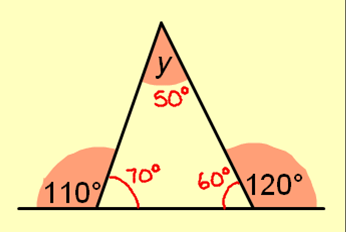
- Angles in a straight line add up to 180 degrees
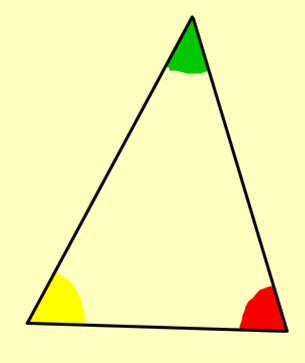
- Angles in a triangle always add up to 180
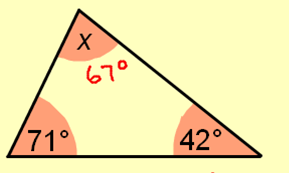
- If the two angles at the bottom are added together they make up '103'. I then know that 180 take away 103 is 67 meaning angle 'x' is 67 degrees.
- Here I know that angles on a straight line add up t0 180. Therefore for the first angle I take 110 away from 180 meaning my first angle is 70. For the second angle I take 120 away from 180 meaning my second angle is 60. 70 + 60 is 130. So angle y is 50 degrees
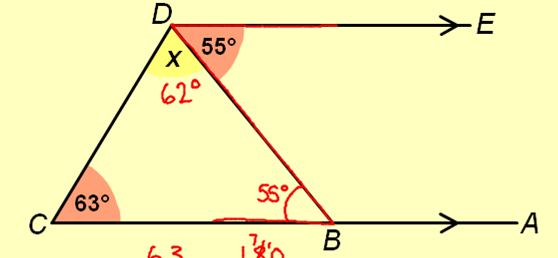
- Here we have an alternate angle so to get angle 'x' we need to work out angle B. B would be 55 degrees because it is an alternate angle. 63 + 55 is 118 so 180 - 118 gives me 62, therefore, angle 'x' is 62 degrees.
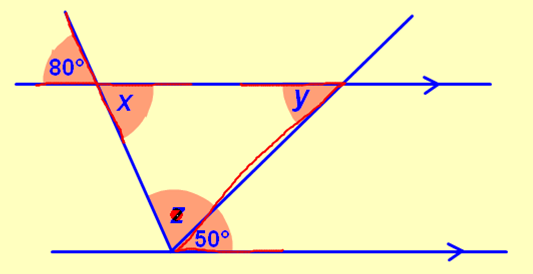
- Angle 'x' would be 80 degrees because vertically opposite angles are the same. Angle 'y' would be 50 degrees because alternate angles are the same. This means angle 'z' would be 50 degrees because 80 + 50 = 130 and 130 taken away from 180 is 50 degrees.
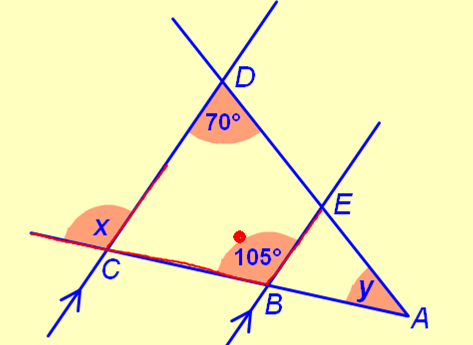
- In this triangle we can see a letter 'F' (highlighted in red) this shows a corresponding angle. This means angle 'x' is 105degrees because corresponding angles are the same.
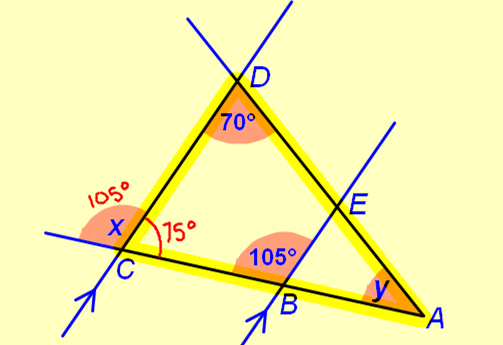
- I already know that angle 'x' is 105 degrees. I know that angles on a straight line add up to 180. 180 - 105 is 75 so the inside of the angle is 75 degrees. 75 + 70 is 145. To get angle 'y' I need to take 145 from 180 and I get 35. Therefore, angle 'y' is 35 degrees.
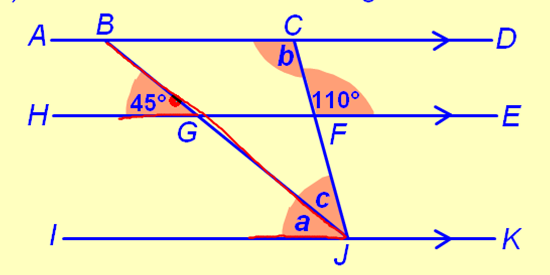
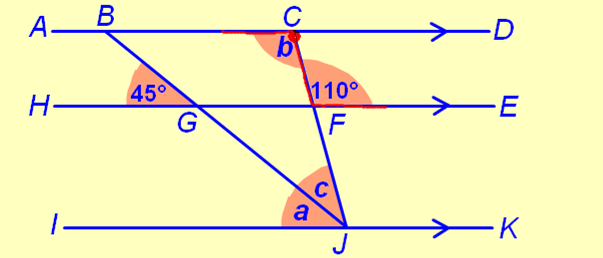
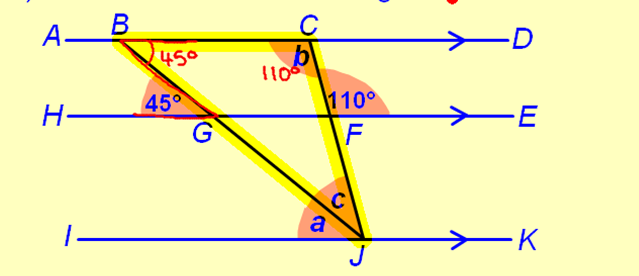
- To get angle 'a' we see that it is a corresponding angle so therefore angle 'a' will be 45 degrees.
- Angle 'b' would be 110 degrees because alternate angles are the same
- To get angle 'c' we already know that the first angle is 45 degrees because alternate angles are the same. We then know that angle 'b' is 110 because we already worked that out previously. 110 + 45 = 155, 180 - 155 = 25. Therefore, angle 'c' is 25 degrees.
- Angle 'b' would be 110 degrees because alternate angles are the same
Ratio
- How to write ratio in its simplest form
- For example if you want to write 15 : 25 in its simplest form you would find out the biggest number that goes into the two (in this case '5') and divide the two numbers by 5
- Therefore the ratio for 15 : 25 in its simplest form is 3 : 5
- For example if you want to write 15 : 25 in its simplest form you would find out the biggest number that goes into the two (in this case '5') and divide the two numbers by 5
- How to write ratio in its simplest form
Interior and Exterior angles
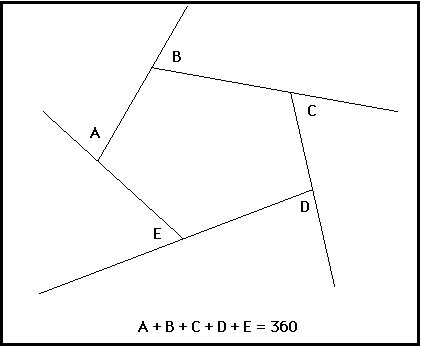
- Exterior angles
- Exterior angles are the angles outside of the triangle
- to find the exterior angle you need to divide 360 (because that's what all the angles will add up to) by the number of sides of the shape
- e.g. for this pentagon the exterior angles will be 360/ 5 which = 72 degrees
- to find the exterior angle you need to divide 360 (because that's what all the angles will add up to) by the number of sides of the shape
- Exterior angles are the angles outside of the triangle
- Interior angles
- Interior angles are the angles are the angles inside the shape
- to find the interior angle you need to do (number of sides - 2) then times that by 180 (because thatd what all the angles will add up to)
- e.g. for this hexagon the interior angles will be (6-2) which is 4, then 4 x 180 which is 720 for the total angle
- to find the interior angle you need to do (number of sides - 2) then times that by 180 (because thatd what all the angles will add up to)
- Interior angles are the angles are the angles inside the shape
- Exterior angles
Cumulative frequency
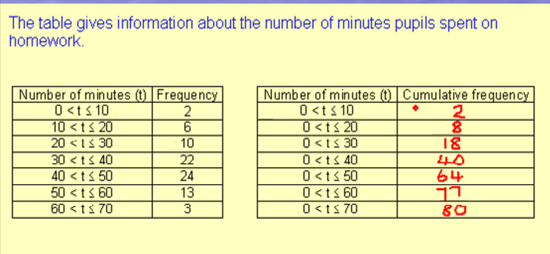
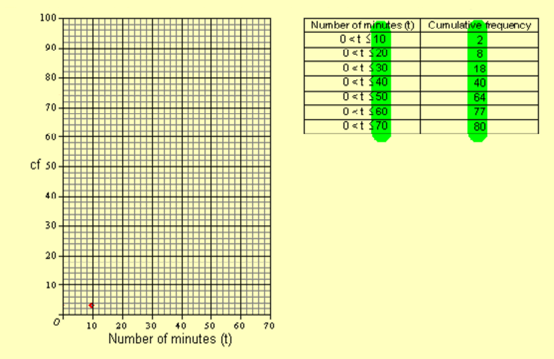
- to find cumulative frequency you need to add the frequency on each time like you see in the picture
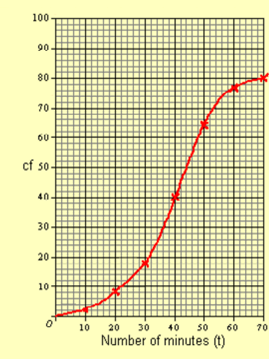
- When planting it on a scatter graph your graph would look something like this
- to do this you need to plot these numbers
Bilder und Dateien der Mindmap

Informationen
- Beschreibung
- Mindmap am Maths, erstellt von Ebony Street am 10/11/2014.
- Erstellt von
- Ebony Street
- Aufrufe
- 7
- Bewertung