
Mindmap
Trust - lecture 7
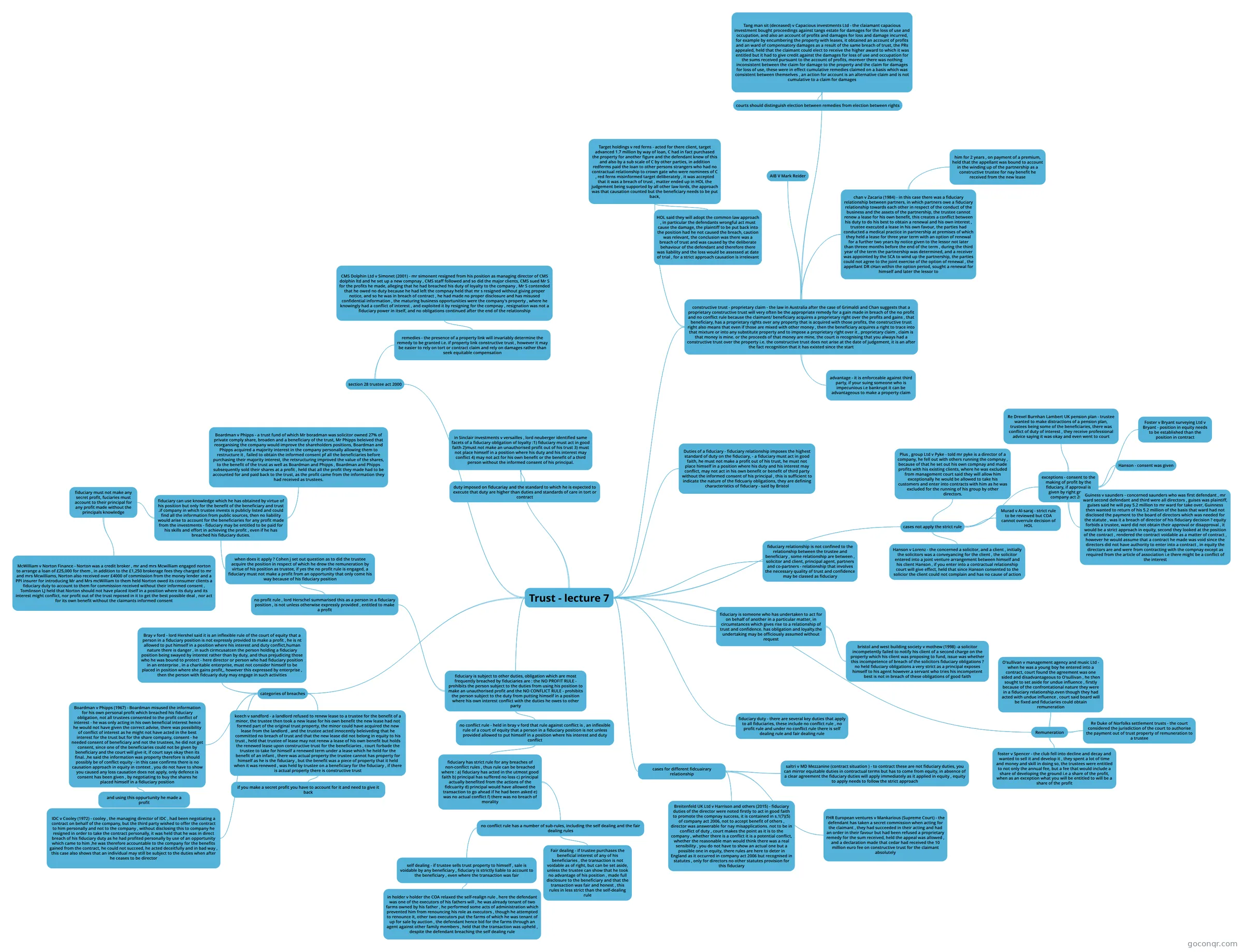
Mind map: Trust - lecture 7
Inhalt der Mindmap
Trust - lecture 7
fiduciary duty - there are several key duties that apply to all fiduciaries, these include no conflict rule , no profit rule and under no conflict rule there is self dealing rule and fair dealing rule
fiduciary is someone who has undertaken to act for on behalf of another in a particular matter, in circumstances which gives rise to a relationship of trust and confidence. has obligation and loyalty.the undertaking may be officiously assumed without request
- bristol and west building society v mothew (1998) -a solicitor incompetently failed to notify his client of a second charge on the property which his client was proposing to fund, issue was whether this incompetence of breach of the solicitors fiduciary obligations ? no held fiduciary obligations a very strict as a principal exposes himself to his agent however.a servant who tries his incompetent best is not in breach of these obligations of good faith
fiduciary relationship is not confined to the relationship between the trustee and beneficiary , some relationship are between , solicitor and client, principal agent, partners and co-partners - relationship that involves the necessary quality of trust and confidence may be classed as fiduciary
Duties of a fiduciary - fiduciary relationship imposes the highest standard of duty on the fiduciary, - a fiduciary must act in good faith, he must not make a profit out of his trust, he must not place himself in a position where his duty and his interest may conflict, may not act in his own benefit or benefit of third party without the informed consent of his principal , this is sufficient to indicate the nature of the fidcuariy obligations, they are defining characteristics of fiduciary - said by Bristol
in Sinclair investments v versailles , lord neuberger identified same facets of a fiduciary obligation of loyalty :1) fiduciary must act in good faith 2)must not make an unauthorised profit out of his trust 3) must not place himself in a position where his duty and his interest may conflict 4) may not act for his own benefit or the benefit of a third person without the informed consent of his principal.
- duty imposed on fiducariay and the standard to which he is expected to execute that duty are higher than duties and standards of care in tort or contract
fiduciary is subject to other duties, obligation which are most frequently breached by fiduciaries are : the NO PROFIT RULE - prohibits the person subject to the duties from using his position to make an unauthorised profit and the NO CONFLICT RULE - prohibits the person subject to the duty from putting himself in a position where his own interest conflict with the duties he owes to other party
- no conflict rule - held in bray v ford that rule against conflict is , an inflexible rule of a court of equity that a person in a fiduciary position is not unless provided allowed to put himself in a position where his interest and duty conflict
- fiduciary has strict rule for any breaches of non-conflict rules , thus rule can be breached where : a) fiduciary has acted in the utmost good faith b) principal has suffered no loss c) principal actually benefited from the actions of the fidcuarity d) principal would have allowed the transaction to go ahead if he had been asked e) was no actual conflict f) there was no breach of morality
- no conflict rule has a number of sub-rules, including the self dealing and the fair dealing rules
- self dealing - if trustee sells trust property to himself , sale is voidable by any beneficiary , fiduciary is strictly liable to account to the beneficiary , even where the transaction was fair
- in holder v holder the COA relaxed the self-realign rule , here the defendant was one of the executors of his fathers will , he was already tenant of two farms owned by his father , he performed some acts of administration which prevented him from renouncing his role as executors , though he attempted to renounce it, other two executors put the farms of which he was tenant of up for sale by auction , the defendant hence bid for the farms through an agent against other family members , held that the transaction was upheld , despite the defendant breaching the self dealing rule
- Fair dealing - if trustee purchases the beneficial interest of any of his beneficiaries , the transaction is not voidable as of right, but can be set aside, unless the trustee can show that he took no advantage of his position , made full disclosure to the beneficiary and that the transaction was fair and honest , this rules in less strict than the self-dealing rule
- self dealing - if trustee sells trust property to himself , sale is voidable by any beneficiary , fiduciary is strictly liable to account to the beneficiary , even where the transaction was fair
- no conflict rule has a number of sub-rules, including the self dealing and the fair dealing rules
- fiduciary has strict rule for any breaches of non-conflict rules , thus rule can be breached where : a) fiduciary has acted in the utmost good faith b) principal has suffered no loss c) principal actually benefited from the actions of the fidcuarity d) principal would have allowed the transaction to go ahead if he had been asked e) was no actual conflict f) there was no breach of morality
- no profit rule , lord Herschel summarised this as a person in a fiduciary position , is not unless otherwise expressly provided , entitled to make a profit
- when does it apply ? Cohen j set out question as to did the trustee acquire the position in respect of which he drew the remuneration by virtue of his position as trustee, if yes the no profit rule is engaged, a fiduciary must not make a profit from an opportunity that only come his way because of his fiduciary position
- fiduciary can use knowledge which he has obtained by virtue of his position but only for the benefit of the beneficiary and trust .if company in which trustee invests is publicly listed and could find all the information from public sources, then no liability would arise to account for the beneficiaries for any profit made from the investments - fiduciary may be entitled to be paid for his skills and effort in achieving the profit , even if he has breached his fiduciary duties.
- Boardman v Phipps - a trust fund of which Mr boradman was solicitor owned 27% of private comply share, broaden and a beneficiary of the trust, Mr Phipps beleived that reorganising the company would improve the shareholders positions, Boardman and Phipps acquired a majority interest in the company personally allowing them to restructure it , failed to obtain the informed consent pf all the beneficiaries before purchasing their majority interest, the retsructuring improved the value of the shares, to the benefit of the trust as well as Boardman and Phipps , Boardman and Phipps subsequently sold their shares at a profit , held that all the profit they made had to be accounted for and paid back to the trust, as the profit came from the information they had received as trustees.
- fiduciary must not make any secret profit, fuciaries must account to their principal for any profit made without the principals knowledge
- McWilliam v Norton Finance - Norton was a credit broker , mr and mrs Mcwilliam engaged norton to arrange a loan of £25,000 for them , in addition to the £1,250 brokerage fees they charged to mr and mrs Mcwilliams, Norton also received over £4000 of commission from the money lender and a PPI insurer for introducing Mr and Mrs mcWilliam to them held Norton owed its consumer clients a fiduciary duty to account to them for commission received without their informed consent , Tomlinson LJ held that Norton should not have placed itself in a position where its duty and its interest might conflict, nor profit out of the trust reposed in it to get the best possible deal , nor act for its own benefit without the claimants informed consent
- fiduciary can use knowledge which he has obtained by virtue of his position but only for the benefit of the beneficiary and trust .if company in which trustee invests is publicly listed and could find all the information from public sources, then no liability would arise to account for the beneficiaries for any profit made from the investments - fiduciary may be entitled to be paid for his skills and effort in achieving the profit , even if he has breached his fiduciary duties.
- when does it apply ? Cohen j set out question as to did the trustee acquire the position in respect of which he drew the remuneration by virtue of his position as trustee, if yes the no profit rule is engaged, a fiduciary must not make a profit from an opportunity that only come his way because of his fiduciary position
- no conflict rule - held in bray v ford that rule against conflict is , an inflexible rule of a court of equity that a person in a fiduciary position is not unless provided allowed to put himself in a position where his interest and duty conflict
cases for different fidcuairary relationship
- Breitenfeld UK Ltd v Harrison and others (2015) - fiduciary duties of the director were noted firstly to act in good faith to promote the compnay success, it is contained in s.1(7)(5) of company act 2006, not to accept benefit of others , director was answerable for nay misapplications. not to be in conflict of duty , court makes the point as it is to the company , whether there is a conflict it is a potential conflict, whether the reasonable man would think there was a real sensibility , you do not have to show an actual one but a possible one in equity, there rules are here to deter in England as it occurred in company act 2006 but recognised in statutes , only for directors no other statutes provision for this fiduciary
- saltri v MD Mezzanine (contract situation ) - to contract these are not fiduciary duties, you can mirror equitable duties in contractual terms but has to come from equity, in absence of a clear agreement the fiduciary duties will apply immediately as it applied in equity , equity to apply needs to follow the strict approach
- FHR European ventures v Mankarious (Supreme Court) - the defendant has taken a secret commission when acting for the claimant , they had succeeded in their acting and had an order in their favour but had been refused a proprietary remedy for the sum received, held the appeal was allowed , and a declaration made that cedar had received the 10 million euro fee on constructive trust for the claimant absolutely
categories of breaches
- keech v sandford - a landlord refused to renew lease to a trustee for the benefit of a minor, the trustee then took a new lease for his own benefit the new lease had not formed part of the original trust property, the minor could have acquired the new lease from the landlord , and the trustee acted innocently beleiveding that he committed no breach of trust and that the new lease did not belong in equity to his trust , held that trustee of lease may not renew a lease of his own benefit but holds the renewed lease upon constructive trust for the beneficiaries , court forbade the trustee to take for himself a renewed term under a lease which he held for the benefit of an infant , there was actual property the trustee cannot has property for himself as he is the fiduciary , but the benefit was a piece of property that it held when it was renewed , was held by trustee on a beneficiary for the fiduciary , if there is actual property there is constructive trust
- if you make a secret profit you have to account for it and need to give it back
- Bray v ford - lord Hershel said it is an inflexible rule of the court of equity that a person in a fiduciary position is not expressly provided to make a profit , he is nt allowed to put himself in a position where his interest and duty conflict,human nature there is danger , in such cirmcusatcen the person holding a fiduciary position being swayed by interest rather than by duty, and thus prejudicing those who he was bound to protect - here director or person who had fiduciary position in an enterprise , in a charitable enterprise, must not consider himself to be placed in position where she gains profit,, however this expressed by enterprise , then the person with fidcuariy duty may engage in such activities
- Boardman v Phipps (1967) - Boardman misused the information for his own personal profit which breached his fiduciary obligation, not all trustees consented to the profit conflict of interest - he was only acting in his own beneficial interest hence he would not have given the correct advise, there was possibility of conflict of interest as he might not have acted in the best interest for the trust but for the share company, consent - he needed consent of beneficiary and not the trustees, he did not get consent, since one of the beneficiaries could not be given by beneficiary and the court will give it, if court says okay then its final. ,he said the information was property therefore is should possibly be of conflict equity - in this case confirms there is no causation approach in equity in context , you do not have to show you caused any loss causation does not apply, only defence is consent has been given , by negotiating to buy the shares he placed himself in a fidiuciary position
- and using this oppurtunity he made a profit
- IDC v Cooley (1972) - cooley , the managing director of IDC , had been negotiating a contract on behalf of the company, but the third party wished to offer the contract to him personally and not to the company , without disclosing this to company he resigned in order to take the contract personally, it was held that he was in direct breach of his fiduciary duty as he had profited personally by use of an opportunity which came to him ,he was therefore accountable to the company for the benefits gained from the contract, he could not succeed, he acted deceitfully and in bad way , this case also shows that an individual may still be subject to the duties when after he ceases to be director
- keech v sandford - a landlord refused to renew lease to a trustee for the benefit of a minor, the trustee then took a new lease for his own benefit the new lease had not formed part of the original trust property, the minor could have acquired the new lease from the landlord , and the trustee acted innocently beleiveding that he committed no breach of trust and that the new lease did not belong in equity to his trust , held that trustee of lease may not renew a lease of his own benefit but holds the renewed lease upon constructive trust for the beneficiaries , court forbade the trustee to take for himself a renewed term under a lease which he held for the benefit of an infant , there was actual property the trustee cannot has property for himself as he is the fiduciary , but the benefit was a piece of property that it held when it was renewed , was held by trustee on a beneficiary for the fiduciary , if there is actual property there is constructive trust
cases not apply the strict rule
- Hanson v Lorenz - the concerned a solicitor, and a client , initially the solicitors was a conveyancing for the client , the solicitor entered into a joint venture arrangement between himself and his client Hanson , if you enter into a contractual relationship court will give effect, held that since Hanson consented to the solicior the client could not complain and has no cause of action
- Murad v Al-saraj - strict rule to be reviewed but COA cannot overrule decision of HOL
- Plus , group Ltd v Pyke - told mr pyke is a director of a company, he fell out with others running the compnay , because of that he set out his own compnay and made profits with his existing clients, where he was excluded from management court said they will allow him exceptionally he would be allowed to take his customers and enter into contracts with him as he was excluded for the running of his group by other directors.
- exceptions - consent to the making of profit by the fiduciary, if approval is given by right group company act 2006
- Re Drexel Burnhan Lambert UK pension plan - trustee wanted to make distractions of a pension plan, trustees being some of the beneficiaries, there was conflict of duty of interest , they receive professional advice saying it was okay and even went to court
- Hanson - consent was given
- Guiness v saunders - concerned saunders who was first defendant , mr ward second defendant and third were all directors , guises was plaintiff, guises said he will pay 5.2 million to mr ward for take over, Guinness then wanted to return of his 5.2 million of the basis that ward had not disclosed the payment to the board of directors which was needed for the statute , was it a breach of director of his fiduciary decision ? equity forbids a trustee, ward did not obtain their approval or disapproval , it would be a strict approach in equity, second they looked at the position of the contract , rendered the contract voidable as a matter of contract , however he would assume that a contract he made was void since the directors did not have authority to enter into a contract , in equity the directors are and were from contracting with the compnay except as required from the article of association i.e there might be a conflict of the interest
- Foster v Bryant surveying Ltd v Bryant - position in equity needs to be established than the position in contract
Remuneration
- O'sullivan v management agency and music Ltd - when he was a young boy he entered into a contract, court found the agreement was one sided and disadvantageous to O'sullivan , he then sought to set aside for undue influence , firstly because of the confrontational nature they were in a fiduciary relationship.even though they had acted with undue influence , court said board will be fixed and fiduciaries could obtain remuneration
- foster v Spencer - the club fell into decline and decay and wanted to sell it and develop it , they spent a lot of time and money and skill in doing so, the trustees were entitled to not only the annual fee, but a fee that would include a share of developing the ground i.e a share of the profit, when as an exception what you will be entitled to will be a share of the profit
- Re Duke of Norfolks settlement trusts - the court considered the jurisdiction of the court to authorise the payment out of trust property of remuneration to a trustee
section 28 trustee act 2000
- remedies - the presence of a property link will invariably determine the remedy to be granted i.e. if property link constructive trust , however it may be easier to rely on tort or contract claim and rely on damages rather than seek equitable compensation
- CMS Dolphin Ltd v Simonet (2001) - mr simonent resigned from his position as managing director of CMS dolphin ltd and he set up a new compnay , CMS staff followed and so did the major clients, CMS sued Mr S for the profits he made, alleging that he had breached his duty of loyalty to the company , Mr S contended that he owed no duty because he had left the compnay held that mr s resigned without giving proper notice, and so he was in breach of contract , he had made no proper disclosure and has misused confidential information , the maturing business opportunities were the company's property , where he knowingly had a conflict of interest , and exploited it by resigning for the compnay , resignation was not a fiduciary power in itself, and no obligations continued after the end of the relationship
- remedies - the presence of a property link will invariably determine the remedy to be granted i.e. if property link constructive trust , however it may be easier to rely on tort or contract claim and rely on damages rather than seek equitable compensation
constructive trust - proprietary claim - the law in Australia after the case of Grimaldi and Chan suggests that a proprietary constructive trust will very often be the appropriate remedy for a gain made in breach of the no profit and no conflict rule because the claimant/ beneficiary acquires a proprietary right over the profits and gains , that beneficiary, has a proprietary rights over any property that is acquired with those profits, the constructive trust right also means that even if those are mixed with other money , then the beneficiary acquires a right to trace into that mixture or into any substitute property and to impose a proprietary right over it , proprietary claim , claim is that money is mine. or the proceeds of that money are mine, the court is recognising that you always had a constructive trust over the property i.e. the constructive trust does not arise at the date of judgement, it is an after the fact recognition that it has existed since the start
- advantage - it is enforceable against third party, if your suing someone who is impecunious i.e bankrupt it can be advantageous to make a property claim
- chan v Zacaria (1984) - in this case there was a fiduciary relationship between partners, in which partners owe a fiduciary relationship towards each other in respect of the conduct of the business and the assets of the partnership, the trustee cannot renew a lease for his own benefit, this creates a conflict between his duty to do his best to obtain a renewal and his own interest , trustee executed a lease in his own favour, the parties had conducted a medical practice in partnership at premises of which they held a lease for three year term with an option of renewal for a further two years by notice given to the lessor not later than threee months before the end of the term , during the third year of the term the partnership was determined, and a receiver was appointed by the SCA to wind up the partnership, the parties could not agree to the joint exercise of the option of renewal , the appellant DR cHan within the option period, sought a renewal for himself and later the lessor to
- him for 2 years , on payment of a premium, held that the appellant was bound to account in the winding up of the partnership as a constructive trustee for nay benefit he received from the new lease
- Target holdings v red ferns - acted for there client, target advanced 1.7 million by way of loan, C had in fact purchased the property for another figure and the defendant knew of this and also by a sub scale of C by other parties, in addition redferms paid the loan to other persons strangers who had no contractual relationship to crown gate who were nominees of C , red ferns misinformed target deliberately , it was accepted that it was a breach of trust , matter ended up in HOL the judgement being supported by all other law lords, the approach was that causation counted but the beneficiary needs to be put back,
- HOL said they will adopt the common law approach , in particular the defendants wrongful act must cause the damage, the plaintiff to be put back into the position had he not caused the breach, caution was relevant, the conclusion was there was a breach of trust and was caused by the deliberate behaviour of the defendant and therefore there was liability and the loss would be assessed at date of trial , for a strict approach causation is irrelevant
- AIB V Mark Reider
- Tang man sit (deceased) v Capacious investments Ltd - the claiamant capacious investment bought proceedings against tangs estate for damages for the loss of use and occupation, and also an account of profits and damages for loss and damage incurred, for example by encumbering the property with leases, it obtained an account of profits and an ward of compensatory damages as a result of the same breach of trust, the PRs appealed, held that the claimant could elect to receive the higher award to which it was entitled but it had to give credit against the damages for loss of use and occupation for the sums received pursuant to the account of profits, morever there was nothing inconsistent between the claim for damage to the property and the claim for damages for loss of use, these were in effect cumulative remedies claimed on a basis which was consistent between themselves , an action for account is an alternative claim and is not cumulative to a claim for damages
- courts should distinguish election between remedies from election between rights
Informationen
- Beschreibung
- Law Mindmap am Trust - lecture 7, erstellt von Anika B am 21/12/2018.
- Erstellt von
- Anika B
- Aufrufe
- 2
- Bewertung