
Mindmap
quadratic
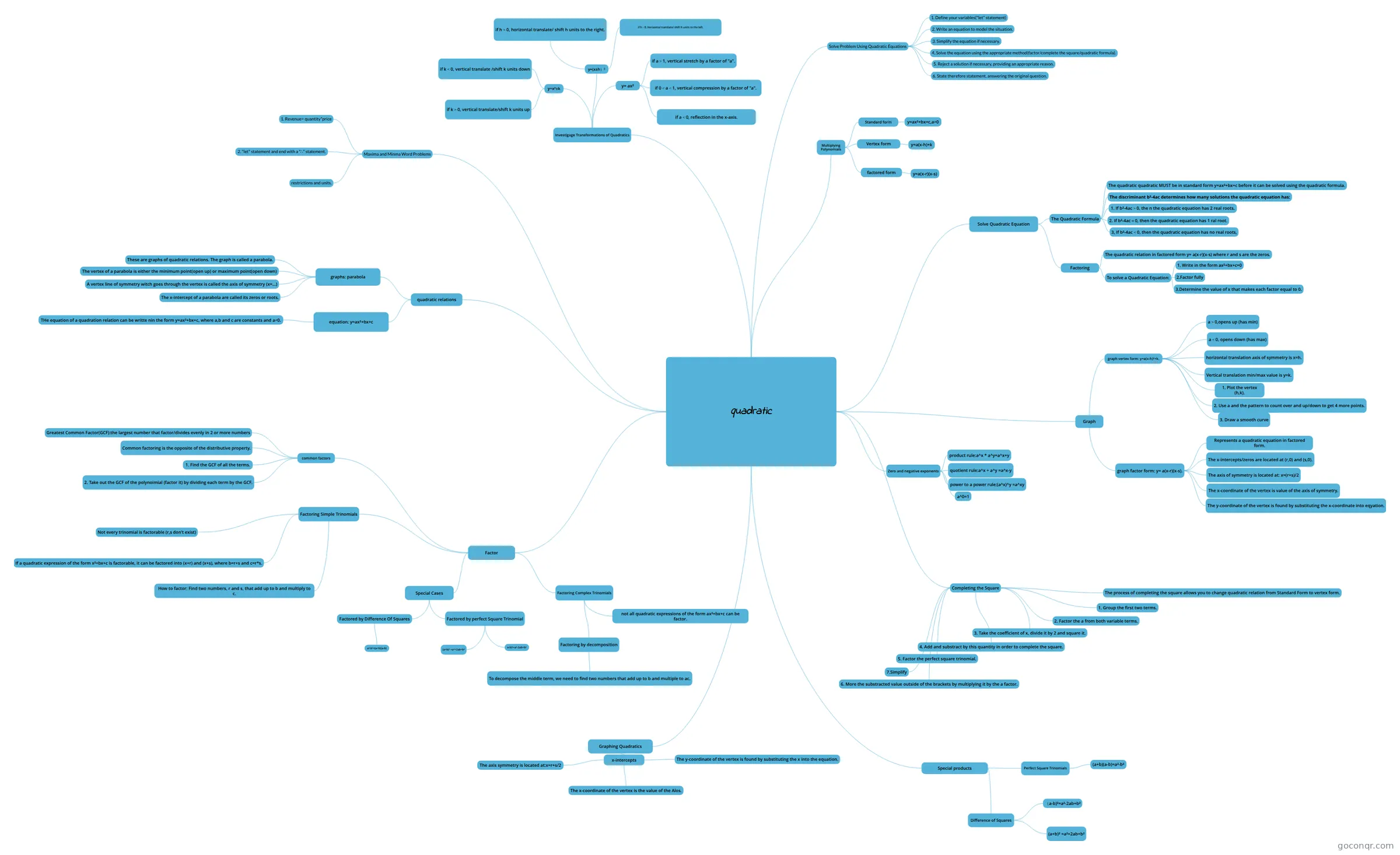
Mind map: Quadratic equations, factoring, and graphing
Inhalt der Mindmap
quadratic
Multiplying Polynomials
- Standard form
- y=ax²+bx+c,a≠0
- factored form
- y=a(x-r)(x-s)
- Vertex form
- y=a(x-h)+k
- Standard form
Investigage Transformations of Quadratics
- y=x²±k
- if k>0, vertical translate/shift k units up
- if k<0, vertical translate /shift k units down
- y=(x±h)²
- if h>0, horizontal translate/ shift h units to the right.
- if h<0, horizontal translate/ shift h units to the left.
- y= ax²
- if a>1, vertical stretch by a factor of "a".
- if 0<a<1, vertical compression by a factor of "a".
- if a<0, reflection in the x-axis.
- y=x²±k
Graph
- graph vertex form: y=a(x-h)²+k.
- a>0,opens up (has min)
- a<0, opens down (has max)
- horizontal translation axis of symmetry is x=h.
- Vertical translation min/max value is y=k.
- 1. Plot the vertex (h,k).
- 2. Use a and the pattern to count over and up/down to get 4 more points.
- 3. Draw a smooth curve
- graph factor form: y= a(x-r)(x-s).
- Represents a quadratic equation in factored form.
- The x-intercepts/zeros are located at (r,0) and (s,0).
- The axis of symmetry is located at: x=(r+s)/2
- The x-coordinate of the vertex is value of the axis of symmetry.
- The y-coordinate of the vertex is found by substituting the x-coordinate into eqyation.
- graph vertex form: y=a(x-h)²+k.
Zero and negative exponents
- product rule:a^x * a^y=a^x+y
- quotient rule:a^x ÷ a^y =a^x-y
- power to a power rule:(a^x)^y =a^xy
- a^0=1
Special products
- Perfect Square Trinomials
- (a+b)(a-b)=a²-b²
- Difference of Squares
- (a+b)² =a²+2ab+b²
- (a-b)²=a²-2ab+b²
- Perfect Square Trinomials
Factor
- common factors
- Greatest Common Factor(GCF):the largest number that factor/divides evenly in 2 or more numbers
- Common factoring is the opposite of the distributive property.
- 1. Find the GCF of all the terms.
- 2. Take out the GCF of the polynoimial (factor it) by dividing each term by the GCF.
- Factoring Simple Trinomials
- Not every trinomial is factorable (r,s don't exist)
- If a quadratic expression of the form x²+bx+c is factorable, it can be factored into (x+r) and (x+s), where b=r+s and c=r*s.
- How to factor: Find two numbers, r and s, that add up to b and multiply to c.
- Factoring Complex Trinomials
- Factoring by decomposition
- To decompose the middle term, we need to find two numbers that add up to b and multiple to ac.
- not all quadratic expressions of the form ax²+bx+c can be factor.
- Factoring by decomposition
- Special Cases
- Factored by Difference Of Squares
- a²-b²=(a+b)(a-b)
- Factored by perfect Square Trinomial
- (a+b)² =a²+2ab+b²
- a-b)²=a²-2ab+b²
- Factored by Difference Of Squares
- common factors
Solve Quadratic Equation
- Factoring
- The quadratic relation in factored form y= a(x-r)(x-s) where r and s are the zeros.
- To solve a Quadratic Equation:
- 1. Write in the form ax²+bx+c=0
- 2.Factor fully
- 3.Determine the value of x that makes each factor equal to 0.
- The Quadratic Formula
- The quadratic quadratic MUST be in standard form y=ax²+bx+c before it can be solved using the quadratic formula.
- The discriminant b²-4ac determines how many solutions the quadratic equation has:
- 1. If b²-4ac>0, the n the quadratic equation has 2 real roots.
- 2. If b²-4ac=0, then the quadratic equation has 1 ral root.
- 3, If b²-4ac<0, then the quadratic equation has no real roots,
- Factoring
Graphing Quadratics
- x-intercepts
- The axis symmetry is located at:x=r+s/2
- The x-coordinate of the vertex is the value of the Alos.
- The y-coordinate of the vertex is found by substituting the x into the equation.
- x-intercepts
quadratic relations
- graphs: parabola
- These are graphs of quadratic relations. The graph is called a parabola.
- The vertex of a parabola is either the minimum point(open up) or maximum point(open down)
- A vertex line of symmetry witch goes through the vertex is called the axis of symmetry (x=...)
- The x-intercept of a parabola are called its zeros or roots.
- equation: y=ax²+bx+c
- THe equation of a quadration relation can be writte nin the form y=ax²+bx+c, where a,b and c are constants and a≠0.
- graphs: parabola
Completing the Square
- The process of completing the square allows you to change quadratic relation from Standard Form to vertex form.
- 1. Group the first two terms.
- 2. Factor the a from both variable terms.
- 3. Take the coefficient of x, divide it by 2 and square it.
- 4. Add and substract by this quantity in order to complete the square.
- 5. Factor the perfect square trinomial.
- 6. More the substracted value outside of the brackets by multiplying it by the a factor.
- 7.Simplify
Maxima and Minma Word Problems
- 1. Revenue= quantity*price
- 2. "let" statement and end with a "∴" statement.
- restrictions and units.
Solve Problem Using Quadratic Equations
- 1. Define your variables("let" statement)
- 2. Write an equation to model the situation.
- 3. Simplify the equation if necessary.
- 4, Solve the equation using the appropriate method(factor/complete the square/quadratic formula).
- 5. Reject a solution if necessary, providing an appropriate reason.
- 6. State therefore statement, answering the original question.
Informationen
- Beschreibung
- Mindmap am quadratic, erstellt von Yang Wang am 09/04/2019.
- Erstellt von
- Yang Wang
- Aufrufe
- 5
- Bewertung