
Mindmap
Language Development
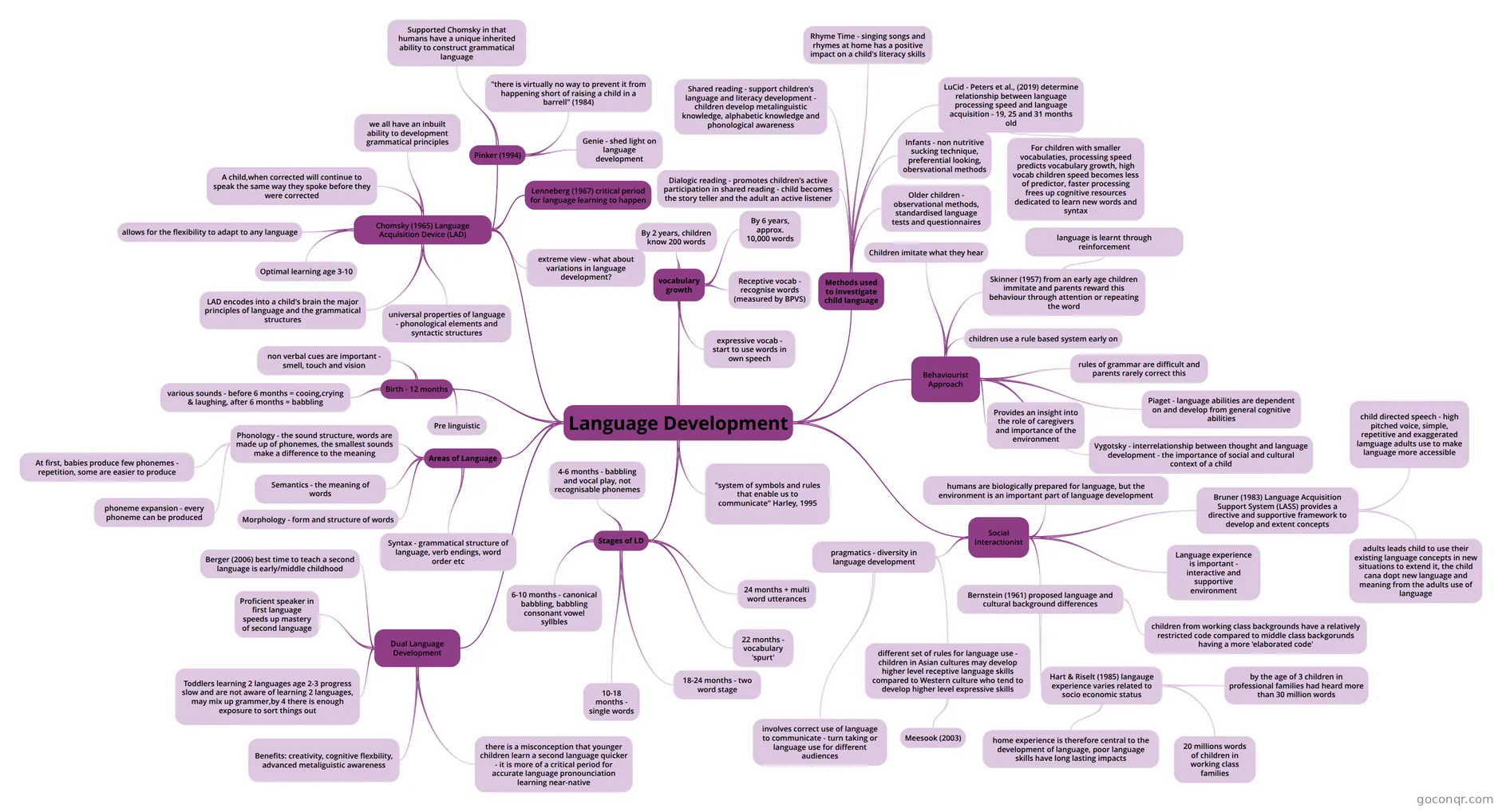
Mind map: Language development
Inhalt der Mindmap
Language Development
"system of symbols and rules that enable us to communicate" Harley, 1995
Stages of LD
- 4-6 months - babbling and vocal play, not recognisable phonemes
- 6-10 months - canonical babbling, babbling consonant vowel syllbles
- 10-18 months - single words
- 18-24 months - two word stage
- 22 months - vocabulary 'spurt'
- 24 months + multi word utterances
Areas of Language
- Phonology - the sound structure, words are made up of phonemes, the smallest sounds make a difference to the meaning
- At first, babies produce few phonemes - repetition, some are easier to produce
- phoneme expansion - every phoneme can be produced
- Semantics - the meaning of words
- Morphology - form and structure of words
- Syntax - grammatical structure of language, verb endings, word order etc
- Phonology - the sound structure, words are made up of phonemes, the smallest sounds make a difference to the meaning
Birth - 12 months
- Pre linguistic
- various sounds - before 6 months = cooing,crying & laughing, after 6 months = babbling
- non verbal cues are important - smell, touch and vision
vocabulary growth
- By 2 years, children know 200 words
- (Goldfield and Reznick, 1990)
- By 6 years, approx. 10,000 words
- (Anglin,1993)
- Receptive vocab - recognise words (measured by BPVS)
- expressive vocab - start to use words in own speech
- By 2 years, children know 200 words
Methods used to investigate child language
- Dialogic reading - promotes children's active participation in shared reading - child becomes the story teller and the adult an active listener
- The adult provides assistance as required, facilitates, expands and responds to the child's verbalisations (Blomm-Hoffman et al., 2006) Promotes language and literacy skills, enjoyment of reading Supported by international research
- Mol, Bus et al (2008) meta-analysis looked at DR interventions vs control group, 16 studies were included - moderate effect size was reported for expressive vocabulary Effect size reduced when children reached age 4/5 DR can be useful home literacy activities of families with 2-3 year old children
- Infants - non nutritive sucking technique, preferential looking, obersvational methods
- Non-nutritive sucking technique - when a baby is sucking but they are full so they are just sucking for comfort
- Preferential looking - experimental method used to assess the perceptual capabilities of non verbal individuals - infants will fixate a more interesting stimulus when it is presented simultaneously with a less interesting stimulus
- Older children - observational methods, standardised language tests and questionnaires
- LuCid - Peters et al., (2019) determine relationship between language processing speed and language acquisition - 19, 25 and 31 months old
- For children with smaller vocabulaties, processing speed predicts vocabulary growth, high vocab children speed becomes less of predictor, faster processing frees up cognitive resources dedicated to learn new words and syntax
- Shared reading - support children's language and literacy development - children develop metalinguistic knowledge, alphabetic knowledge and phonological awareness
- Ninio (1983) SR is a 'vocabulary acquisition device Kame'enui and Simmons (1999) suggested children acquire more vocab through SR than direct instruction Theory of mind & strengthen the emotional bonds between parent and child Adults typically maintain a high level of control
- Noble et al (2019) meta-analysis of shared book reading Impacts vocab, conversation skills, reading ability, print exposure, grammatical development 54 studies were included - modest impact (small) Weak evidence - small scale, small dose, no pre test or control group Theoretical evidence base to support shared reading interventions but require more robust studies
- Rhyme Time - singing songs and rhymes at home has a positive impact on a child's literacy skills
- Rhythm and repetition helps develop language skills Roulstone, Loader, Northstone and Beveridge (2007) - data at 25 months reported positive impacts of pretend play, turn taking, imitation and nursery rhymes
- Dialogic reading - promotes children's active participation in shared reading - child becomes the story teller and the adult an active listener
Chomsky (1965) Language Acquisition Device (LAD)
- we all have an inbuilt ability to development grammatical principles
- universal properties of language - phonological elements and syntactic structures
- LAD encodes into a child's brain the major principles of language and the grammatical structures
- Optimal learning age 3-10
- allows for the flexibility to adapt to any language
- A child,when corrected will continue to speak the same way they spoke before they were corrected
- Pinker (1994)
- Supported Chomsky in that humans have a unique inherited ability to construct grammatical language
- "there is virtually no way to prevent it from happening short of raising a child in a barrell" (1984)
- Genie - shed light on language development
- Lenneberg (1967) critical period for language learning to happen
- extreme view - what about variations in language development?
Behaviourist Approach
- Children imitate what they hear
- Skinner (1957) from an early age children immitate and parents reward this behaviour through attention or repeating the word
- Parents responses inform the sounds made by children
- language is learnt through reinforcement
- children use a rule based system early on
- rules of grammar are difficult and parents rarely correct this
- Provides an insight into the role of caregivers and importance of the environment
- Piaget - language abilities are dependent on and develop from general cognitive abilities
- Vygotsky - interrelationship between thought and language development - the importance of social and cultural context of a child
Social Interactionist
- humans are biologically prepared for language, but the environment is an important part of language development
- Bruner (1983) Language Acquisition Support System (LASS) provides a directive and supportive framework to develop and extent concepts
- child directed speech - high pitched voice, simple, repetitive and exaggerated lamguage adults use to make language more accessible
- adults leads child to use their existing language concepts in new situations to extend it, the child cana dopt new language and meaning from the adults use of language
- Language experience is important - interactive and supportive environment
- Bernstein (1961) proposed language and cultural background differences
- children from working class backgrounds have a relatively restricted code compared to middle class backgorunds having a more 'elaborated code'
- restricted code not inferior and potential to communicate ideas
- more associated to dialect
- problems with the term social class
- schooling system is primarily elaborated code
- Hart & Riselt (1985) langauge experience varies related to socio economic status
- by the age of 3 children in professional families had heard more than 30 million words
- 20 millions words of children in working class families
- home experience is therefore central to the development of language, poor language skills have long lasting impacts
- children from working class backgrounds have a relatively restricted code compared to middle class backgorunds having a more 'elaborated code'
- pragmatics - diversity in language development
- different set of rules for language use - children in Asian cultures may develop higher level receptive language skills compared to Western culture who tend to develop higher level expressive skills
- Meesook (2003)
- Asian cultures emphasised the listeners role in ensuring accurate communication whereas the responsibility rests with the speaker in Western Cultures
- Meesook (2003)
- involves correct use of language to communicate - turn taking or language use for different audiences
- different set of rules for language use - children in Asian cultures may develop higher level receptive language skills compared to Western culture who tend to develop higher level expressive skills
Dual Language Development
- there is a misconception that younger children learn a second language quicker - it is more of a critical period for accurate language pronounciation learning near-native
- Berger (2006) best time to teach a second language is early/middle childhood
- Proficient speaker in first language speeds up mastery of second language
- Toddlers learning 2 languages age 2-3 progress slow and are not aware of learning 2 languages, may mix up grammer,by 4 there is enough exposure to sort things out
- Benefits: creativity, cognitive flexbility, advanced metaliguistic awareness
Informationen
- Beschreibung
- Mindmap am Language Development, erstellt von Megan handy am 01/04/2020.
- Erstellt von
- Megan handy
- Aufrufe
- 1
- Bewertung