
Mindmap
UTILITARIANISM
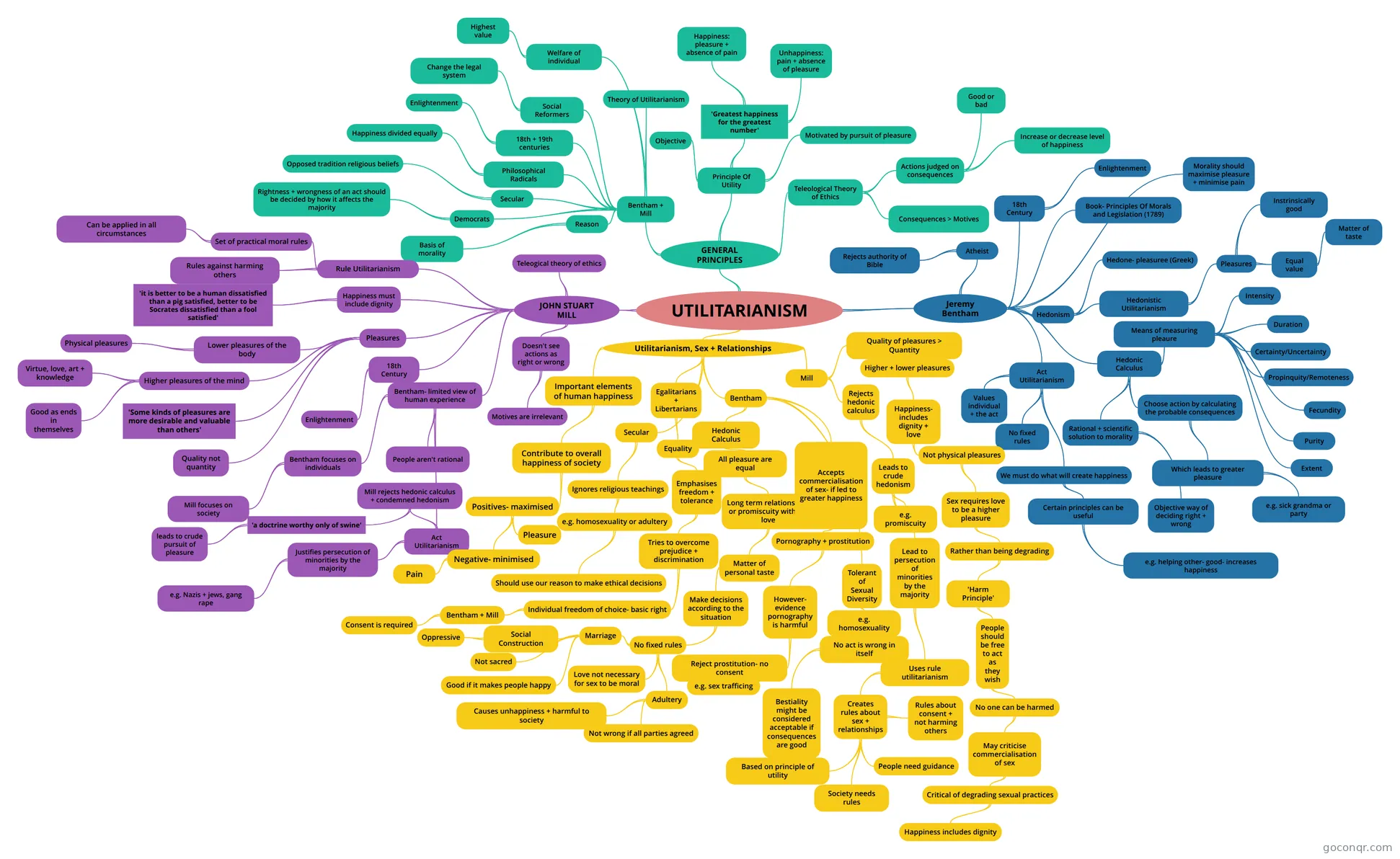
Mind map: Utilitarianism
Inhalt der Mindmap
UTILITARIANISM
GENERAL PRINCIPLES
- Principle Of Utility
- 'Greatest happiness for the greatest number'
- Happiness: pleasure + absence of pain
- Unhappiness: pain + absence of pleasure
- Objective
- Motivated by pursuit of pleasure
- 'Greatest happiness for the greatest number'
- Teleological Theory of Ethics
- Actions judged on consequences
- Good or bad
- Increase or decrease level of happiness
- Consequences > Motives
- Actions judged on consequences
- Bentham + Mill
- Theory of Utilitarianism
- 18th + 19th centuries
- Enlightenment
- Social Reformers
- Change the legal system
- Philosophical Radicals
- Happiness divided equally
- Secular
- Opposed tradition religious beliefs
- Democrats
- Rightness + wrongness of an act should be decided by how it affects the majority
- Reason
- Basis of morality
- Welfare of individual
- Highest value
- Principle Of Utility
Jeremy Bentham
- 18th Century
- Enlightenment
- Atheist
- Rejects authority of Bible
- Book- Principles Of Morals and Legislation (1789)
- Morality should maximise pleasure + minimise pain
- Hedonism
- Hedone- pleasuree (Greek)
- Hedonistic Utilitarianism
- Pleasures
- Instrinsically good
- Equal value
- Matter of taste
- Pleasures
- Hedonic Calculus
- Means of measuring pleaure
- Intensity
- Duration
- Certainty/Uncertainty
- Propinquity/Remoteness
- Fecundity
- Purity
- Extent
- Choose action by calculating the probable consequences
- Which leads to greater pleasure
- e.g. sick grandma or party
- Which leads to greater pleasure
- Rational + scientific solution to morality
- Objective way of deciding right + wrong
- Means of measuring pleaure
- Act Utilitarianism
- We must do what will create happiness
- Certain principles can be useful
- e.g. helping other- good- increases happiness
- Certain principles can be useful
- No fixed rules
- Values individual + the act
- We must do what will create happiness
- 18th Century
JOHN STUART MILL
- 18th Century
- Enlightenment
- Teleogical theory of ethics
- Doesn't see actions as right or wrong
- Motives are irrelevant
- Bentham- limited view of human experience
- People aren't rational
- Bentham focuses on individuals
- Mill focuses on society
- Act Utilitarianism
- Justifies persecution of minorities by the majority
- e.g. Nazis + jews, gang rape
- Mill rejects hedonic calculus + condemned hedonism
- 'a doctrine worthy only of swine'
- leads to crude pursuit of pleasure
- 'a doctrine worthy only of swine'
- Justifies persecution of minorities by the majority
- Happiness must include dignity
- 'it is better to be a human dissatisfied than a pig satisfied, better to be Socrates dissatisfied than a fool satisfied'
- Pleasures
- Quality not quantity
- 'Some kinds of pleasures are more desirable and valuable than others'
- Higher pleasures of the mind
- Virtue, love, art + knowledge
- Good as ends in themselves
- Lower pleasures of the body
- Physical pleasures
- Rule Utilitarianism
- Set of practical moral rules
- Can be applied in all circumstances
- Rules against harming others
- Set of practical moral rules
- 18th Century
Utilitarianism, Sex + Relationships
- Important elements of human happiness
- Contribute to overall happiness of society
- Positives- maximised
- Negative- minimised
- Pain
- Pleasure
- Negative- minimised
- Positives- maximised
- Contribute to overall happiness of society
- Secular
- Ignores religious teachings
- e.g. homosexuality or adultery
- Should use our reason to make ethical decisions
- e.g. homosexuality or adultery
- Ignores religious teachings
- Egalitarians + Libertarians
- Equality
- Emphasises freedom + tolerance
- Tries to overcome prejudice + discrimination
- Individual freedom of choice- basic right
- Bentham + Mill
- Consent is required
- Bentham + Mill
- Individual freedom of choice- basic right
- Tries to overcome prejudice + discrimination
- Emphasises freedom + tolerance
- Equality
- Bentham
- Hedonic Calculus
- All pleasure are equal
- Long term relationships or promiscuity without love
- Matter of personal taste
- Make decisions according to the situation
- No fixed rules
- Marriage
- Social Construction
- Oppressive
- Good if it makes people happy
- Not sacred
- Social Construction
- Love not necessary for sex to be moral
- Adultery
- Causes unhappiness + harmful to society
- Not wrong if all parties agreed
- Marriage
- No fixed rules
- Make decisions according to the situation
- Matter of personal taste
- Long term relationships or promiscuity without love
- All pleasure are equal
- Accepts commercialisation of sex- if led to greater happiness
- Pornography + prostitution
- However- evidence pornography is harmful
- Reject prostitution- no consent
- e.g. sex trafficing
- Reject prostitution- no consent
- However- evidence pornography is harmful
- Pornography + prostitution
- Tolerant of Sexual Diversity
- e.g. homosexuality
- No act is wrong in itself
- Bestiality might be considered acceptable if consequences are good
- No act is wrong in itself
- e.g. homosexuality
- Hedonic Calculus
- Mill
- Rejects hedonic calculus
- Leads to crude hedonism
- e.g. promiscuity
- Lead to persecution of minorities by the majority
- Uses rule utilitarianism
- Creates rules about sex + relationships
- Based on principle of utility
- People need guidance
- Society needs rules
- Rules about consent + not harming others
- Creates rules about sex + relationships
- Uses rule utilitarianism
- Leads to crude hedonism
- Quality of pleasures > Quantity
- Higher + lower pleasures
- Happiness- includes dignity + love
- Not physical pleasures
- Sex requires love to be a higher pleasure
- Rather than being degrading
- 'Harm Principle'
- People should be free to act as they wish
- No one can be harmed
- May criticise commercialisation of sex
- Critical of degrading sexual practices
- Happiness includes dignity
- Critical of degrading sexual practices
- May criticise commercialisation of sex
- No one can be harmed
- People should be free to act as they wish
- 'Harm Principle'
- Rather than being degrading
- Sex requires love to be a higher pleasure
- Not physical pleasures
- Happiness- includes dignity + love
- Higher + lower pleasures
- Rejects hedonic calculus
- Important elements of human happiness
Informationen
- Beschreibung
- Mindmap am UTILITARIANISM, erstellt von isabelzentner am 07/03/2015.
- Erstellt von
- isabelzentner
- Aufrufe
- 1
- Tags
- Bewertung