
Mindmap
Cognitive Approach
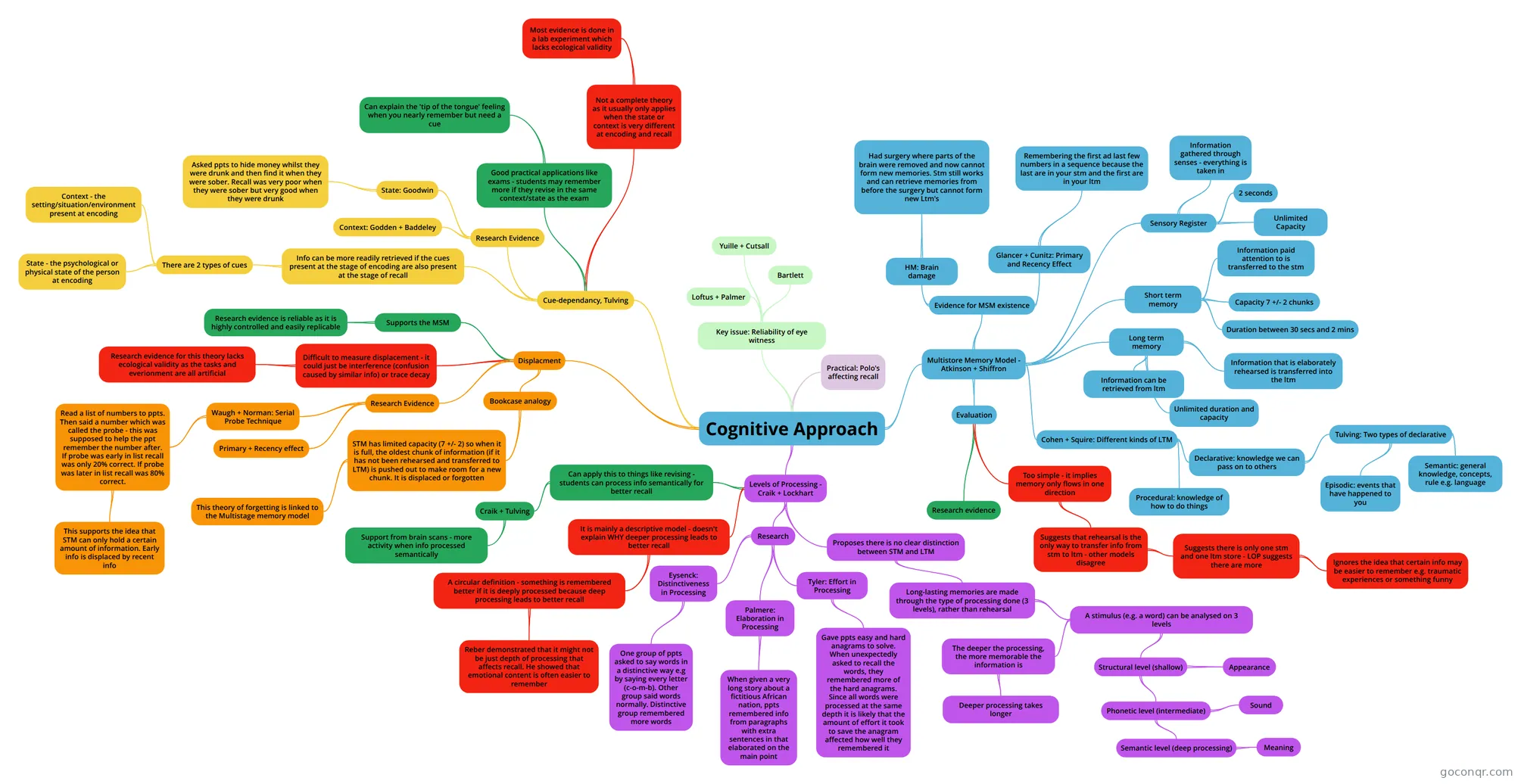
Mind map: Cognitive approach psychology
Inhalt der Mindmap
Cognitive Approach
Multistore Memory Model - Atkinson + Shiffron
- Sensory Register
- 2 seconds
- Information gathered through senses - everything is taken in
- Unlimited Capacity
- Short term memory
- Information paid attention to is transferred to the stm
- Capacity 7 +/- 2 chunks
- Duration between 30 secs and 2 mins
- Long term memory
- Information that is elaborately rehearsed is transferred into the ltm
- Unlimited duration and capacity
- Information can be retrieved from ltm
- Evidence for MSM existence
- Glancer + Cunitz: Primary and Recency Effect
- Remembering the first ad last few numbers in a sequence because the last are in your stm and the first are in your ltm
- HM: Brain damage
- Had surgery where parts of the brain were removed and now cannot form new memories. Stm still works and can retrieve memories from before the surgery but cannot form new Ltm's
- Glancer + Cunitz: Primary and Recency Effect
- Cohen + Squire: Different kinds of LTM
- Procedural: knowledge of how to do things
- Declarative: knowledge we can pass on to others
- Tulving: Two types of declarative
- Episodic: events that have happened to you
- Semantic: general knowledge, concepts, rule e.g. language
- Tulving: Two types of declarative
- Evaluation
- Too simple - it implies memory only flows in one direction
- Suggests that rehearsal is the only way to transfer info from stm to ltm - other models disagree
- Suggests there is only one stm and one ltm store - LOP suggests there are more
- Ignores the idea that certain info may be easier to remember e.g. traumatic experiences or something funny
- Suggests there is only one stm and one ltm store - LOP suggests there are more
- Suggests that rehearsal is the only way to transfer info from stm to ltm - other models disagree
- Research evidence
- Too simple - it implies memory only flows in one direction
- Sensory Register
Levels of Processing - Craik + Lockhart
- Proposes there is no clear distinction between STM and LTM
- Long-lasting memories are made through the type of processing done (3 levels), rather than rehearsal
- A stimulus (e.g. a word) can be analysed on 3 levels
- Structural level (shallow)
- Appearance
- Phonetic level (intermediate)
- Sound
- Semantic level (deep processing)
- Meaning
- The deeper the processing, the more memorable the information is
- Deeper processing takes longer
- Structural level (shallow)
- A stimulus (e.g. a word) can be analysed on 3 levels
- Long-lasting memories are made through the type of processing done (3 levels), rather than rehearsal
- Research
- Tyler: Effort in Processing
- Gave ppts easy and hard anagrams to solve. When unexpectedly asked to recall the words, they remembered more of the hard anagrams. Since all words were processed at the same depth it is likely that the amount of effort it took to save the anagram affected how well they remembered it
- Palmere: Elaboration in Processing
- When given a very long story about a fictitious African nation, ppts remembered info from paragraphs with extra sentences in that elaborated on the main point
- Eysenck: Distinctiveness in Processing
- One group of ppts asked to say words in a distinctive way e.g by saying every letter (c-o-m-b). Other group said words normally. Distinctive group remembered more words
- Tyler: Effort in Processing
- It is mainly a descriptive model - doesn't explain WHY deeper processing leads to better recall
- A circular definition - something is remembered better if it is deeply processed because deep processing leads to better recall
- Reber demonstrated that it might not be just depth of processing that affects recall. He showed that emotional content is often easier to remember
- A circular definition - something is remembered better if it is deeply processed because deep processing leads to better recall
- Can apply this to things like revising - students can process info semantically for better recall
- Craik + Tulving
- Support from brain scans - more activity when info processed semantically
- Craik + Tulving
- Proposes there is no clear distinction between STM and LTM
Displacment
- Bookcase analogy
- STM has limited capacity (7 +/- 2) so when it is full, the oldest chunk of information (if it has not been rehearsed and transferred to LTM) is pushed out to make room for a new chunk. It is displaced or forgotten
- This theory of forgetting is linked to the Multistage memory model
- STM has limited capacity (7 +/- 2) so when it is full, the oldest chunk of information (if it has not been rehearsed and transferred to LTM) is pushed out to make room for a new chunk. It is displaced or forgotten
- Research Evidence
- Primary + Recency effect
- Waugh + Norman: Serial Probe Technique
- Read a list of numbers to ppts. Then said a number which was called the probe - this was supposed to help the ppt remember the number after. If probe was early in list recall was only 20% correct. If probe was later in list recall was 80% correct.
- This supports the idea that STM can only hold a certain amount of information. Early info is displaced by recent info
- Read a list of numbers to ppts. Then said a number which was called the probe - this was supposed to help the ppt remember the number after. If probe was early in list recall was only 20% correct. If probe was later in list recall was 80% correct.
- Difficult to measure displacement - it could just be interference (confusion caused by similar info) or trace decay
- Research evidence for this theory lacks ecological validity as the tasks and everionment are all artificial
- Supports the MSM
- Research evidence is reliable as it is highly controlled and easily replicable
- Bookcase analogy
Cue-dependancy, Tulving
- Info can be more readily retrieved if the cues present at the stage of encoding are also present at the stage of recall
- There are 2 types of cues
- Context - the setting/situation/environment present at encoding
- State - the psychological or physical state of the person at encoding
- There are 2 types of cues
- Research Evidence
- Context: Godden + Baddeley
- State: Goodwin
- Asked ppts to hide money whilst they were drunk and then find it when they were sober. Recall was very poor when they were sober but very good when they were drunk
- Good practical applications like exams - students may remember more if they revise in the same context/state as the exam
- Can explain the 'tip of the tongue' feeling when you nearly remember but need a cue
- Not a complete theory as it usually only applies when the state or context is very different at encoding and recall
- Most evidence is done in a lab experiment which lacks ecological validity
- Info can be more readily retrieved if the cues present at the stage of encoding are also present at the stage of recall
Key issue: Reliability of eye witness
- Loftus + Palmer
- Yuille + Cutsall
- Bartlett
Practical: Polo's affecting recall
Informationen
- Beschreibung
- Mindmap am Cognitive Approach, erstellt von zoe_h96 am 23/03/2015.
- Erstellt von
- zoe_h96
- Aufrufe
- 0
- Bewertung