
Mindmap
Changing Urban environments
Inhalt der Mindmap
Changing Urban environments
Urbanisation
- The growth of the proportion of a countries population living in urban areas.
- More than 50% of the worlds population live in urban areas (3.4 billion people)
- It differs between richer and poorer countries
- In richer coutries, most of the population already live in urban areas
- In the UK- over 80% of its population live in urban areas
- In poorer countries not much of the population currently live in urban areas.
- In Bangladesh- around 25% of the population live in urban areas.
- Most urbanisation that is happening today- is going on in poorer countries at a fast pace.
- In richer coutries, most of the population already live in urban areas
- Many highly populated cities are located very close or on the coast of their country
- Why do people move to urban areas?
- LEDCs
- There is usually a shortage of services in rural areas- eg, education water, power
- Many people believe that the standard of living is better in the cities (eventhough it may not be)
- There are more jobs in the urban areas
- Industry is attracted to the cities as there is better infrastructure and a larger workforce
- In rural areas many people farm their own food- so during poor harvests and crop failure they face starvation and no money.
- MEDCs
- People moved from rural to urban for work
- Most urbanisation in rich countries took place in the 18th and 19th centuries
- In the late 20th century people moved away from inner city areas and went to the country- they are now being encouraged into these redeveloped areas.
- People moved from rural to urban for work
- LEDCs
- Many young people move to cities to find jobs
- They then have children and cause the population of the city to rise.
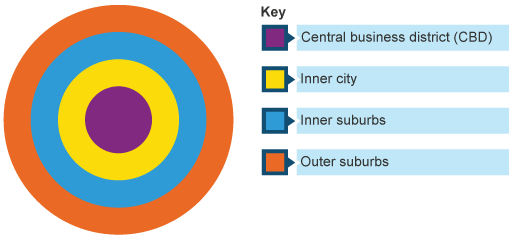
Functional parts of a settlement
- A settlement is a group of buildings and homes where people live- eg, village, town, city.
- The function of a town or zone is its purpose- eg, for residential, recreational use,etc.
- A city is usually made of four or five parts.
- CBD- Central Business District
- This part is at the centre of the city.
- It has lesiure and entertainment facilities- theatres, restaurants, etc.
- It also has the government buildings, universities, offices and train stations.
- Inner city
- This part is found around the CBD
- It used to contain he manufacturing industry but has closed down- leaving derelict land.
- It provided cheap housing for factory workers.
- Houses are arranged in a grid pattern- leaving no green spaces.
- It is quite popular with people who work in the CBD.
- Suburbs
- This zone covers the largest area in most cities
- It is mostly residential- it is quite expensive to live here.
- Its popular with families
- The houses get bigger and newer the further out you go. They go from attatched to dettached
- Rural-Urban Fringe
- Its on the edge of the city and is almost countryside
- New housing estates are sometimes built here.
- Big retail, lesiure parks and supermarkets are built
- It has lots of green space, villages and recreational facilities -like golf and stables.
- CBD- Central Business District
Issues facing urban areas in MEDCs
- Housing
- Greenfield
- Sites which have never been built on- usually at the edge of the city on the rural-urban fringe -out of the way of the cities with more space .
- Brownfield
- Sites which have already been built on- they have usually been abandoned. Derelict buildings/ estates are knocked down and rebuilt on.
- Cities in richer countries often have shortages of good quality housing.
- The UKs population has risen by over 10% since 1971 and by 2025 it is predicted that the population will be over 65 million.
- Cities use many methods to try and reduce the effects of the housing shortage
- Urban renewal schemes
- They encourage investment in new housing, services, and employment in derelict inner city areas.
- Widely used in the 1990s
- New Towns
- To accommodate overspill populations from existing towns and cities where there is a housing shortage.
- Milton Keynes is a well known example- building started in 1970.
- Relocation Incentives
- These encourage people living in large council houses- (who don't need a large house or need to live in the city) to move to more rural areas.
- They free up space in the urban areas for people who need to live in the city- eg, working families
- The London council runs a scheme that encourages older people (who live in big city houses) to move to the seaside or countryside.
- The scheme helps them move out and gives them money.
- Urban renewal schemes
- Greenfield
- Run down CBDs
- Due to online shopping
- Shops can find cheaper rent elsewhere
- Out of town business parks and shopping centres
- Other centres are more easy to access
- Revitalizing CBDs
- Pedestrianising areas to make them more attractive and safe for shoppers
- Improving access with better public transport links and better parking.
- Converting derelict warehouses and docks into new attractions
- Improving areas like parks to make them more attractive
- The London Docklands
- Between 1960 and 1980, all of London's docks were closed, leaving around eight square miles (21 km²) of derelict land in East London.
- During ww2 there were vast amounts of bomb damage to the docks
- As soon as the docks closed there were efforts to redevelop them.
- The massive development programme managed by the London docklands development corporation during the 1980s and 1990s saw a huge area of the Docklands converted into a mixture of residential, commercial and light industrial space.
- Traffic and congestion
- More air pollution
- Increased risk of accidents
- People waste time in traffic and don't reach places in time
- Solutions
- Congestion Charges
- People have to pay to use their cars in the city centre- this discourages car use
- This reduces traffic congestion and traffic jams
- Reduces pollution
- Reduces the risk of accidents
- However people may still use cars in other areas and there will still be pollution
- People have to pay to use their cars in the city centre- this discourages car use
- Park and ride services
- People leave their cars in car parks in a allocated area and use the bus to travel to the city centre- eg, Cambridge
- There is less congestion (more people can share one bus instead of many cars)
- Less pollution and risk of accidents as there aren't as many cars on the road
- However, the roads are small and buses can be inconvenient for pedestrians etc
- People leave their cars in car parks in a allocated area and use the bus to travel to the city centre- eg, Cambridge
- Cycle routes
- Part of the road is given to cyclists, to encourage more people to use their bikes
- Cyclists are safer and less likely to crash into cars etc
- Less congestion as there are less cars
- However, cycle routes aren't always used and it is expensive to build them all over the city (especially if it is hilly)
- Part of the road is given to cyclists, to encourage more people to use their bikes
- Public transport
- People can use the tubs, trains, buses, trams etc.
- Stops congestion and pollution as people are "sharing" transport and not using their own cars
- However these services have huge amounts of people using them- they may become busy and delayed as a result.
- People can use the tubs, trains, buses, trams etc.
- Pedestrianisation of CBD areas
- More areas for people to walk in the city centres-Eg people can get the train to the CBD and walk to their offices etc.
- Less cars means less pollution and clearer roads.
- However some people may not want to walk so much and would still rather take the car.
- More areas for people to walk in the city centres-Eg people can get the train to the CBD and walk to their offices etc.
- Congestion Charges
- Ethnic Segregation
- People from different ethnic backgrounds don't mix for many reasons
- People prefer to live around those with similar backgrounds and who speak the same language as them
- People prefer to live near their places of worship that are important to their culture
- New migrants usually have low paid jobs and can only afford to live in certain areas
- New migrants tend to live near family and friends.
- Solutions
- Ensuring everyone can access information- eg, printing leaflets in many languages.
- Improving communication
- By involving leaders of different ethnic groups when making decisions
- Providing interpreters- in hospitals, police stations etc
- Providing English classes for adults.
- People from different ethnic backgrounds don't mix for many reasons
- Housing
Squatter Settlements
- These are settlements in undesirable and dangerous places
- The land may be contaminated by factories
- They may be near railways of slopes where there is the risk of landslides
- There is the risk of flooding
- They are in undesirable places and the inhabitants have no right to build on the land
- The land is unoccupied so people move in and build their homes
- They are built illegally in and around the city (by people who cant afford proper housing)
- Found in LEDCs
- What are they like?
- They are built form scrap metal, plastic, wood planks (anything people can find)
- They are large over crowded homes with up to 30 people- usually with only 2 rooms.
- There is no basic infastructure
- NO electricity
- NO road access
- NO Clean running water
- NO drains or sewers
- There is very bad sanitation
- Water is contaminated with faeces, rubbish and urine.
- Diseases like typhoid, diarrhoea, and cholera are common and spread quickly due to the overcrowding and poor hygeine
- They are called favelas in South America, and in other countries they are called slums or shanty towns.
- Employment
- Zero tax- cash in hand. So other people don't know what they are earning
- People earn very low wages and they do illegal jobs; eg, selling goods, washing windscreens at traffic lights
- NO pension
- NO healthcare benefits
- People often work very long hours with little pay- the government doesn't monitor the jobs.
- Informal sector- informal economy, or grey economy is the part of an economy that is neither taxed, nor monitored by any form of government.
- Improving Squatter settlements
- People living in these settlements try to improve the area themselves
- The neighbours work together to help build - some have even built small schools
- Self-Help Schemes
- Inhabitants work with building supplies provided by the government to improve life in the settlement.
- The local people build their own homes, and the money saved on labour is used to provide services like electricity and sewers.
- Site and Service Schemes
- People pay a small amount to rent for a site- and they can borrow money for building supplies
- The rent money is used to provide basic services
- People can improve/ build a house on their plot
- People pay a small amount to rent for a site- and they can borrow money for building supplies
- Local service schemes
- These are funded by the local government and improve the temporary accomodation built by residents.
- Eg, the City of Rio spent $120 million on the Favela-Bairro project which is aimed to improve life for the residents
- These are funded by the local government and improve the temporary accomodation built by residents.
- People living in these settlements try to improve the area themselves
- These are settlements in undesirable and dangerous places
Improving Kibera
- Kenya Slum Upgrading Programme (KENSUP)
- Provides modern, low-cost housing.
- With electricity
- A kitchen
- shower
- Small balcony
- The first 17 high-storey flats were built in 2009 and are now home to 5,000 relocated residents
- The new residents' old homes are cleared to leave space to improve infrastructure
- Provides modern, low-cost housing.
- Site and Service schemes
- Sanitation
- The charity: "Practical Action" built 15 blocks of 4 toilets which are run by a local attendant.
- People are charged 2 Kenyan Shillings to use the facilities (all money is invested in maintenance of the facilities)
- New hand-washing stations have been installed in 8 schools
- Local clinics report cases of infections and diseases
- Water
- The Kenya Water for Health Organisation installed 3 large water tanks with new water taps
- This reduces the distance that 2,500 households are away from water
- Each tank holds 6000 litres and serves more than 2,000 people in the area with water for cooking and drinking
- The Kenya Water for Health Organisation installed 3 large water tanks with new water taps
- Roads and Drains
- UN-HABITAT constructed a 2.5km road, 1.8km of storm water drains (which reduce flooding and disease risk) and had improved footbridges to improve the movement of people and goods in kibera
- Sanitation
- Self Help Schemes
- Trash is cash is a scheme set-up by local youth groups to educate young people about waste collection and recycling etc.
- Each group has 60 members and provides a basic door-to-door waste collection service
- People can take their waste to a collection centre where youths sort it.- 2,000 tonnes of waste was collected last year
- Hygiene campaigns
- Practical action ran a campaign to raise awareness of hygiene and sanitation issues- mostly aimed at younger mothers and school children
- 2500 mothers were reached and 4,000 children from 8 schools were reached
- Trash is cash is a scheme set-up by local youth groups to educate young people about waste collection and recycling etc.
- Kenya Slum Upgrading Programme (KENSUP)
Rapid Urbanisation in LEDCs
- Lots of rubbish and waste produced
- People in cities create huge amounts of waste which can damage peoples health and the environment. Especially if its toxic and not disposed of quickly
- Poorer countries struggle to dispose of this waste
- Money
- Poorer countries cannot afford to dispose of waste safely
- Eg, toxic waste has to be treated and this can be expensive
- There are usually more urgent things for money to be spent on- heathcare etc
- Lack of Infastructure
- Poor roads in squatter settlements mean waste disposal lorries can't collect rubbish
- Scale
- A large city will generate thousands of tonnes of waste everyday
- Money
- Overcrowding
- Less jobs
- Air pollution
- Water pollution
- Effects of rapid urbanisation and industrialisation
- More air pollution
- Can lead to harmful acid rain which damages buildings and vegetation
- Leads to many health problems (like headaches and bronchitis)
- The ozone layer can be damaged by some pollutants
- Management
- Setting air quality standards and monitoring pollutant levels (so they stay at a safe level)
- More water pollution
- Can kill fish and other aquatic animals
- Disrupts food chains as harmful chemicals build up and poison humans who eat fish from the polluted water
- Contamination of water supplies can spread diseases like typhoid
- Management
- Building sewage treatment plants
- Passing laws that make factories clean their waste water
- More air pollution
- Lots of rubbish and waste produced
A Sustainable City
- Where residents have a way of life that will last a long time. The environment is not damaged, local people can earn a steady income and are involved in decision making
- Reducing and safely disposing waste
- Less is produced so less goes to landfill sites
- People are encouraged to compost/recycle more
- Kerbside recycling and recycling centres re provided
- Using brownfield sites
- This recycles land and avoids cities growing in size
- Saves the surrounding countryside
- Including local people in decision making
- Local councils consult people about a wide range of things
- Eg, where homes should be built and how local health and social care services are run
- Providing efficient public transport schemes
- Integrated transport systems run door-to-door services to encourage people to leave their cars
- Providing adequate open spaces
- Green, open spaces are vital for making cities sustainable
- They act like the "green lungs" of the city and reduce the CO2 pollution
- Urban parks support a range of wildlife and provide recreational oppurtunities
- Conserving the natural environment
- Renewably generating electricity
- Collecting water and recycling it (instead of using reservoirs)
- Running fuel efficient public transport systems- with less pollution
- Conserving the historic environment
- They must conserve the buildings they already have
- Turning old warehouses into apartments and industrial buildings
- Run-down old houses can be redeveloped to provide housing that will last
- Canals become leisure facilities
Bilder und Dateien der Mindmap
Informationen
- Beschreibung
- Mindmap am Changing Urban environments, erstellt von Dem B am 05/04/2015.
- Erstellt von
- Dem B
- Aufrufe
- 8
- Bewertung