
Mindmap
BIO 150
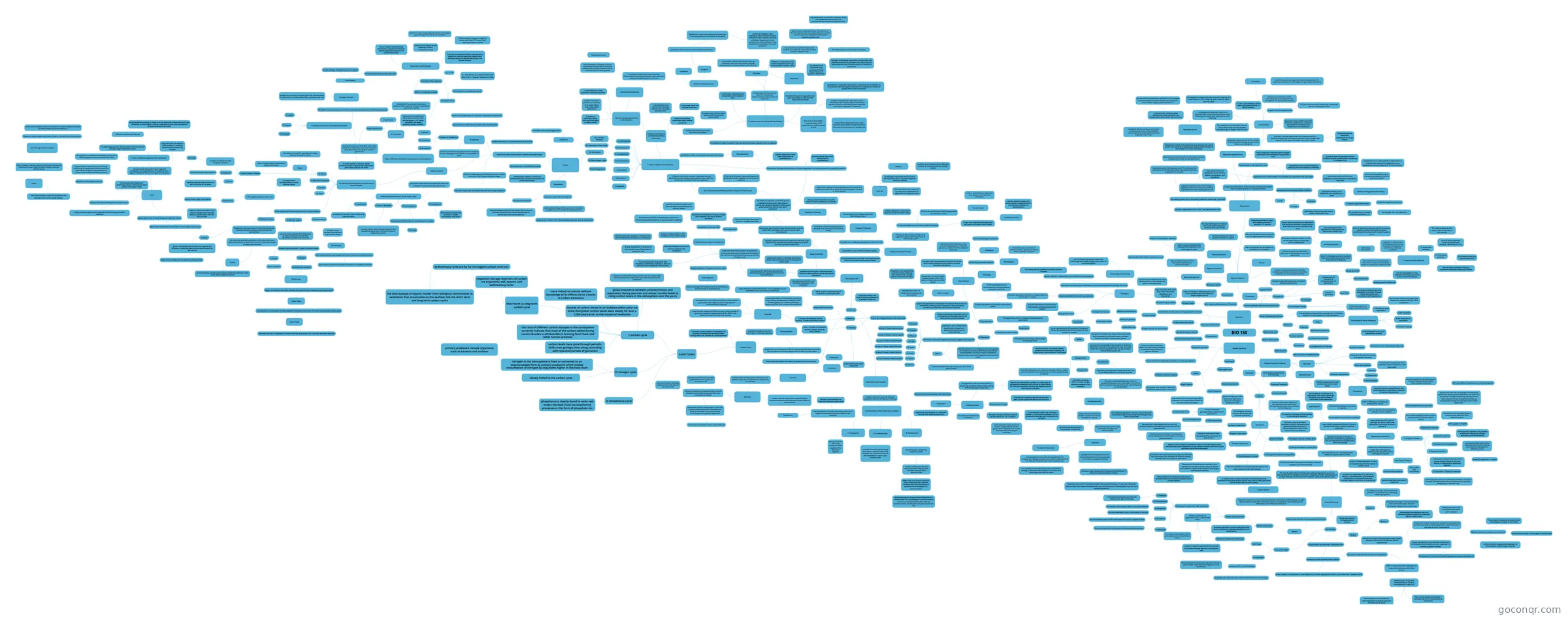
Mind map: BIO 150
Inhalt der Mindmap
BIO 150
Biodiversity Loss
- Habitat Destruction
- Overfishing
- Deforestation
- More Crop land needed to farm
- Overpopulation of humans
- Increased food demand
- Overpopulation of humans
- More Crop land needed to farm
- Elephants
- Poaching
- Ivory
- Aphrodisiac properties
- Ivory
- Poaching
- Invasive species
- Habitat Destruction
Globalization
- Spread of pathogens and disease
- Spread of invasive species
Canaries in coal mines
- Amphibians are the early warning signals for humans
- Climate change
- Weather intensification
- Climate change
- Carbon monoxide alarms
- Carbon dioxide risk for humans
- Global Warming
- Melting of glaciers
- much more water
- stronger hurricanes
- much more water
- Melting of glaciers
- Global Warming
- Carbon dioxide risk for humans
- Amphibians are the early warning signals for humans
Genetic Variation
- Alleles
- Different variants of a gene
- Allele Fixation
- population only exhibits 1 allele at a particular gene in every individual
- Allele Frequency
- the number of time a particular allele is present in the population divided by the total number of alleles
- 3 ways to measure genotype/allele frequencies in populations
- 1) Observable traits
- 2) Gel electrophoresis
- 3) DNA sequencing
- Genotype
- Species
- Shared Gene pool
- Natural populations
- groups of organisms that breed with each other and live in the same geographic area
- Group of individuals capable of sharing alleles with each other through reproduction that produces fertile offspring
- Hybridization
- interbreeding between 2 varieties or species
- Hybrid Offspring are individuals produced by a cross
- can be infertile if 2 incompatible species are bred together
- Hybrid Offspring are individuals produced by a cross
- interbreeding between 2 varieties or species
- Hybridization
- Speciation
- formation of new and distinct species in the course of evolution
- Evolution is as much about speciation which is the engine that generates biodiversity as it is about adaptation which is the result of natural selection
- Species concepts
- 1) Biological Species Concept (BSC)
- species are groups of actually or potentially interbreeding populations that are reproductively isolated from other such groups
- Reproductive Isolation
- reason why most species can't breed with other species, caused by barriers either pre or post egg fertilization
- Pre Zygotic Factors
- occur before egg fertilization and are more common than post zygotic factors
- 1) Behavioral Isolation
- the actions of one species doesn't attract sexual attention from another species
- NOT a factor in PLANTS
- 2) Gametic Isolation
- incompatibility between the gametes of different individuals typically belonging to different species
- 3) Mechanical Incompatibility
- structural configuration of the genitalia that prevents mating with another individual of a different species
- especially prevalent in insects
- structural configuration of the genitalia that prevents mating with another individual of a different species
- 4) Temporal Isolation
- individuals are reproductively active during different times of the year making it impossible to reproduce together
- 5) Geographic / Ecological Isolation
- individuals don't live near each other and have no chance to mate OR isolation between individuals who specialize ecologically in different ways
- Post Zygotic Factors
- Genetic Incompatibility
- genetic dissimilarity between 2 organisms
- Ex) different number of chromosomes prevents 2 individuals from producing offspring together
- genetic dissimilarity between 2 organisms
- occur after egg fertilization
- Genetic Incompatibility
- Pre Zygotic Factors
- Partially Reproductively Isolated
- populations have not yet diverged into separate species but whose genetic differences are extensive enough for the hybrid offspring they produce to have reduced fertility compared to offspring produced by crosses of individuals within each population
- Not truly different species but can't breed together
- populations have not yet diverged into separate species but whose genetic differences are extensive enough for the hybrid offspring they produce to have reduced fertility compared to offspring produced by crosses of individuals within each population
- reason why most species can't breed with other species, caused by barriers either pre or post egg fertilization
- Reproductive Isolation
- most widely accepted definition of what a species is but doesn't apply to asexual organisms
- more useful in theory than in practice
- more useful than ESC and PSC although the other 2 both help generalize the concept of what a species is
- species are groups of actually or potentially interbreeding populations that are reproductively isolated from other such groups
- 2) Ecological Species Concept (ESC)
- idea that there is a 1:1 correspondence between a species and its niche
- Niche is the combination of traits an organism has and the habitat in which it exits
- turns out its impossible for 2 species to coexist in the same exact niche because competition for the same resources inevitably leads to extinction of one species
- Niche is the combination of traits an organism has and the habitat in which it exits
- idea that there is a 1:1 correspondence between a species and its niche
- 3) Phylogenetic Species Concept (PSC)
- idea that members of a species all share a common ancestry and a common fate
- PSC can be useful when thinking about asexual species but given the arbitrariness of the decisions involved in assessing whether descendants of a single ancestor warrant the term "species" limits its functional utility
- idea that members of a species all share a common ancestry and a common fate
- 4) Morphospecies Concept
- idea that members of the same species usually look alike more than like other species
- in modern era has been extended to the molecular level, members of the same species usually have similar DNA sequences distinct from those of other species
- Cryptic Species
- organisms /species that have been traditionally considered as belonging to a single species because they look similar but turn out to belong to 2 species because of differences at the DNA sequence level
- Cryptic Species
- in modern era has been extended to the molecular level, members of the same species usually have similar DNA sequences distinct from those of other species
- Drawback of morphospecies concept is that members of the same species may not always look alike but instead show different phenotypes called polymorphisms
- Polymorphisms are discontinuous genetic variations causing multiple phenotypes within a single species
- members of the same species can look very different from each other but members of different species can also look very similar to each other
- idea that members of the same species usually look alike more than like other species
- 1) Biological Species Concept (BSC)
- Allopatric Speciation
- speciation that results from the geographical separation of populations
- physical separation doesn't immediately cause reproductive isolation but over many generations will
- speciation that results from the geographical separation of populations
- Peripatric Speciation
- specific kind of allopatric speciation where a few individuals from a mainland population disperse to a new location remote from the original population and evolve separately
- Sympatric Speciation
- formation of a new species from a surviving ancestral species while both continue to live in the same location
- for sympatric speciation to occur natural selection must act strongly to counteract the homogenizing effect of gene flow
- formation of a new species from a surviving ancestral species while both continue to live in the same location
- real biological entities not just convenient way to group organisms
- set of alleles possessed by the individual
- Genotype Frequency
- the number of individuals in a population with a given genotype divided by the total number of individuals in the population
- Species
- Phenotype
- Observable traits
- Causes of genetic variation
- Mutation
- Somatic mutation
- mutations in non-reproductive body cells
- Germ line mutation
- mutations in reproductive cells, passes on these mutations to next generation
- Mutation classification
- 1) Neutral
- 2) Deleterious
- 3) Advantageous
- mutation is the ultimate source of all genetic variation
- Somatic mutation
- Recombination
- Shuffles mutations into new combination to form new alleles
- Conjugation
- process of genetic recombination that occurs between 2 organisms in addition to asexual reproduction
- asexual organisms exchange genetic material through direct contact while temporarily joined
- process of genetic recombination that occurs between 2 organisms in addition to asexual reproduction
- Conjugation
- Shuffles mutations into new combination to form new alleles
- Genetic Diversity
- Asexual reproduction decreases genetic diversity
- Mitosis
- Mitotic cell division
- mitosis and cytokinesis
- 5 phases of mitosis after DNA replication
- 1) Prophase
- chromosomes condense and become visible under light microscope
- 2) Prometaphase
- the spindle microtubules attach to the centromeres
- 3) Metaphase
- the chromosomes line up in the middle of the cell
- 4) Anaphase
- the centromeres split and the chromosomes move to opposite poles
- 5) Telophase
- the nuclear envelope reforms and chromosomes decondense
- 1) Prophase
- Mitosis is followed by cytokinesis when 1 cell divides into 2
- In animals a contractile ring of actin pinches the cell splitting it into 2
- In plants a new cell wall called the cell plate is synthesized/made between the daughter cells
- 5 phases of mitosis after DNA replication
- produces genetically identical daughter cells and is the basis for asexual reproduction and development
- mitosis and cytokinesis
- Mitotic cell division
- Mitosis
- Sexual reproduction increases genetic diversity
- Meiosis
- Cell Division
- single parent cell produces 2 daughter cells
- prokaryotic cells divide by binary fission
- binary fission is the process of a cell replicating its DNA, segregates its DNA, and divides into 2 separate cells
- Eukaryotic cells divide by mitosis and cytokinesis
- DNA in eukaryotic cells is packaged as linear chromosomes rather than circular
- Humans have 23 pairs of chromosomes or 46 total chromosomes in each cell
- Homologous chromosomes are chromosomes of the same type with the same set of genes
- Each human parent contributes 1 complete set of 23 chromosomes at fertilization
- Humans have 23 pairs of chromosomes or 46 total chromosomes in each cell
- DNA in eukaryotic cells is packaged as linear chromosomes rather than circular
- prokaryotic cells divide by binary fission
- Cell Cycle Phases
- 1) M Phase
- consists of mitosis and cytokinesis
- 2) Interphase
- consists of G1, S, and G2 phases
- G0 phase is for cells that don't need to divide and exit the cell cycle
- During S phase chromosomes replicate forming a pair of sister chromatids held together at the centromere
- consists of G1, S, and G2 phases
- 1) M Phase
- single parent cell produces 2 daughter cells
- meiotic cell division produces genetically unique daughter cells and is the basis for sexual reproduction
- Sexual reproduction involves both meiosis and fertilization, both of which are very important in increasing genetic diversity
- fertilization is the fusion of haploid gametes to produce a diploid cell
- meiotic cell division reduces the number of chromosomes by half and produces haploid gametes or spores that have one copy of every chromosome
- Meiosis involves 2 successive cell divisions
- First division is reductional meaning the chromosome number is cut in half
- Second division is equational meaning the chromosome number stays the same
- Each division consist of the stages of the cell cycle
- Meiosis involves 2 successive cell divisions
- Sexual reproduction involves both meiosis and fertilization, both of which are very important in increasing genetic diversity
- Meiosis I
- homologous chromosomes pair and exchange genetic material at chiasmata regions crossing over
- centromeres don't split and sister chromatids don't separate
- homologous chromosomes pair and exchange genetic material at chiasmata regions crossing over
- Meiosis II
- chromosomes align in the center of the cell, centromeres split, and sister chromatids separate from each other
- Cell Division
- Meiosis
- Asexual reproduction decreases genetic diversity
- Mutation
- Population genetics
- Study of patterns of genetic variation in natural populations
- Goal is to make inferences about the evolutionary process from observing patterns of genetic variation
- Alleles
Evolution
- Hardy Weinberg Equilibrium
- if all conditions of equilibrium are met then it indicates evolution is not happening in that population
- 5 conditions of Hardy Weinberg
- 1) Sufficiently large population
- 2) No migration
- 3) No mutations in population
- 4) Random mating
- 5) No difference in survival / reproductive success
- 5 conditions of Hardy Weinberg
- if all conditions of equilibrium are met then it indicates evolution is not happening in that population
- Primary selection mechanisms of evolution
- 1) selection
- Natural Selection
- results in allele frequencies changing between generations based on the allele's impact on survival and reproduction
- Positive selection
- type of natural selection that increases the frequency of an advantageous allele
- more of a helpful gene variation
- type of natural selection that increases the frequency of an advantageous allele
- Fitness
- extent to which the individuals genotype is represented in the next generation
- more fit individuals are more suited to their environment and survive more and have more offspring
- Inbreeding Depression
- reduction in fitness from breeding among relatives causing homozygosity of deleterious recessive mutations
- Inbreeding Depression
- more fit individuals are more suited to their environment and survive more and have more offspring
- extent to which the individuals genotype is represented in the next generation
- Negative selection
- type of natural selection that decreases frequency of a deleterious allele
- less of a gene that doesn't improve survival
- type of natural selection that decreases frequency of a deleterious allele
- Natural selection can be stabilizing, directional, or disruptive
- Stabilizing selection selects against extremes of a gene
- Ex) most babies are born about the same weight because it improves survival chances
- Directional selection results in shift of the mean value of a trait over time in a population
- over generations more organisms in that population tend to be a certain way
- Artificial Selection
- form of directional selection similar to natural selection except withe selection done intentionally by humans with a specific goal in mind
- Disruptive selection selects against the average expression of a gene
- Example would be all newly born babies are either 2 pounds or 12 pounds
- occurs when individuals in a population with extreme versions of a trait are the ones that survive and reproduce the most
- Stabilizing selection selects against extremes of a gene
- Balancing Selection
- type of natural selection that acts to maintain 2 or more alleles of a gene in the population
- Heterozygote Advantage
- form of balancing slection where the heterozygote's fitness is higher than either of the homozygotes
- Heterozygote Advantage
- type of natural selection that acts to maintain 2 or more alleles of a gene in the population
- Populations
- a population consists of all the individuals of a given species that live and reproduce in a particular place
- population size is the number of individuals at a particular time and place
- populations are characterized by 3 factors:
- 1) size
- 2) range
- population range is the total area in which a population lives
- 3) density
- population density is the population size divided by its range
- population density often limits population growth because of decreasing resources
- growth of natural populations often follows a logistic growth pattern producing a S-shaped curve
- S-shaped curve is when growth is exponential at first but then tapers off as population size approaches carrying capacity of the environment
- this limit of population size is the carrying capacity (k) of the local environment
- Factors limiting population density
- 1) density-dependent factors
- Ex) competition for limited resources, predation, etc.
- 2) density-independent factors
- Ex) drought, fire, hurricane, etc.
- 1) density-dependent factors
- growth of natural populations often follows a logistic growth pattern producing a S-shaped curve
- population density often limits population growth because of decreasing resources
- population density is the population size divided by its range
- population size can be estimated by sampling and mark-recapture methods
- can increase or decrease over time
- main determinants of population size are births, deaths, immigration, and emigration
- population growth rate is the change in population size over time and commonly expressed as the per capita growth rate
- per capita growth rate is the rate of growth or decline per individual
- change in population size / time = per capita growth rate
- populations grow continuously when life cycles are not synchronized and discretely when organisms reproduce seasonally or annually
- Discrete population growth is when population size changes at one step in each generation
- Exponential growth is characterized by a constant per capita growth rate meaning the population grows proportionally to the number of current individuals
- Discrete population growth is when population size changes at one step in each generation
- per capita growth rate is the rate of growth or decline per individual
- population growth rate is the change in population size over time and commonly expressed as the per capita growth rate
- populations are characterized by 3 factors:
- population size is the number of individuals at a particular time and place
- Population age structure
- helps ecologists understand past changes and predict future changes in population size
- population age structure is the number of individuals of each age group usually shown as a histogram
- growing / younger populations are characterized by a pyramid-shaped age structure distribution with youngest age classes having more individuals than older classes
- stable populations show even distribution of all age classes
- growing / younger populations are characterized by a pyramid-shaped age structure distribution with youngest age classes having more individuals than older classes
- Survivorship
- the proportion of individuals from an initial cohort that survives to each successive age or stage in the life cycle
- 3 types of survivorship curves
- 1) Type 1 Survivorship is when most individuals die later in life Ex) humans
- 2) Type 2 survivorship is when individuals die at a consistent rate throughout the life cycle Ex) rodents
- 3) Type 3 survivorship is when most individuals die at an early age Ex) fish
- r-strategists are organisms that live in unpredictable environments, produce many offspring, but invest little resources in their offspring
- K-strategists are organisms who have few offspring but invest heavily in their offspring which leads to higher survival rates
- Life history
- the life history of an organism is the evolved pattern of resource investment in each stage of a given species lifetime
- organisms often exhibit trade-offs between reproduction and other physiological functions which impacts survival probability
- Metapopulations
- multiple small, interconnected populations whose dynamics are influences by colonization and extinction
- the size of local populations (patches) and the degree of connectedness between patches determines in part whether a given patch will survive
- ecological islands can be actual islands surrounded by water OR any habitat surrounded by uninhabitable areas that organisms cant cross
- multiple small, interconnected populations whose dynamics are influences by colonization and extinction
- a population consists of all the individuals of a given species that live and reproduce in a particular place
- Sexual selection
- form of selection that promotes traits that increase an individual's access to reproductive opportunities
- 2 types of sexual selection
- 1) Intrasexual selection
- form of sexual selection involving interactions between individuals of 1 sex
- Ex) males competing with other males for females in their species
- form of sexual selection involving interactions between individuals of 1 sex
- 2) Intersexual selection
- form of sexual selection involving interactions between males and females
- Ex) females choosing a male to mate with
- form of sexual selection involving interactions between males and females
- 1) Intrasexual selection
- 2 types of sexual selection
- form of selection that promotes traits that increase an individual's access to reproductive opportunities
- Natural Selection
- 2) genetic drift
- change in allele frequency due to chance between generations
- 3) migration
- results in gene flow
- Gene Flow
- movement of alleles from one population to another through interbreeding between members of each population
- Gene Flow
- consequence of migration is homogenization of populations
- more similarities
- reduces genetic differences
- can be maladapative if the migrated individuals are well fit to their new environment
- reduces genetic differences
- more similarities
- results in gene flow
- 4) mutation
- 5) nonrandom mating
- Ex) breeding cattle for higher milk production
- Nonrandom mating alters genotype frequencies without affecting allele frequencies
- 1) selection
- Non-Adaptive Mechanisms of Evolution
- Genetic Drift
- leads to changes in allele frequency and in turn evolution but NOT based on fitness improvements
- Bottleneck effect
- Founder Event
- Ex) colonizing an island
- type of genetic drift when only a few individuals establish a new population
- Genetic Drift
- Phylogeny
- the history of descent with modification and the accumulation of change over time
- Nature displays "nested patterns of similarity among species
- First recognized by Swedish naturalist Carolous Linnaeus
- Darwin described this pattern as evolution
- Evolution produces 2 distinct but related patterns both evident in nature
- 1) The nested patterns of similarities found among species on present day Earth
- Homology
- similarity by common descent
- Homologous
- characters that are similar in different species because of decent from a common ancestor
- Analogous
- describes similar characters that evolved independently in different groups as a result of similar selection pressures
- result of convergent evolution
- Homology
- 2) Historical pattern of evolution recorded by fossils
- Fossil Record
- provides direct documentation of ancient life and offers strong complementary data to consider along with phylogeny
- Unique functions of fossils
- 1) enable us to calibrate phylogenies in terms of time
- Geologic Timescale
- the series of time divisions that mark Earth's long history
- calibration of the timescale became possible with discovery of radioactive decay
- Radiometric Dating
- dating ancient materials using the decay of radio isotopes as a yardstick
- uses known rates of decay and compares how much of a substance is still left to determine how long ago it started to decay (death)
- Half Life
- the amount of time it takes for an amount of a substance to reach half of its original value
- all isotopes of elements have a unique half life which vary in duration based on molecular stability
- Isotope
- variation of an element with a different number of neutrons than the average version
- Isotope
- Half Life
- uses known rates of decay and compares how much of a substance is still left to determine how long ago it started to decay (death)
- dating ancient materials using the decay of radio isotopes as a yardstick
- Radiometric Dating
- Geologic Timescale
- 2) provide our only record of extinct species
- 3) place evolutionary changes within the context of Earth's dynamic enviromental history
- Mass Extinctions
- catastrophic drops in recorded biodiversity which have occurred 5 times in the past 541 million years
- typically cause the dominant creature at the time to go extinct which provides evolutionary opportunities for survivors to become dominant
- Mass Extinctions
- Fossils are the remains of once-living organisms preserved through time in sedimentary rock
- 2 required properties to be able to become a fossil
- 1) Have a skeleton or other hard body parts that can resist decay
- 2) live in an environment where being buried by sediment is likely
- 2 ways that organisms who lack hard body parts can leave a fossil record
- 1) trace fossils
- track or trail left by an organisms as it moves or burrows into sediments
- 2) molecular fossils
- sterols, bacterial lipids, and some pigment molecules which are relatively resistant to decomposition
- 1) trace fossils
- 2 required properties to be able to become a fossil
- 1) enable us to calibrate phylogenies in terms of time
- Unique functions of fossils
- provides direct documentation of ancient life and offers strong complementary data to consider along with phylogeny
- Fossil Record
- 1) The nested patterns of similarities found among species on present day Earth
- Evolution produces 2 distinct but related patterns both evident in nature
- Nature displays "nested patterns of similarity among species
- Phylogenetic trees
- "tree of life"
- visual representation of speciation throughout history by branching off and formation of new species and nodes
- Nodes
- the point in phylogenetic trees where the branch splits representing the most recent common ancestor between 2 descendant species
- evolutionary relatedness is determined by following nodes from the tips to the root of the tree, the more recent the common ancestor then the more closely related those species are
- branches of the tree can be rotated around a node without changing the evolutionary relationships of the groups
- Monophyletic
- describes groups/taxa in which all members share a single common ancestor not shared with any other species/group of species
- identifying monophyletic groups is a major goal of phylogenetics because they include all descendants of a common ancestor and only the descendants of that common ancestor
- monophyletic groups show the evolutionary path a given group has taken since its origin
- Phylogenetic trees are constructed by comparing character states shared among different groups of organisms
- Character States
- the observed condition of a character
- Ex) presence of lungs
- Characters
- anatomical, physiological, or molecular features that make up organisms
- characters have several observed conditions
- character states in different species can be similar for 1 of 2 reasons:
- 1) the character state may have been present in the common ancestor of the 2 groups and retained over time (common ancestry)
- 2) the character state may have evolved independently in the 2 groups as an adaptation to similar environments (convergent evolution)
- Character States
- identifying monophyletic groups is a major goal of phylogenetics because they include all descendants of a common ancestor and only the descendants of that common ancestor
- Paraphyletic
- describes groupings that include some, but not all the descendants of a common ancestor
- the way to distinguish between mono or paraphyletic groups is if it only takes 1 cut on the tree to separate the group from the rest of the tree its monophyletic
- Synapomorphies
- shared derived characters present in some but not all members of a group
- synapomorphies are the basis of cladistic phylogenetic reconstruction
- Cladistics
- phylogenetic reconstruction on the basis of shared evolutionary changes in characters (synapomorphies)
- molecular data complement comparative morphology in reconstructing phylogenetic history
- molecular data is NOT intrinsically better than anatomical data, it's just that molecular data provides more details because there are more characters (alleles/genes) that can vary among the species
- molecular data complement comparative morphology in reconstructing phylogenetic history
- Principle of Parsimony
- the phylogenetic tree with the least amount of evolutionary changes provides the simplest explanation of the data and is favored over more complex trees
- this is based on the assumption that evolutionary change is relatively rare/infrequent and over time most organisms stay the same
- the phylogenetic tree with the least amount of evolutionary changes provides the simplest explanation of the data and is favored over more complex trees
- phylogenetic reconstruction on the basis of shared evolutionary changes in characters (synapomorphies)
- Cladistics
- derived character states are evolutionary innovations
- synapomorphies are the basis of cladistic phylogenetic reconstruction
- shared derived characters present in some but not all members of a group
- describes groupings that include some, but not all the descendants of a common ancestor
- Polyphyletic
- describes groupings DON'T include the last common ancestor of all members
- describes groups/taxa in which all members share a single common ancestor not shared with any other species/group of species
- Nodes
- provide hypotheses of evolutionary relationships among populations or species
- Phylogenetics is one of 2 related disciplines within systematics
- Systematics
- the study of evolutionary relationships among organisms
- 2 disciplines of systematics
- 1) Phylogenetics
- goal of phylogenetics is to discover the pattern of evolutionary relatedness among groups of species or other groups by comparing anatomical and molecular features
- Sister Groups
- groups that are more closely related to each other than either of them is to any other group
- closeness of the relationship is determined by checking how recently the 2 groups shared a common ancestor
- phylogenetic trees are simply sets of sister group relationships
- groups that are more closely related to each other than either of them is to any other group
- Sister Groups
- goal of phylogenetics is to discover the pattern of evolutionary relatedness among groups of species or other groups by comparing anatomical and molecular features
- 2) Taxonomy
- goal of taxonomy is to recognize and name groups of individuals as species and then group closely related species into more inclusive taxonomic groups of genus and up throughout the taxonomic ranks
- Taxonomic ranks from biggest to smallest, biggest starting at #1
- 1) Domain
- one of the 3 largest limbs of the tree of life
- 1) Eukarya
- organisms whose cells have a nucleus enclosed by a nuclear membrane
- Eukaryotic Cells
- opposite of prokaryotic, characterized by having a nucleus with a nuclear membrane enclosing it
- internal protein scaffolding and dynamic membrane systems organize the interior of eukaryotic cells
- eukaryotic cells have dynamic cytoskeletons which require dynamic membranes that allows the cell to continue functioning even as the cell changes shape
- Endomembrane System Components
- nuclear envelope which is the membrane around the nucleus
- endoplasmic reticulum (ER)
- assembly of membranes running through the cytoplasm, the site of protein synthesis
- all membranes of the endomembrane system are interconnected either directly or by movement of vesicles
- vesicles are small transport pods that are used to send material to different places
- all membranes of the endomembrane system are interconnected either directly or by movement of vesicles
- assembly of membranes running through the cytoplasm, the site of protein synthesis
- Golgi apparatus
- where proteins get "packaged" and sent to appropriate area
- Plasma membrane of the entire cell that surround the cytoplasm
- Provides eukaryotic organisms new movement possibilities, example is ability to consume entire molecules "endocytosis"
- energy metabolism is localized to mitochondria and chloroplasts in eukaryotic cells
- aerobic respiration happens in mitochondria and photosynthesis happens in chloroplasts
- increases sources of food because cells can now ingest larger food materials and break them down with enzymes in the cytoplasm
- energy metabolism is localized to mitochondria and chloroplasts in eukaryotic cells
- Endomembrane System Components
- eukaryotic cells have dynamic cytoskeletons which require dynamic membranes that allows the cell to continue functioning even as the cell changes shape
- Eukaryotes have multiple linear chromosomes and can begin DNA replication from many sites on each chromosome
- the ability to replicate more DNA quickly enables functions other than protein coding such as gene regulation which gives eukaryotes finer control over gene expression
- Sex in eukaryotes promotes genetic variation in 2 basic ways
- 1) Meiotic cell division results in gametes that are genetically unique because each gamete has a different combination of alleles than other gametes
- 2) During fertilization, new combinations of genes are brought together by the fusion of gametes
- Eukaryotes developed the abilities of aerobic respiration and photosynthesis by engulfing bacteria
- aerobic respiration came from endocytosis of proteobacteria
- photosynthesis came from endocytosis of cyanobacteria
- Endosymbiosis
- symbiosis in which one partner lives within the other
- Symbiosis is a close interaction that has evolved between species that live together
- 7 super kingdoms of eukaryotes
- 1) Opisthokonts
- Ex) animals /humans
- 2) Amoebozoans
- Ex) plasmodial slime molds
- Coenocytic
- multiple nuclei inside bigger cells
- Coenocytic
- Ex) plasmodial slime molds
- 3) Archaeplastids
- Ex) land plants
- Plants
- Desiccation
- excessive water loss or drying out
- plants expose large surface areas to air to obtain sunlight and CO2 needed for photosynthesis
- evaporation of water from these exposed areas can lead to desiccation
- plants expose large surface areas to air to obtain sunlight and CO2 needed for photosynthesis
- Desiccation tolerance
- suite of biochemical traits that allows cells to survive extreme dehydration by minimizing damage to membranes and macromolecules
- excessive water loss or drying out
- Land plants share many cellular features with green algae
- land plants are a monophyletic group
- monophyletic means it includes all descendants and the common ancestor of all the descendants
- embryo formation is a shared feature of all plants
- Bryophytes
- group of plants that rely on surface water for hydration
- have evolved the ability to withstand intermittent desiccation
- 3 groups of bryophytes
- 1) Mosses
- 2) Liverworts
- 3) Hornworts
- distinctive feature of bryophytes is the majority of their aboveground surfaces are permeable to water
- group of plants that rely on surface water for hydration
- Cell wall made mostly of cellulose surrounds almost every cell in both pants and green algae
- cell wall is rigid/ stiff and allows for build up of turgor pressure
- Vascular plants
- pull water from the soil through their roots and transport it up the plant using bulk flow
- Vascular plants produce 4 major organ types
- 1) Lycophytes
- monophyletic group of spore-dispersing vascular plants
- 2) Ferns / Horsetails
- vascular plants where the gametophyte and sporophyte generations are free living and disperse by spores
- 3) Gymnosperms
- seed plants whose ovules are not enclosed in a carpel
- Pine trees
- seed plants whose ovules are not enclosed in a carpel
- 4) Angiosperms
- seed plants characterized by flowers, double fertilization, and fruits
- 1) Lycophytes
- Vascular plants produce 4 major organ types
- Major differences between vascular plants and bryophytes
- 1) vascular plants use bulk flow rather than diffusion to distribute nutrients internally, bulk flow allows for plants to achieve greater size
- Steps of Bulk Flow
- 1) Ventilation
- movement of an animal's respiratory medium either water or air past a specialized respiratory surface
- Respiratory Gas Exchange
- Gills are highly folded delicate structures in aquatic animals that facilitate gas exchange with the surrounding water
- Lungs are the organs for gas exchange in many terrestrial animals
- Alveoli in human lungs allow for carbon and oxygen gas exchange into and out of the blood
- Tracheae in terrestrial insects, tracheae are a system of internal tubes that branch from openings along the abdominal surface into smaller airways
- Tracheae direct oxygen to respiring tissues and direct CO2 away from respiring tissues in insects
- Respiratory Gas Exchange
- movement of an animal's respiratory medium either water or air past a specialized respiratory surface
- 2) Circulation
- movement of a specialized body fluid in animals that carries oxygen, CO2, water, nutrients, and waste products though the body
- Circulatory fluid
- blood in vertebrate animals
- hemolymph in invertebrate animals
- Circulatory flow equation
- Q = P / R
- Q = rate of flow, p= pressure behind the fluid, and R = vascular resistance to flow
- Q = P / R
- Circulatory fluid
- movement of a specialized body fluid in animals that carries oxygen, CO2, water, nutrients, and waste products though the body
- 1) Ventilation
- Steps of Bulk Flow
- 2) water uptake in vascular plants primarily occurs in specialized organs that grow below ground, the roots
- 3 essential nutrients in dry material of plants
- 1) Carbon
- 2) Oxygen
- 3) Hydrogen
- Nitrogen is a very important nutrient as well and very abundant in Earth's atmosphere
- Nitrogen Fixation
- process of converting nitrogen gas or N2 into ammonia or NH3 which is a form that primary producers can use
- Root Nodule
- where nitrogen fixing bacteria live in plants
- structure formed by dividing root cells
- Nitrogen Fixation
- 3 essential nutrients in dry material of plants
- 1) vascular plants use bulk flow rather than diffusion to distribute nutrients internally, bulk flow allows for plants to achieve greater size
- All vascular plants are built from the same 4 types of organs
- 1) leaves
- Shoot
- the collective name for aboveground organ systems of vascular plants
- shoot includes leaves, reproductive organs, and stems
- principal site of photosynthesis in most vascular plants
- CO2 uptake results in water loss
- Transpiration
- loss of water vapor from leaves
- vascular plants can sustain high rates of transpiration because they can access water from the soil via roots
- Transpiration
- CO2 uptake results in water loss
- 3 major tissues of leaves
- 1) sheets of epidermal cells lining the surfaces
- cell walls
- 2) Mesophyll
- where photosynthesis happens
- 3) Veins
- vascular conduits that connect the leaf to the rest of the plant
- 1) sheets of epidermal cells lining the surfaces
- Shoot
- 2) reproductive organs
- 3) stems
- 4) roots
- Plant organs are constructed from only 3 types of tissue
- 1) Epidermis tissue
- Epidermis is the outer layer of cells that forms the interface between the plant and the external environment
- the epidermis provides protection to the plant and some epidermal cells have special structure for enhanced uptake of water and nutrients
- Cuticle
- protective waxy substance secreted by epidermal cells that limits water loss through the leaves
- Cuticle
- Stomata
- pores in the epidermis of a leaf that regulate the diffusion of gases between the atmosphere and the leaf interior
- allow CO2 to diffuse into the leaf for photosynthesis
- Each stoma consists of 2 guard cells surrounding a central pore
- guard cells shrink or swell to open or close the stoma
- Fungi
- heterotrophs that depend on preformed organic molecules for both carbon and energy intake
- unlike animals fungi don't have organs to breakdown and digest food so they absorb their organic molecules directly through their cell walls
- 2 major problems caused by this mechanism
- 1) simple molecules can diffuse readily into the cells but complex larger molecules cannot
- Diffusion and Partial Pressure
- partial pressure is simply a measure of the fractional concentration of a gas compared to other gases in that air multiplied by the total atmospheric pressure exerted by all gases
- Diffusion and Partial Pressure
- 2) fungi have no means of locomotion so they can't actively explore their environment for food
- Hyphae which are thin filaments in fungi allow fungi to explore their environment for food resources by forming networks of interconnected filaments called mycelia
- Mycelium is the singular version
- fungi transport food and signaling molecules across long distances through these complex hyphae networks called mycelia
- Septa
- walls that partially divide the cytoplasm into separate cells within fungal hyphae
- Not all fungi produce hyphae
- Yeasts are single celled fungi found in moist, nutrient rich environments
- due to where yeasts are found they don not require hyphae to search for food as they are surrounded by it
- Yeasts are single celled fungi found in moist, nutrient rich environments
- Septa
- Hyphae which are thin filaments in fungi allow fungi to explore their environment for food resources by forming networks of interconnected filaments called mycelia
- 1) simple molecules can diffuse readily into the cells but complex larger molecules cannot
- fungi cell walls are made of chitin which is a modified polysaccharide containing nitrogen
- 2 major problems caused by this mechanism
- Fungi are principal decomposers of plant tissue
- fungi use dead organic plant material to source energy and raw materials
- Fungi
- guard cells shrink or swell to open or close the stoma
- pores in the epidermis of a leaf that regulate the diffusion of gases between the atmosphere and the leaf interior
- the epidermis provides protection to the plant and some epidermal cells have special structure for enhanced uptake of water and nutrients
- Epidermis is the outer layer of cells that forms the interface between the plant and the external environment
- 2) Vascular tissue
- vascular tissue extends from the leaves to roots and allows for bulk flow movement of water and nutrients
- Vascular plants produce 2 types of vascular tissue
- 1) Xylem
- water transport
- 2) Phloem
- carbohydrate transport
- Phloem sap
- sugar rich solution that flows through the lumen of sieve tubes and sieve plate pores
- Sieve Tubes
- multicellular unit composed of sieve elements connected end to end, the route where phloem takes place
- Sieve Plates
- modified end wall in angiosperm phloem that has large pores and links sieve elements together
- Sieve Plates
- multicellular unit composed of sieve elements connected end to end, the route where phloem takes place
- Sieve Tubes
- sugar rich solution that flows through the lumen of sieve tubes and sieve plate pores
- Phloem sap
- carbohydrate transport
- 1) Xylem
- Vascular plants produce 2 types of vascular tissue
- vascular tissue extends from the leaves to roots and allows for bulk flow movement of water and nutrients
- 3) Ground tissue
- all other tissue besides the epidermis and vascular tissue
- Parenchyma
- thin-walled cells that are capable of further division and differentiation
- parenchyma cells perform most of the plant's metabolic functions
- thin-walled cells that are capable of further division and differentiation
- Parenchyma
- all other tissue besides the epidermis and vascular tissue
- 1) Epidermis tissue
- 1) leaves
- pull water from the soil through their roots and transport it up the plant using bulk flow
- land plants are a monophyletic group
- Desiccation
- Plants
- Ex) land plants
- 4) Stramenopiles
- Ex) Brown algae / kelp
- 5) Alveolates
- Ex) Dinoflagellates
- 6) Rhizarians
- 7) Excavates
- Simple multicellularity is widespread among eukaryotes
- simple multicellular eukaryotes share several properties
- 1) cell adhesion with nearby cells although there is little exchange between cells
- 2) most cells retain full range of functions
- 3) nearly every cell is in direct contact with the external environment
- simple multicellularity is most common among algae
- 3 requirements of Complex Multicellularity
- 1) molecular mechanisms for cell adhesion with adjacent cells
- Transmembrane proteins
- Cadherins
- Integrins
- epithelial cells secrete the matrix called basal lamina
- Epithelia are organized sheets of cells that line the inside and cover the outside of the body
- animal cell adhesion likely originated from modified versions of proteins that originally attached unicellular organisms to their environment (rock surface) or that attached pre to predator for easier predation
- Epithelia are organized sheets of cells that line the inside and cover the outside of the body
- epithelial cells secrete the matrix called basal lamina
- Transmembrane proteins
- 2) specialized structures that allow for intercellular communication and transfer of resources
- Diffusion
- the random motion of molecules with net movement occurring from areas of higher concentration to areas of lower concentration
- diffusion is only effective for smaller organisms with high surface area to volume ratios
- Bulk Flow
- the movement of fluids over long distances through organisms due to pressure differences
- complex multicellular organisms use bulk flow and pressure gradients to transport key resources over large distances that diffusion would not be able to accomplish
- Ex) blood vessels and the heart in humans
- complex multicellular organisms use bulk flow and pressure gradients to transport key resources over large distances that diffusion would not be able to accomplish
- the movement of fluids over long distances through organisms due to pressure differences
- Gap junctions are protein channels in animals that allow for molecules to move between adjacent cells
- plants have an additional layer of protection in the cell wall but they have plasmodesmata which are thin strands of cytoplasm that connect neighboring plant cells
- plasmodesmata are lined by extension of the cell membranes and connect the endomembrane systems of adjacent cells
- plants have an additional layer of protection in the cell wall but they have plasmodesmata which are thin strands of cytoplasm that connect neighboring plant cells
- Diffusion
- 3) network of genetic regulation over gene expression driving cell and tissue differentiation
- Key feature of complex multicellularity is 3D organization in space instead of time
- interior cells deep within tissue don't have the same access to resources from the external environment as surface cells
- complex multicellular organisms require mechanisms for transferring environmental signals to interior cells where genes are either activated or repressed in response
- development in complex multicellular organisms can be defined as increasing or decreasing gene expression in response to molecular signals from surrounding cells
- 1) molecular mechanisms for cell adhesion with adjacent cells
- 3 requirements of Complex Multicellularity
- Selection pressures favoring multicellularity
- 1) multicellularity helps organisms avoid getting eaten
- 2) able to maintain position on a surface or in water better than single celled eukaryotes
- 3) feeding is potentially easier with more cells able to capture food
- Costs of multicellularity
- in complex multicellular organisms with differentiated reproductive tissues, most cells don't reproduce supporting those that do
- this separation of function requires cooperation among cells but creates opportunity for cells to cheat and use nutrients only for their growth
- Example is cancer
- this separation of function requires cooperation among cells but creates opportunity for cells to cheat and use nutrients only for their growth
- in complex multicellular organisms with differentiated reproductive tissues, most cells don't reproduce supporting those that do
- simple multicellular eukaryotes share several properties
- 1) Opisthokonts
- Sex in eukaryotes promotes genetic variation in 2 basic ways
- the ability to replicate more DNA quickly enables functions other than protein coding such as gene regulation which gives eukaryotes finer control over gene expression
- internal protein scaffolding and dynamic membrane systems organize the interior of eukaryotic cells
- opposite of prokaryotic, characterized by having a nucleus with a nuclear membrane enclosing it
- 2) Bacteria
- single celled organisms
- bacteria lack membrane bound organelles of eukaryotic cells
- instead proteins perform cell metabolic processes in the cytoplasm
- these bacterial proteins float freely in the cytoplasm or are embedded in the cell's plasma membrane
- structural support for bacterial cells is provided by a cell wall made of peptidoglycan
- Peptidoglycan
- complex polymer of sugars and amino acids
- Peptidoglycan
- structural support for bacterial cells is provided by a cell wall made of peptidoglycan
- these bacterial proteins float freely in the cytoplasm or are embedded in the cell's plasma membrane
- instead proteins perform cell metabolic processes in the cytoplasm
- bacteria lack membrane bound organelles of eukaryotic cells
- 1 circular chromosome and no nucleus , divides using binary fission
- Plasmids
- small circular molecule of DNA carrying a small number of genes that replicate independently of the DNA in the bacterium's main circular chromosome
- not essential for the cell's survival but it may contain genes that have adaptive value under specific environmental conditions
- transcribed mRNA is immediately translated into proteins by ribosomes in bacterial cells because there is no nuclear membrane separating DNA from surrounding cytoplasm
- Plasmids
- Cell Size
- bacterial and archaea cells are limited in size because they rely on diffusion for the delivery of nutrients
- Diffusion
- random particle motion from areas of higher molecule concentration to areas of lower molecule concentration
- Equilibrium
- net movement of particles only stops when the 2 regions achieve equal concentrations of the molecule
- diffusion continues but net movement between areas stops
- net movement of particles only stops when the 2 regions achieve equal concentrations of the molecule
- Equilibrium
- diffusion explains why bacterial cells are small because a small cell has more surface area compared to volume.
- this means that the interior parts of the cell where nutrients and other molecules are going to are closer to the surrounding environment compared to large cells
- interior parts are closer to the walls of the cell
- surface area of the cell increases proportional to the square of the radius (r^2)
- volume of the cell increases proportional to the cube of the radius (r^3)
- this means that the interior parts of the cell where nutrients and other molecules are going to are closer to the surrounding environment compared to large cells
- random particle motion from areas of higher molecule concentration to areas of lower molecule concentration
- Diffusion
- bacterial and archaea cells are limited in size because they rely on diffusion for the delivery of nutrients
- Horizontal Gene Transfer
- transfer of genetic material between organisms that are NOT parent/offspring
- 3 mechanisms of horizontal gene transfer
- 1) Conjugation
- process of direct cell to cell transfer of DNA usually in the form of a plasmid
- 2) Transformation
- process of converting cells from one state to another when DNA released into the environment by cell breakdown is taken up by recipient cells
- 3) Transduction
- horizontal gene transfer by means of viruses
- viruses invade bacterial cells and sometimes integrate their viral DNA into the host's bacterial DNA
- before the virus leaves the cell to infect other cells the viral DNA removes itself from the bacterial genome and is packaged in a protein capsule
- sometimes genetic material from the bacteria is incorporated into the packaged virus particle and as the virus particle infects other cells the bacterial genes are brought along and spread this way
- before the virus leaves the cell to infect other cells the viral DNA removes itself from the bacterial genome and is packaged in a protein capsule
- viruses invade bacterial cells and sometimes integrate their viral DNA into the host's bacterial DNA
- horizontal gene transfer by means of viruses
- 1) Conjugation
- 3 mechanisms of horizontal gene transfer
- transfer of genetic material between organisms that are NOT parent/offspring
- single celled organisms
- 3) Archaea
- single celled prokaryotic organisms
- Prokaryotic
- no nucleus
- oxygen poor environments on Earth are populated by organisms that don't produce or consume oxygen but are able to cycle carbon
- These organisms share the feature of prokaryotic cell structure
- Photosynthesis
- process of transforming CO2 into organic molecules (glucose)
- Carbon Cycle
- intricately linked network of biological and physical processes that shuttles carbon among rocks, soil, oceans, air, and organisms
- Earth Cycles
- 1) carbon cycle
- global imbalance between photosynthesis and respiration during summer and winter months leads to rising carbon levels in the atmosphere over the years
- records of carbon stored in air bubbles within polar ice show that global carbon levels were steady for over a 1,000 years prior to the industrial revolution
- more industrial activity without knowledge of its effects led to a boom in carbon emissions
- the ratio of different carbon isotopes in the atmosphere currently indicate that most of the carbon added during recent decades is attributable to burning fossil fuels and other human activities
- carbon levels have gone through periodic shifts over geologic time along coinciding with repeated periods of glaciation
- Short term vs long term carbon cycle
- important storage reservoirs of carbon are organisms, soil, oceans, and sedimentary rocks
- sedimentary rocks are by far the biggest carbon reservoir
- the slow leakage of organic matter from biological communities to sediments that accumulate on the seafloor link the short term and long term carbon cycles
- sedimentary rocks are by far the biggest carbon reservoir
- important storage reservoirs of carbon are organisms, soil, oceans, and sedimentary rocks
- 2) nitrogen cycle
- nitrogen in the atmosphere is fixed or converted to an organic/usable form by primary producers which enable consumption of nitrogen by organisms higher in the food chain
- primary producers include organisms such as bacteria and archaea
- closely linked to the carbon cycle
- nitrogen in the atmosphere is fixed or converted to an organic/usable form by primary producers which enable consumption of nitrogen by organisms higher in the food chain
- 3) phosphorus cycle
- phosphorus is mostly found in rocks and enters the food chain via weathering processes in the form of phosphate ion
- 1) carbon cycle
- Prokaryotic
- have 1 circular chromosome and no nucleus, divide by binary fission
- single celled prokaryotic organisms
- 1) Eukarya
- one of the 3 largest limbs of the tree of life
- 2) Kingdom
- group of closely related phyla
- 3) Phylum
- group of closely related classes
- 4) Class
- group of closely related orders
- 5) Order
- group of closely related families
- 6) Family
- group of closely related genera
- 7) Genus
- group of closely related species
- 8) Species
- Taxon
- a named taxonomic group at any rank, taxa is the plural version
- 1) Domain
- Taxonomic ranks from biggest to smallest, biggest starting at #1
- provides us with a hierarchical classification of species in groups that are more and more inclusive
- allows us to have a convenient way to communicate information about the features each group possesses
- goal of taxonomy is to recognize and name groups of individuals as species and then group closely related species into more inclusive taxonomic groups of genus and up throughout the taxonomic ranks
- 1) Phylogenetics
- Systematics
- the history of descent with modification and the accumulation of change over time
- Hardy Weinberg Equilibrium
Informationen
- Beschreibung
- Science Mindmap am BIO 150, erstellt von John Donnelly am 28/08/2020.
- Erstellt von
- John Donnelly
- Aufrufe
- 6
- Bewertung