
Mindmap
Collision theory
Inhalt der Mindmap
Collision theory
Reactions happen if particles collide, so if you increase the number of collisions, the reaction happens more quickly. there are 4 factors that all lead to more collisions:
- Temperature, concentration, the presence of a catalyst and the size of the particles
Temperature
- Increasing the temperature means the particles are going faster and have more energy
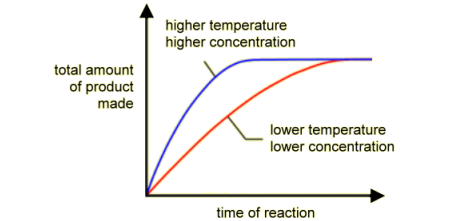
- If the temperature is increased: the reactant particles move more quickly they have more energy the particles collide more often, and more of the collisions result in a reaction the rate of reaction increases
- Higher temperatures also increase the energy of the collisions since the particals are moving faster. reactions only happen if the particles collided with enough energy. at a higher temperature there'll be more particles colliding with enough energy to make the reaction happen.
- Increasing the temperature means the particles are going faster and have more energy
Concentration
- Increasing the concentration ( or pressure ) means the particles are more crowded together
- If the concentration of a dissolved reactant is increased, or the pressure of a reacting gas is increased: the reactant particles become more crowded there is a greater chance of the particles colliding the rate of reaction increases
- Increasing the concentration ( or pressure ) means the particles are more crowded together
Size of particles
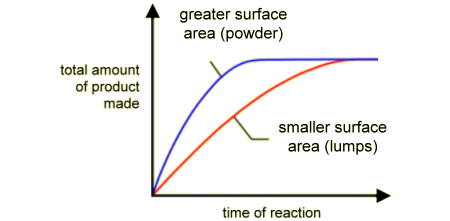
- The rate of a chemical reaction can be raised by increasing the surface area of a solid reactant. This is done by cutting the substance into small pieces, or grinding it into a powder.
- Smaller solid particles ( or more surface area) means other particles can get to it more easily
- If a solid reactant is broken into small pieces or ground into a powder: its surface area increases more particles are exposed to the other reactant there are more collisions the rate of reaction increases
- For Example : calcium carbonate + hydrochloric acid = calcium chloride dioxide + water
- Calcium carbonate is the chemical name for marble, you can change the surface area by breaking large marble chips into small chips
- For Example : calcium carbonate + hydrochloric acid = calcium chloride dioxide + water
- Fine powders of combustion materials dispersed in the air burn very very fast because they have such a big surface area, if they spark they will explode
- Explosions are very fast reactions in which a lot of gaseous product is released very quickly. For example: burning hydrogen explosions from TNT or dynamite
- The rate of a chemical reaction can be raised by increasing the surface area of a solid reactant. This is done by cutting the substance into small pieces, or grinding it into a powder.
Catalysts
- A catalyst is a substance that can increase the rate of a reaction, without being chemically changed or used up in the reaction, and because it isn't used up you only need a tiny bit of it to catalyst large amounts or reaction
- Catalyst are very specific, they only work in certain reactions
- eg: iron, making ammonia from nitrogen and hydrogen
- A catalyst works by giving the reaction particles a surface to stick to where they can bump into each other, and reduces the energy needed by the particles before they react.
- The number of collisions is NOT increased but there are just more successful collisions
Bilder und Dateien der Mindmap
Informationen
- Beschreibung
- GCSE chemistry Mindmap am Collision theory, erstellt von Abi Kohen am 27/10/2013.
- Erstellt von
- Abi Kohen
- Aufrufe
- 1.041
- Tags
- Bewertung