
Mindmap
Questionnaires
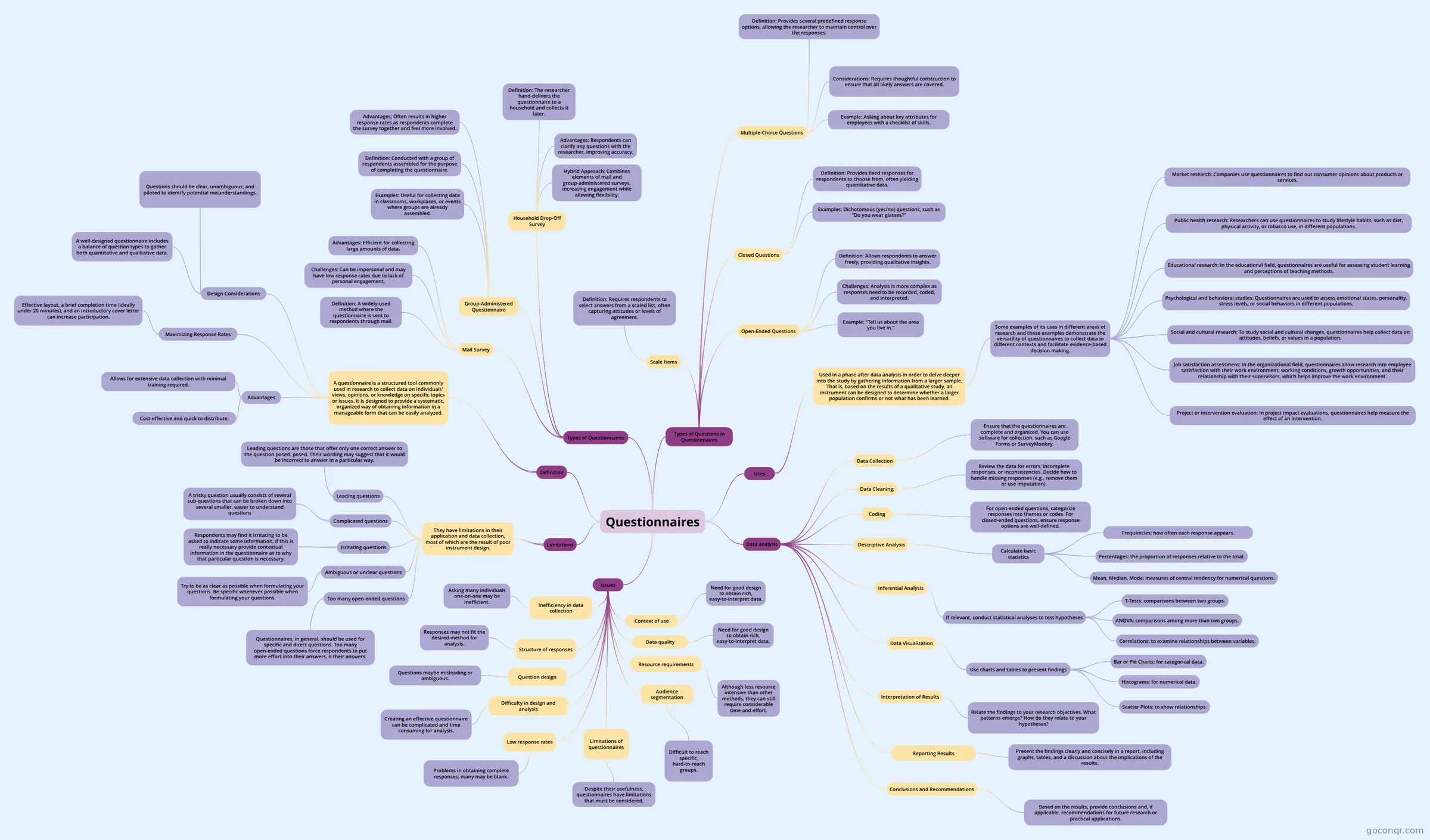
Mind map: Questionnaires
Inhalt der Mindmap
Questionnaires
Definition
- A questionnaire is a structured tool commonly used in research to collect data on individuals' views, opinions, or knowledge on specific topics or issues. It is designed to provide a systematic, organized way of obtaining information in a manageable form that can be easily analyzed.
- Advantages
- Cost-effective and quick to distribute.
- Allows for extensive data collection with minimal training required.
- Design Considerations
- Questions should be clear, unambiguous, and piloted to identify potential misunderstandings.
- A well-designed questionnaire includes a balance of question types to gather both quantitative and qualitative data.
- Maximizing Response Rates
- Effective layout, a brief completion time (ideally under 20 minutes), and an introductory cover letter can increase participation.
- Advantages
- A questionnaire is a structured tool commonly used in research to collect data on individuals' views, opinions, or knowledge on specific topics or issues. It is designed to provide a systematic, organized way of obtaining information in a manageable form that can be easily analyzed.
Issues
- Structure of responses
- Responses may not fit the desired method for analysis.
- Resource requirements
- Although less resource intensive than other methods, they can still require considerable time and effort.
- Audience segmentation
- Difficult to reach specific, hard-to-reach groups.
- Limitations of questionnaires
- Despite their usefulness, questionnaires have limitations that must be considered.
- Data quality
- Need for good design to obtain rich, easy-to-interpret data.
- Difficulty in design and analysis
- Creating an effective questionnaire can be complicated and time consuming for analysis.
- Low response rates
- Problems in obtaining complete responses; many may be blank.
- Question design
- Questions maybe misleading or ambiguous.
- Inefficiency in data collection
- Asking many individuals one-on-one may be inefficient.
- Context of use
- Need for good design to obtain rich, easy-to-interpret data.
- Structure of responses
Types of Questionnaires
- Mail Survey
- Challenges: Can be impersonal and may have low response rates due to lack of personal engagement.
- Definition: A widely-used method where the questionnaire is sent to respondents through mail.
- Advantages: Efficient for collecting large amounts of data.
- Household Drop-Off Survey
- Definition: The researcher hand-delivers the questionnaire to a household and collects it later.
- Hybrid Approach: Combines elements of mail and group-administered surveys, increasing engagement while allowing flexibility.
- Advantages: Respondents can clarify any questions with the researcher, improving accuracy.
- Group-Administered Questionnaire
- Examples: Useful for collecting data in classrooms, workplaces, or events where groups are already assembled.
- Definition: Conducted with a group of respondents assembled for the purpose of completing the questionnaire.
- Advantages: Often results in higher response rates as respondents complete the survey together and feel more involved.
- Mail Survey
Uses
- Used in a phase after data analysis in order to delve deeper into the study by gathering information from a larger sample. That is, based on the results of a qualitative study, an instrument can be designed to determine whether a larger population confirms or not what has been learned.
- Some examples of its uses in different areas of research and these examples demonstrate the versatility of questionnaires to collect data in different contexts and facilitate evidence-based decision making.
- Market research: Companies use questionnaires to find out consumer opinions about products or services.
- Public health research: Researchers can use questionnaires to study lifestyle habits, such as diet, physical activity, or tobacco use, in different populations.
- Educational research: In the educational field, questionnaires are useful for assessing student learning and perceptions of teaching methods.
- Psychological and behavioral studies: Questionnaires are used to assess emotional states, personality, stress levels, or social behaviors in different populations.
- Social and cultural research: To study social and cultural changes, questionnaires help collect data on attitudes, beliefs, or values in a population.
- Job satisfaction assessment: In the organizational field, questionnaires allow research into employee satisfaction with their work environment, working conditions, growth opportunities, and their relationship with their supervisors, which helps improve the work environment.
- Project or intervention evaluation: In project impact evaluations, questionnaires help measure the effect of an intervention.
- Some examples of its uses in different areas of research and these examples demonstrate the versatility of questionnaires to collect data in different contexts and facilitate evidence-based decision making.
- Used in a phase after data analysis in order to delve deeper into the study by gathering information from a larger sample. That is, based on the results of a qualitative study, an instrument can be designed to determine whether a larger population confirms or not what has been learned.
Limitations
- They have limitations in their application and data collection, most of which are the result of poor instrument design.
- Leading questions
- Leading questions are those that offer only one correct answer to the question posed. posed. Their wording may suggest that it would be incorrect to answer in a particular way.
- Complicated questions
- A tricky question usually consists of several sub-questions that can be broken down into several smaller, easier to understand questions
- Irritating questions
- Respondents may find it irritating to be asked to indicate some information, if this is really necessary provide contextual information in the questionnaire as to why that particular question is necessary.
- Ambiguous or unclear questions
- Try to be as clear as possible when formulating your questions. Be specific whenever possible when formulating your questions.
- Too many open-ended questions
- Questionnaires, in general, should be used for specific and direct questions. Too many open-ended questions force respondents to put more effort into their answers. n their answers.
- Leading questions
- They have limitations in their application and data collection, most of which are the result of poor instrument design.
Data analysis
- Inferential Analysis
- If relevant, conduct statistical analyses to test hypotheses
- T-Tests: comparisons between two groups.
- ANOVA: comparisons among more than two groups.
- Correlations: to examine relationships between variables.
- If relevant, conduct statistical analyses to test hypotheses
- Data Visualization
- Use charts and tables to present findings
- Bar or Pie Charts: for categorical data.
- Histograms: for numerical data.
- Scatter Plots: to show relationships.
- Use charts and tables to present findings
- Coding
- For open-ended questions, categorize responses into themes or codes. For closed-ended questions, ensure response options are well-defined.
- Data Collection
- Ensure that the questionnaires are complete and organized. You can use software for collection, such as Google Forms or SurveyMonkey.
- Data Cleaning:
- Review the data for errors, incomplete responses, or inconsistencies. Decide how to handle missing responses (e.g., remove them or use imputation).
- Interpretation of Results
- Relate the findings to your research objectives. What patterns emerge? How do they relate to your hypotheses?
- Descriptive Analysis
- Calculate basic statistics
- Frequencies: how often each response appears.
- Percentages: the proportion of responses relative to the total.
- Mean, Median, Mode: measures of central tendency for numerical questions.
- Calculate basic statistics
- Reporting Results
- Present the findings clearly and concisely in a report, including graphs, tables, and a discussion about the implications of the results.
- Conclusions and Recommendations
- Based on the results, provide conclusions and, if applicable, recommendations for future research or practical applications.
- Inferential Analysis
Types of Questions in Questionnaires
- Closed Questions
- Definition: Provides fixed responses for respondents to choose from, often yielding quantitative data.
- Examples: Dichotomous (yes/no) questions, such as “Do you wear glasses?”
- Multiple-Choice Questions
- Definition: Provides several predefined response options, allowing the researcher to maintain control over the responses.
- Considerations: Requires thoughtful construction to ensure that all likely answers are covered.
- Example: Asking about key attributes for employees with a checklist of skills.
- Open-Ended Questions
- Definition: Allows respondents to answer freely, providing qualitative insights.
- Challenges: Analysis is more complex as responses need to be recorded, coded, and interpreted.
- Example: "Tell us about the area you live in."
- Scale Items
- Definition: Requires respondents to select answers from a scaled list, often capturing attitudes or levels of agreement.
- Closed Questions
Informationen
- Beschreibung
- Members: Perla Sugey Leocadio Garcia ,Genesi Abigail Bastida Mendez ,Daniela Natzieli Torres Garcia ,Vanessa Morales Ordonez ,Ambar Celeste Perez Benavides
- Erstellt von
- Perla Leocadio Garcia
- Aufrufe
- 15
- Bewertung