
Mindmap
Chapter 1
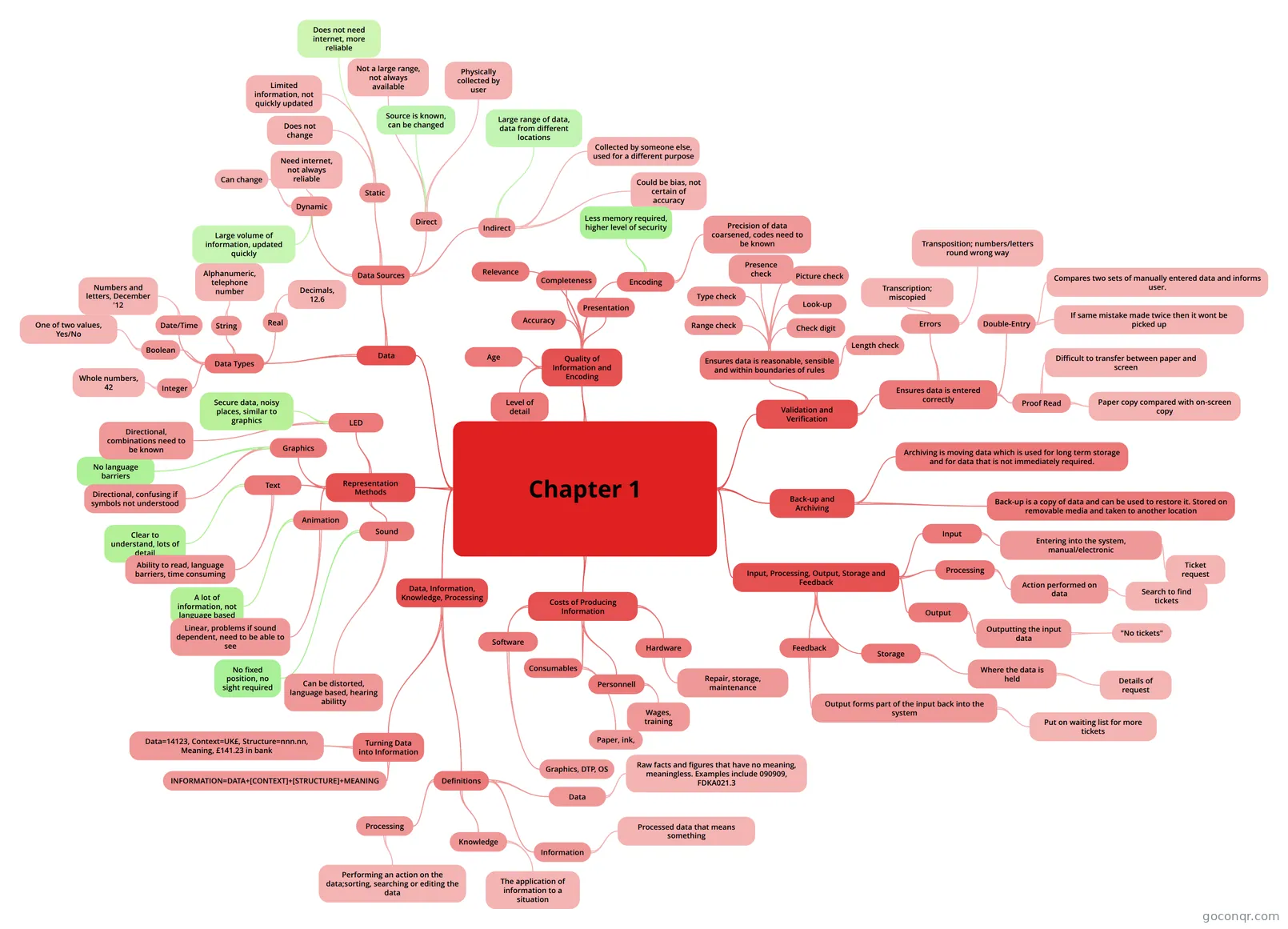
Mind map: Chapter 1 data and information
Inhalt der Mindmap
Chapter 1
Data, Information, Knowledge, Processing
- Definitions
- Data
- Raw facts and figures that have no meaning, meaningless. Examples include 090909, FDKA021.3
- Information
- Processed data that means something
- Knowledge
- The application of information to a situation
- Processing
- Performing an action on the data;sorting, searching or editing the data
- Data
- Turning Data into Information
- INFORMATION=DATA+[CONTEXT]+[STRUCTURE]+MEANING
- Data=14123, Context=UK£, Structure=nnn.nn, Meaning, £141.23 in bank
- Definitions
Representation Methods
- Text
- Clear to understand, lots of detail
- Ability to read, language barriers, time consuming
- Graphics
- No language barriers
- Directional, confusing if symbols not understood
- Sound
- No fixed position, no sight required
- Can be distorted, language based, hearing abilitty
- Animation
- A lot of information, not language based
- Linear, problems if sound dependent, need to be able to see
- LED
- Secure data, noisy places, similar to graphics
- Directional, combinations need to be known
- Text
Data
- Data Types
- Integer
- Whole numbers, 42
- Boolean
- One of two values, Yes/No
- Real
- Decimals, 12.6
- Date/Time
- Numbers and letters, December '12
- String
- Alphanumeric, telephone number
- Integer
- Data Sources
- Static
- Does not change
- Limited information, not quickly updated
- Does not need internet, more reliable
- Dynamic
- Can change
- Need internet, not always reliable
- Large volume of information, updated quickly
- Direct
- Physically collected by user
- Source is known, can be changed
- Not a large range, not always available
- Indirect
- Collected by someone else, used for a different purpose
- Large range of data, data from different locations
- Could be bias, not certain of accuracy
- Static
- Data Types
Quality of Information and Encoding
- Accuracy
- Relevance
- Age
- Level of detail
- Completeness
- Presentation
- Encoding
- Less memory required, higher level of security
- Precision of data coarsened, codes need to be known
Validation and Verification
- Ensures data is reasonable, sensible and within boundaries of rules
- Range check
- Type check
- Presence check
- Length check
- Look-up
- Picture check
- Check digit
- Ensures data is entered correctly
- Errors
- Transcription; miscopied
- Transposition; numbers/letters round wrong way
- Double-Entry
- Compares two sets of manually entered data and informs user.
- If same mistake made twice then it wont be picked up
- Proof Read
- Paper copy compared with on-screen copy
- Difficult to transfer between paper and screen
- Errors
- Ensures data is reasonable, sensible and within boundaries of rules
Input, Processing, Output, Storage and Feedback
- Input
- Entering into the system, manual/electronic
- Ticket request
- Entering into the system, manual/electronic
- Processing
- Action performed on data
- Search to find tickets
- Action performed on data
- Output
- Outputting the input data
- "No tickets"
- Outputting the input data
- Storage
- Where the data is held
- Details of request
- Where the data is held
- Feedback
- Output forms part of the input back into the system
- Put on waiting list for more tickets
- Output forms part of the input back into the system
- Input
Costs of Producing Information
- Software
- Graphics, DTP, OS
- Personnell
- Wages, training
- Consumables
- Paper, ink,
- Hardware
- Repair, storage, maintenance
- Software
Back-up and Archiving
- Back-up is a copy of data and can be used to restore it. Stored on removable media and taken to another location
- Archiving is moving data which is used for long term storage and for data that is not immediately required.
Informationen
- Beschreibung
- ICT AS (Chapter 1 - Data, Information, Knowledge) Mindmap am Chapter 1, erstellt von Katie Difford am 10/04/2013.
- Erstellt von
- Katie Difford
- Aufrufe
- 120
- Tags
- Bewertung