
Mindmap
P.E.R.V.E.R.T
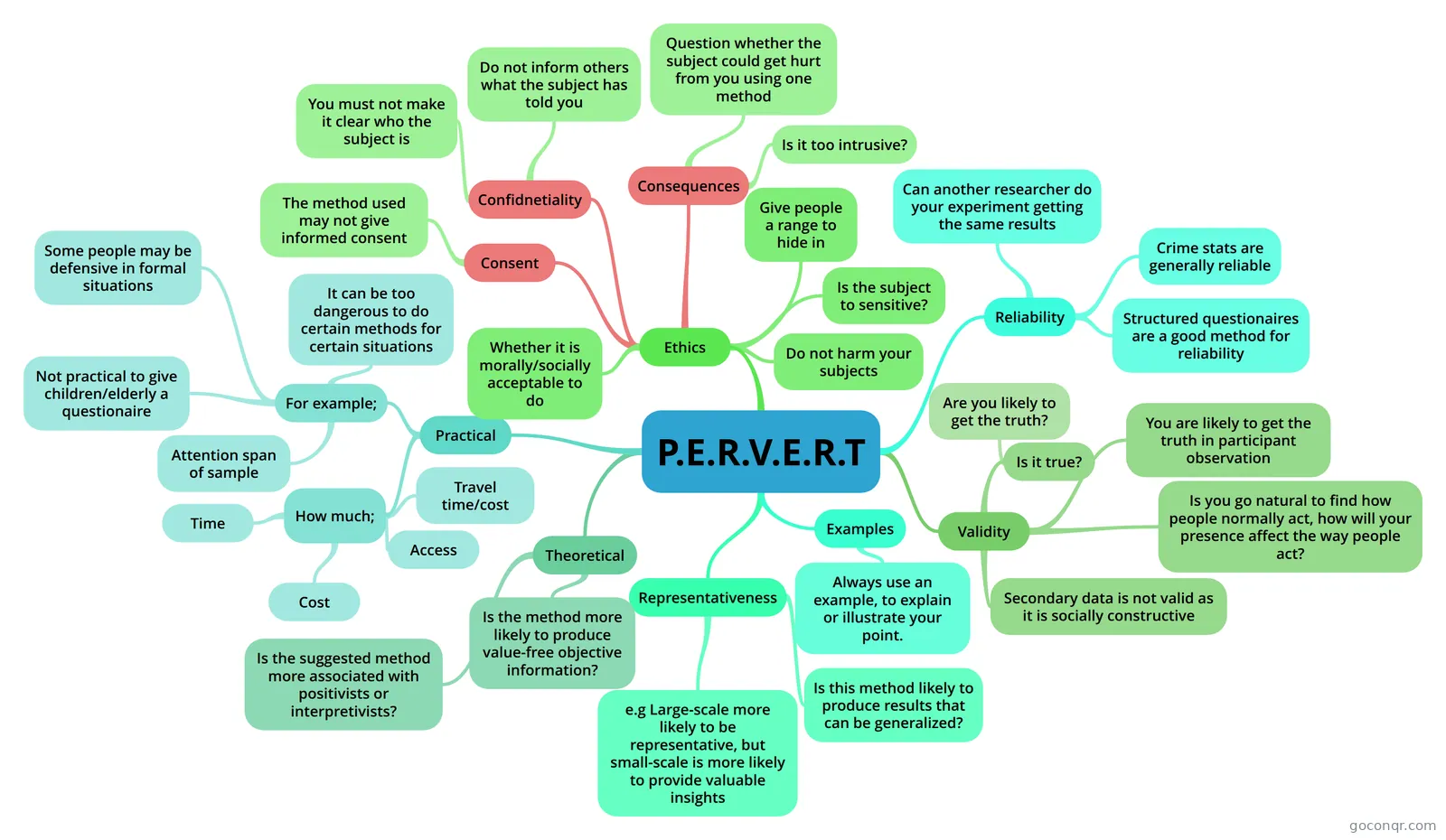
Mind map: P.E.R.V.E.R.T research methods
Inhalt der Mindmap
P.E.R.V.E.R.T
Practical
- How much;
- Time
- Cost
- Access
- Travel time/cost
- For example;
- Not practical to give children/elderly a questionaire
- Because they cant read/see/understand the questions
- Attention span of sample
- Young children will have a small attention span, so a long formal interview probably is not the best option
- It can be too dangerous to do certain methods for certain situations
- e.g it may be to dangerous to interview a street gang
- Some people may be defensive in formal situations
- so they may not give you the whole truth
- Not practical to give children/elderly a questionaire
- How much;
Ethics
- Whether it is morally/socially acceptable to do
- Do not harm your subjects
- Consent
- The method used may not give informed consent
- e.g a child can not give informed consent, they are not aware enough.
- The method used may not give informed consent
- Confidnetiality
- You must not make it clear who the subject is
- anonymise your infomation
- Do not inform others what the subject has told you
- You must not make it clear who the subject is
- Consequences
- Question whether the subject could get hurt from you using one method
- you could hurt the person mentally, or lead them to getting physically hurt
- Is it too intrusive?
- Question whether the subject could get hurt from you using one method
- Give people a range to hide in
- Is the subject to sensitive?
Reliability
- Can another researcher do your experiment getting the same results
- Structured questionaires are a good method for reliability
- Exactly the same questions, with no changing and the same subject should lead to the same results
- Crime stats are generally reliable
- easy to compare you can find them in the public domain (no ethical issues)
Validity
- Is it true?
- Are you likely to get the truth?
- You are likely to get the truth in participant observation
- More likely to get the truth in the subjects 'natural' setting than in a formal interview setting
- Is you go natural to find how people normally act, how will your presence affect the way people act?
- Secondary data is not valid as it is socially constructive
- e.g in catholic countries families will cover up sucides as accidents, to save the deceased 'face'
- Is it true?
Examples
- Always use an example, to explain or illustrate your point.
Representativeness
- Is this method likely to produce results that can be generalized?
- e.g Large-scale more likely to be representative, but small-scale is more likely to provide valuable insights
Theoretical
- Is the method more likely to produce value-free objective information?
- Is the suggested method more associated with positivists or interpretivists?
Informationen
- Beschreibung
- Using P.E.R.V.E.R.T to describe the factors affecting which method you use
- Erstellt von
- Phoebe Fletcher
- Aufrufe
- 1.271
- Tags
- Bewertung