
Mindmap
Police Powers
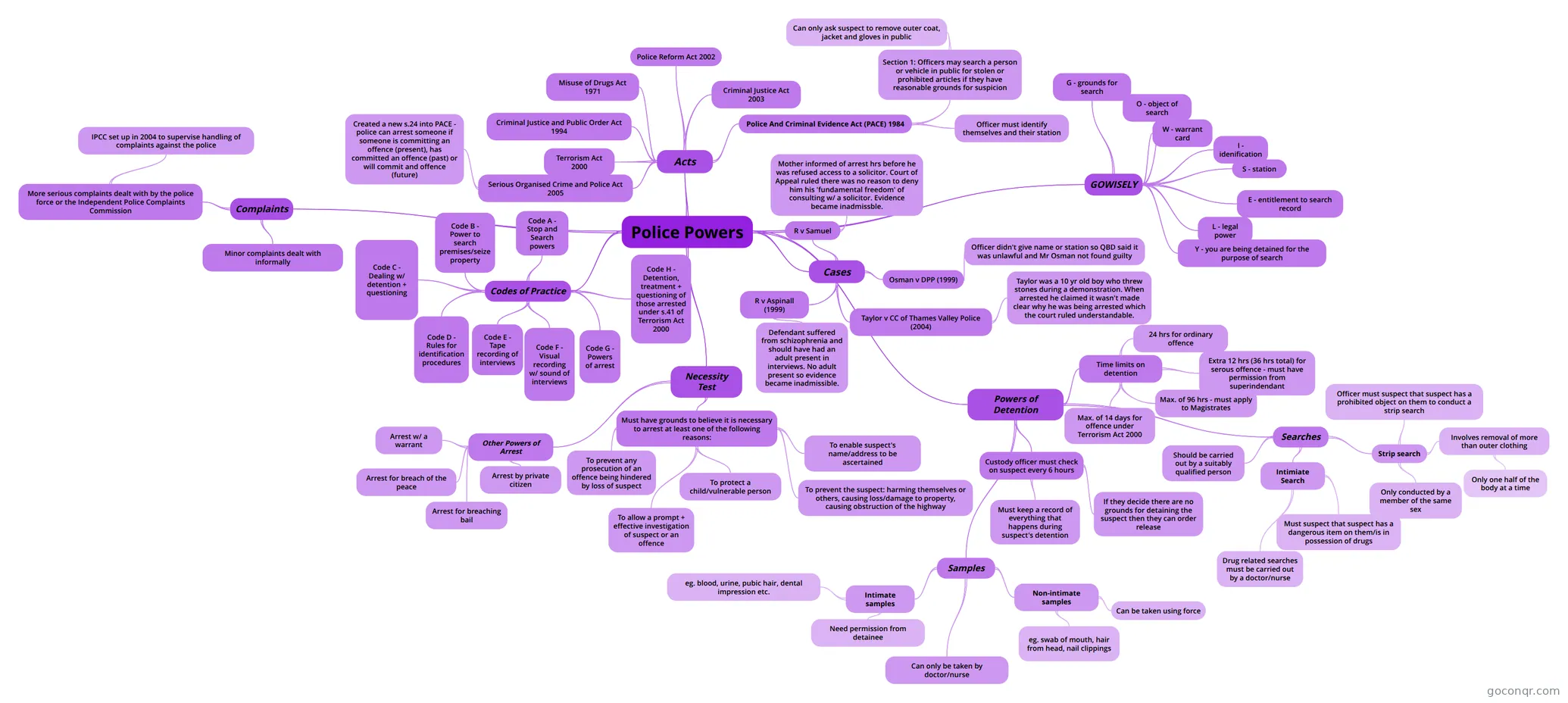
Mind map: Police powers
Inhalt der Mindmap
Police Powers
Acts
- Police And Criminal Evidence Act (PACE) 1984
- Section 1: Officers may search a person or vehicle in public for stolen or prohibited articles if they have reasonable grounds for suspicion
- Can only ask suspect to remove outer coat, jacket and gloves in public
- Officer must identify themselves and their station
- Section 1: Officers may search a person or vehicle in public for stolen or prohibited articles if they have reasonable grounds for suspicion
- Criminal Justice Act 2003
- Misuse of Drugs Act 1971
- Criminal Justice and Public Order Act 1994
- Terrorism Act 2000
- Serious Organised Crime and Police Act 2005
- Created a new s.24 into PACE - police can arrest someone if someone is committing an offence (present), has committed an offence (past) or will commit and offence (future)
- Police Reform Act 2002
- Police And Criminal Evidence Act (PACE) 1984
Cases
- Osman v DPP (1999)
- Officer didn't give name or station so QBD said it was unlawful and Mr Osman not found guilty
- Taylor v CC of Thames Valley Police (2004)
- Taylor was a 10 yr old boy who threw stones during a demonstration. When arrested he claimed it wasn't made clear why he was being arrested which the court ruled understandable.
- R v Samuel
- Mother informed of arrest hrs before he was refused access to a solicitor. Court of Appeal ruled there was no reason to deny him his 'fundamental freedom' of consulting w/ a solicitor. Evidence became inadmissble.
- R v Aspinall (1999)
- Defendant suffered from schizophrenia and should have had an adult present in interviews. No adult present so evidence became inadmissible.
- Osman v DPP (1999)
Codes of Practice
- Code A - Stop and Search powers
- Code B - Power to search premises/seize property
- Code C - Dealing w/ detention + questioning
- Code D - Rules for identification procedures
- Code E - Tape recording of interviews
- Code F - Visual recording w/ sound of interviews
- Code G - Powers of arrest
- Code H - Detention, treatment + questioning of those arrested under s.41 of Terrorism Act 2000
Necessity Test
- Must have grounds to believe it is necessary to arrest at least one of the following reasons:
- To enable suspect's name/address to be ascertained
- To prevent the suspect: harming themselves or others, causing loss/damage to property, causing obstruction of the highway
- To protect a child/vulnerable person
- To allow a prompt + effective investigation of suspect or an offence
- To prevent any prosecution of an offence being hindered by loss of suspect
- Other Powers of Arrest
- Arrest for breaching bail
- Arrest for breach of the peace
- Arrest w/ a warrant
- Arrest by private citizen
- Must have grounds to believe it is necessary to arrest at least one of the following reasons:
Powers of Detention
- Time limits on detention
- 24 hrs for ordinary offence
- Extra 12 hrs (36 hrs total) for serous offence - must have permission from superindendant
- Max. of 96 hrs - must apply to Magistrates
- Max. of 14 days for offence under Terrorism Act 2000
- Custody officer must check on suspect every 6 hours
- If they decide there are no grounds for detaining the suspect then they can order release
- Must keep a record of everything that happens during suspect's detention
- Searches
- Strip search
- Officer must suspect that suspect has a prohibited object on them to conduct a strip search
- Involves removal of more than outer clothing
- Only one half of the body at a time
- Only conducted by a member of the same sex
- Intimiate Search
- Must suspect that suspect has a dangerous item on them/is in possession of drugs
- Drug related searches must be carried out by a doctor/nurse
- Should be carried out by a suitably qualified person
- Strip search
- Samples
- Non-intimate samples
- Can be taken using force
- eg. swab of mouth, hair from head, nail clippings
- Intimate samples
- Need permission from detainee
- eg. blood, urine, pubic hair, dental impression etc.
- Can only be taken by doctor/nurse
- Non-intimate samples
- Time limits on detention
Complaints
- Minor complaints dealt with informally
- More serious complaints dealt with by the police force or the Independent Police Complaints Commission
- IPCC set up in 2004 to supervise handling of complaints against the police
GOWISELY
- G - grounds for search
- O - object of search
- W - warrant card
- I - idenification
- S - station
- E - entitlement to search record
- L - legal power
- Y - you are being detained for the purpose of search
Informationen
- Beschreibung
- Unit 1 - English Legal System
- Erstellt von
- emilyyoung212
- Aufrufe
- 396
- Tags
- Bewertung