
Mindmap
AS Sociology - Families and Households functionalist perspective.
Inhalt der Mindmap
AS Sociology - Families and Households functionalist perspective.
A brief overview of functionalists.
- They believe society is based on consensus.
- It is harmonious, it meets the needs of society and the individual.
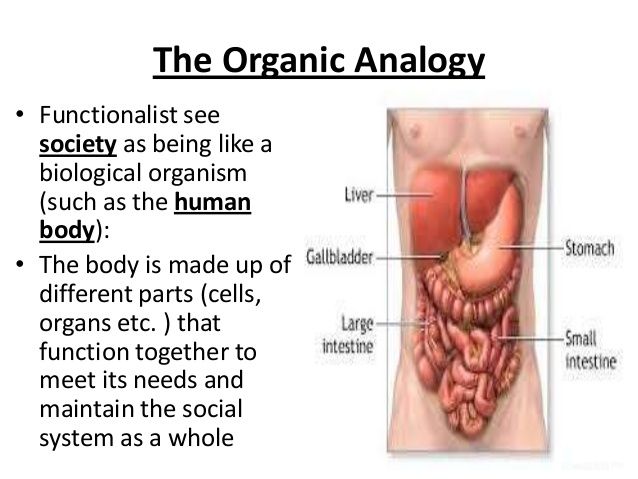
- They believe in the organic analogy ->
- They believe society is structural, it has clear fixed structures.
- They take a macro approach.
- Key theorists
- They believe society is based on consensus.
Childhood
- They believe that there has been a march of progress.
- Childhood is a golden age. - Pilcher (1995)
- Happiness and innocence.
- Clear and distinct life stage.
- It is separate from the adult world.
- Children are protected from adulthood.
- Therefore they are better socilalised.
- And then they become better adapted adults.
- Therefore they are better socilalised.
Family diversity
- Parsons sees the nuclear family provides the best 'functional fit' in society.
- The roles within the division of labour are:
- Expressive - The wife takes care of domesticity, emotions and raises the children.
- Instrumental - The husband is the breadwinner and provides economical capital and provides for the family
- These two roles allow the family to perform two essential functions:
- The primary socialisation of children.
- Stabilisation of adult personalities.
- Other family types are considered dysfunctional.
- The roles within the division of labour are:
- Parsons sees the nuclear family provides the best 'functional fit' in society.
Changing family patterns
- They like marriage as it creates a 'functional fit'.
- They are 'On the fence' about divorce, it's not a threat as remarriage shows committed to the idea of marriage.
- Other family types are dysfunctional.
Social policy
- The state acts on behalf of its member's best interests.
- Fletcher (1966) argues the introduction of health, education and housing policies since the industrial revolution has led to the development of the welfare state that supports families.
- For example, the NHS.
- Fletcher (1966) argues the introduction of health, education and housing policies since the industrial revolution has led to the development of the welfare state that supports families.
- The state acts on behalf of its member's best interests.
Role of the family
- Murdock (1949) believes the family perform 4 essential functions to meet the needs of society and its members.
- 1. Stable satisfaction of the sex drive.
- 2. Reproduction of the next generation.
- 3. Socialisation of the young.
- 4. Meeting its members economical needs.
- Parsons argues there is only two functions.
- 2. The stabilisation of adult personalities.
- 1. The primary socialisation of children.
- He also says that the functions that a family performs depends on the society it is found in.
- It performs a 'functional fit'.
- He identifies two family types:
- Nuclear family
- Britain began to industrialise.
- Industrialisation brought along two new needs:
- 1. Geographically mobile workforce.
- 2. Socially mobile workforce.
- Industrialisation brought along two new needs:
- Britain began to industrialise.
- Extended family
- In pre-industrial times this was the best 'functional fit'.
- They needed to be self-sufficient.
- A unit of production and consumption.
- Nuclear family
- Murdock (1949) believes the family perform 4 essential functions to meet the needs of society and its members.
Couples
- Parsons clear division of labour roles:
- Instrumental
- Expressive
- Believes there are biological differences between sexes.
- Women being more 'naturally' suited to the nurturing role
- Men being more suited to the provider role.
- Bott (1957) talks about two types of conjugal roles within a marriage.
- Segregated conjugal roles
- Joint conjugal roles
- Young and Willmott found there had been a march of progress in Bethnal Green from segregated to joint over 20 years.
- They call a family with joint roles a symmetrical family.
- This march of progress is because of these certain social changes:
- 1. New technology
- 2. Geographical mobility
- 3. Higher standards of living
- 4. Changes in the position in women
- This march of progress is because of these certain social changes:
- They call a family with joint roles a symmetrical family.
- Parsons clear division of labour roles:
Bilder und Dateien der Mindmap
Informationen
- Beschreibung
- A mind map summarising functionalist views on the topics families and households.
- Erstellt von
- Camille Bailey
- Aufrufe
- 721
- Tags
- Bewertung