
Mindmap
Inheritance GCSE
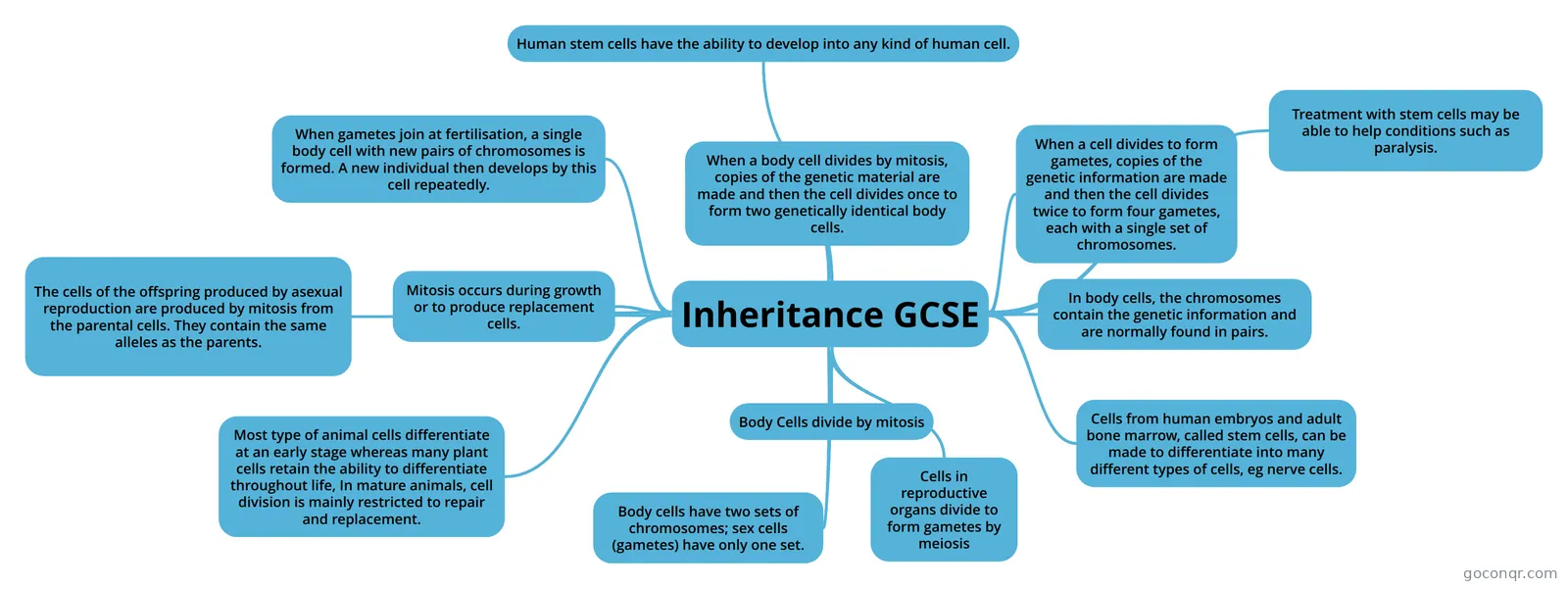
Mind map: Inheritance GCSE biology
Inhalt der Mindmap
Inheritance GCSE
Body Cells divide by mitosis
In body cells, the chromosomes contain the genetic information and are normally found in pairs.
When a body cell divides by mitosis, copies of the genetic material are made and then the cell divides once to form two genetically identical body cells.
Mitosis occurs during growth or to produce replacement cells.
Body cells have two sets of chromosomes; sex cells (gametes) have only one set.
Cells in reproductive organs divide to form gametes by meiosis
When a cell divides to form gametes, copies of the genetic information are made and then the cell divides twice to form four gametes, each with a single set of chromosomes.
When gametes join at fertilisation, a single body cell with new pairs of chromosomes is formed. A new individual then develops by this cell repeatedly.
Most type of animal cells differentiate at an early stage whereas many plant cells retain the ability to differentiate throughout life, In mature animals, cell division is mainly restricted to repair and replacement.
Cells from human embryos and adult bone marrow, called stem cells, can be made to differentiate into many different types of cells, eg nerve cells.
Human stem cells have the ability to develop into any kind of human cell.
Treatment with stem cells may be able to help conditions such as paralysis.
The cells of the offspring produced by asexual reproduction are produced by mitosis from the parental cells. They contain the same alleles as the parents.