
Mindmap
Monopoly
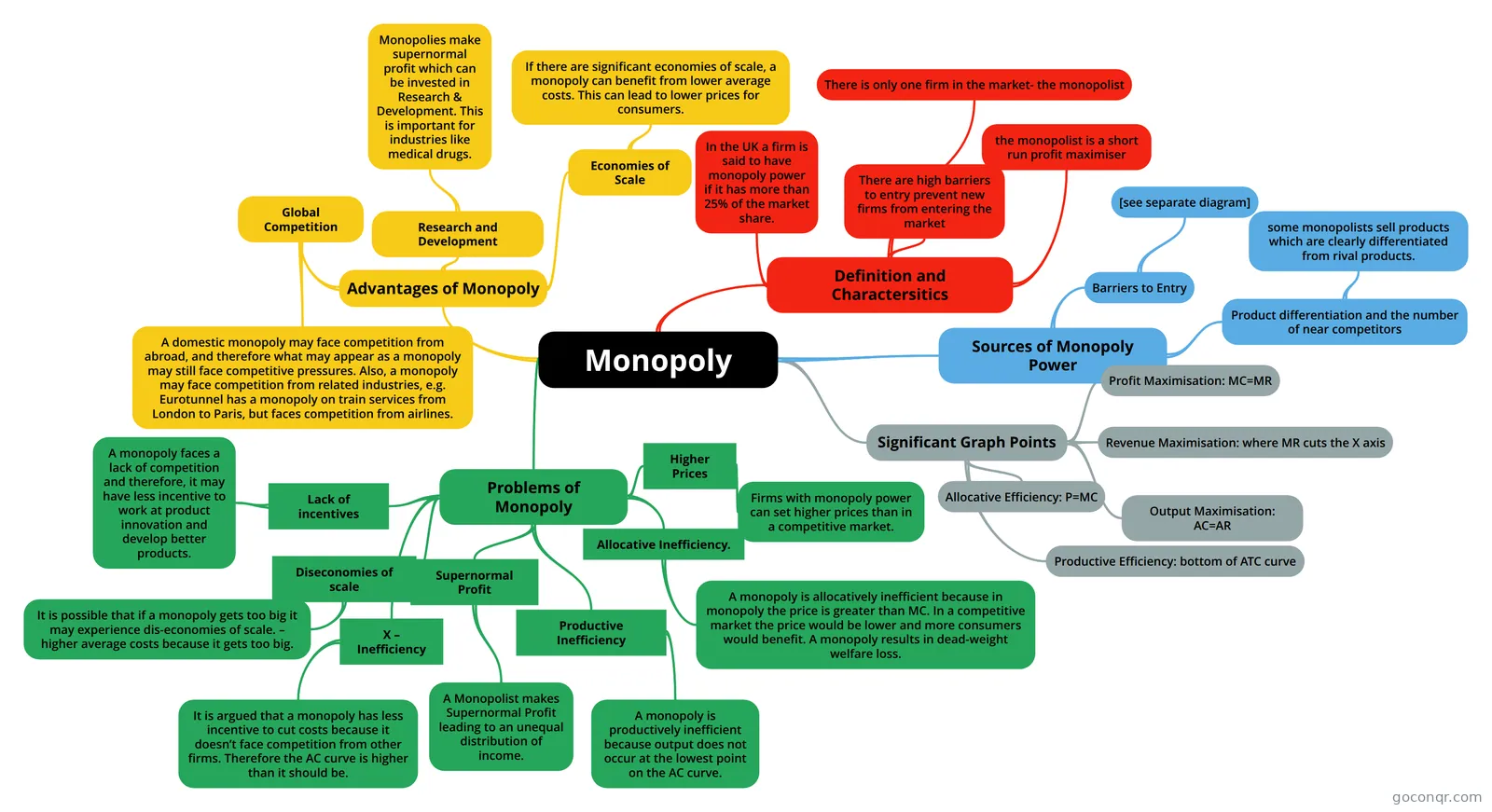
Mind map: Monopoly
Inhalt der Mindmap
Monopoly
Definition and Charactersitics
- In the UK a firm is said to have monopoly power if it has more than 25% of the market share.
- There is only one firm in the market- the monopolist
- There are high barriers to entry prevent new firms from entering the market
- the monopolist is a short run profit maximiser
Sources of Monopoly Power
- Barriers to Entry
- [see separate diagram]
- Product differentiation and the number of near competitors
- some monopolists sell products which are clearly differentiated from rival products.
- Barriers to Entry
Significant Graph Points
- Profit Maximisation: MC=MR
- Revenue Maximisation: where MR cuts the X axis
- Output Maximisation: AC=AR
- Allocative Efficiency: P=MC
- Productive Efficiency: bottom of ATC curve
Problems of Monopoly
- Higher Prices
- Firms with monopoly power can set higher prices than in a competitive market.
- Allocative Inefficiency.
- A monopoly is allocatively inefficient because in monopoly the price is greater than MC. In a competitive market the price would be lower and more consumers would benefit. A monopoly results in dead-weight welfare loss.
- Productive Inefficiency
- A monopoly is productively inefficient because output does not occur at the lowest point on the AC curve.
- X – Inefficiency
- It is argued that a monopoly has less incentive to cut costs because it doesn’t face competition from other firms. Therefore the AC curve is higher than it should be.
- Supernormal Profit
- A Monopolist makes Supernormal Profit leading to an unequal distribution of income.
- Diseconomies of scale
- It is possible that if a monopoly gets too big it may experience dis-economies of scale. – higher average costs because it gets too big.
- Lack of incentives
- A monopoly faces a lack of competition and therefore, it may have less incentive to work at product innovation and develop better products.
- Higher Prices
Advantages of Monopoly
- Economies of Scale
- If there are significant economies of scale, a monopoly can benefit from lower average costs. This can lead to lower prices for consumers.
- Research and Development
- Monopolies make supernormal profit which can be invested in Research & Development. This is important for industries like medical drugs.
- Global Competition
- A domestic monopoly may face competition from abroad, and therefore what may appear as a monopoly may still face competitive pressures. Also, a monopoly may face competition from related industries, e.g. Eurotunnel has a monopoly on train services from London to Paris, but faces competition from airlines.
- Economies of Scale
Informationen
- Beschreibung
- A-Level Economics (Microeconomics) Mindmap am Monopoly, erstellt von Abi Penman am 05/04/2016.
- Erstellt von
- Abi Penman
- Aufrufe
- 2
- Bewertung