
Mindmap
Adaptations
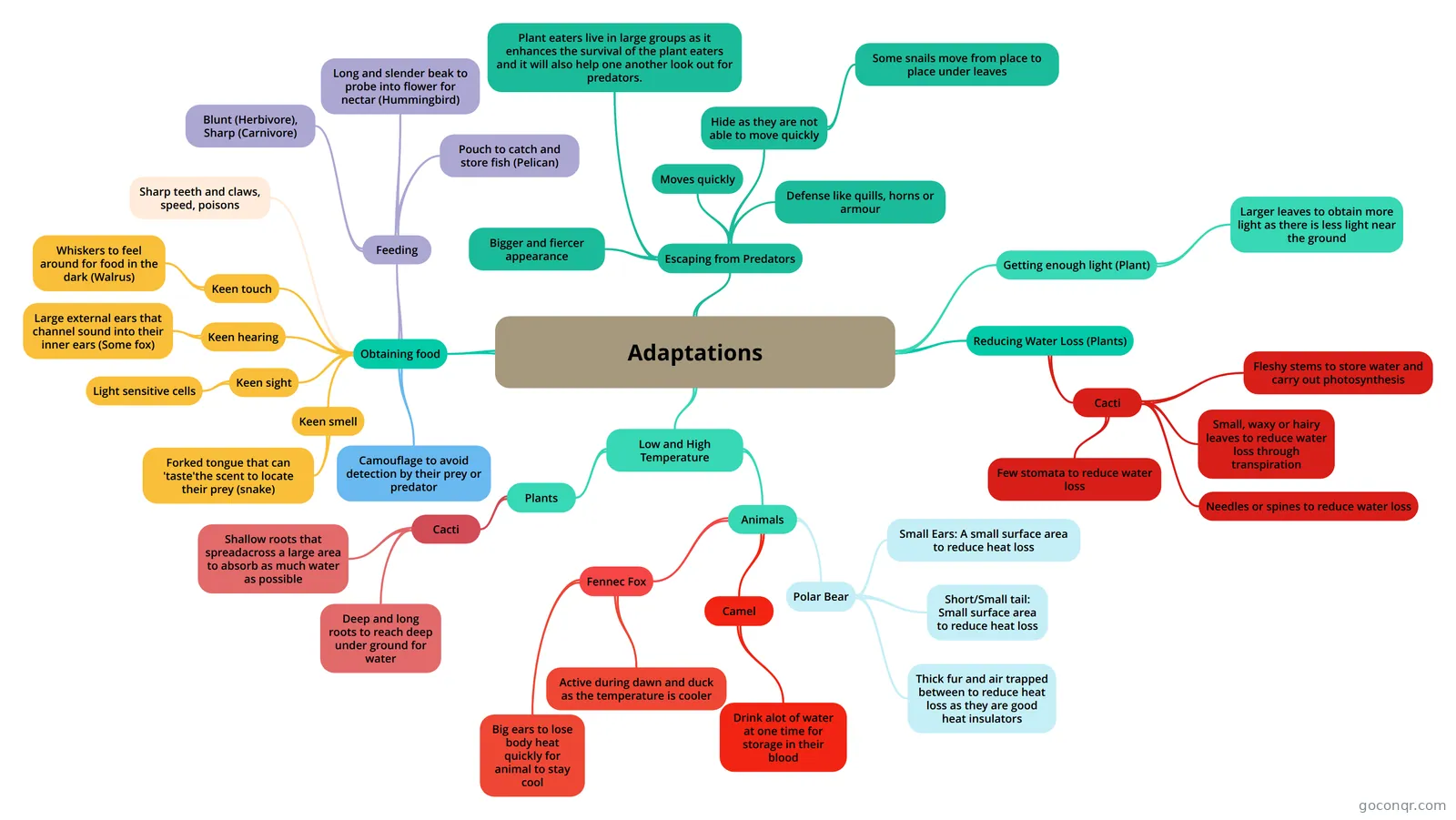
Mind map: Adaptations
Inhalt der Mindmap
Adaptations
- Colour code: Warm colours (Heat) Cool colours ( Low temperature)
Low and High Temperature
- Animals
- Polar Bear
- Thick fur and air trapped between to reduce heat loss as they are good heat insulators
- Small Ears: A small surface area to reduce heat loss
- Short/Small tail: Small surface area to reduce heat loss
- Fennec Fox
- Big ears to lose body heat quickly for animal to stay cool
- Active during dawn and duck as the temperature is cooler
- Camel
- Drink alot of water at one time for storage in their blood
- Polar Bear
- Plants
- Cacti
- Deep and long roots to reach deep under ground for water
- Shallow roots that spreadacross a large area to absorb as much water as possible
- Cacti
- Animals
Getting enough light (Plant)
- Larger leaves to obtain more light as there is less light near the ground
Reducing Water Loss (Plants)
- Cacti
- Small, waxy or hairy leaves to reduce water loss through transpiration
- Needles or spines to reduce water loss
- Fleshy stems to store water and carry out photosynthesis
- Few stomata to reduce water loss
- Cacti
Obtaining food
- Keen smell
- Forked tongue that can 'taste'the scent to locate their prey (snake)
- Keen sight
- Light sensitive cells
- Keen hearing
- Large external ears that channel sound into their inner ears (Some fox)
- Keen touch
- Whiskers to feel around for food in the dark (Walrus)
- Sharp teeth and claws, speed, poisons
- Camouflage to avoid detection by their prey or predator
- Feeding
- Blunt (Herbivore), Sharp (Carnivore)
- Long and slender beak to probe into flower for nectar (Hummingbird)
- Pouch to catch and store fish (Pelican)
- Keen smell
Escaping from Predators
- Plant eaters live in large groups as it enhances the survival of the plant eaters and it will also help one another look out for predators.
- Moves quickly
- Hide as they are not able to move quickly
- Some snails move from place to place under leaves
- Defense like quills, horns or armour
- Bigger and fiercer appearance
Informationen
- Beschreibung
- Primary School Leaving Examination Science Mindmap am Adaptations, erstellt von Mildred Ng am 14/06/2016.
- Erstellt von
- Mildred Ng
- Aufrufe
- 1
- Bewertung