
Mindmap
Personality - Psychodynamic
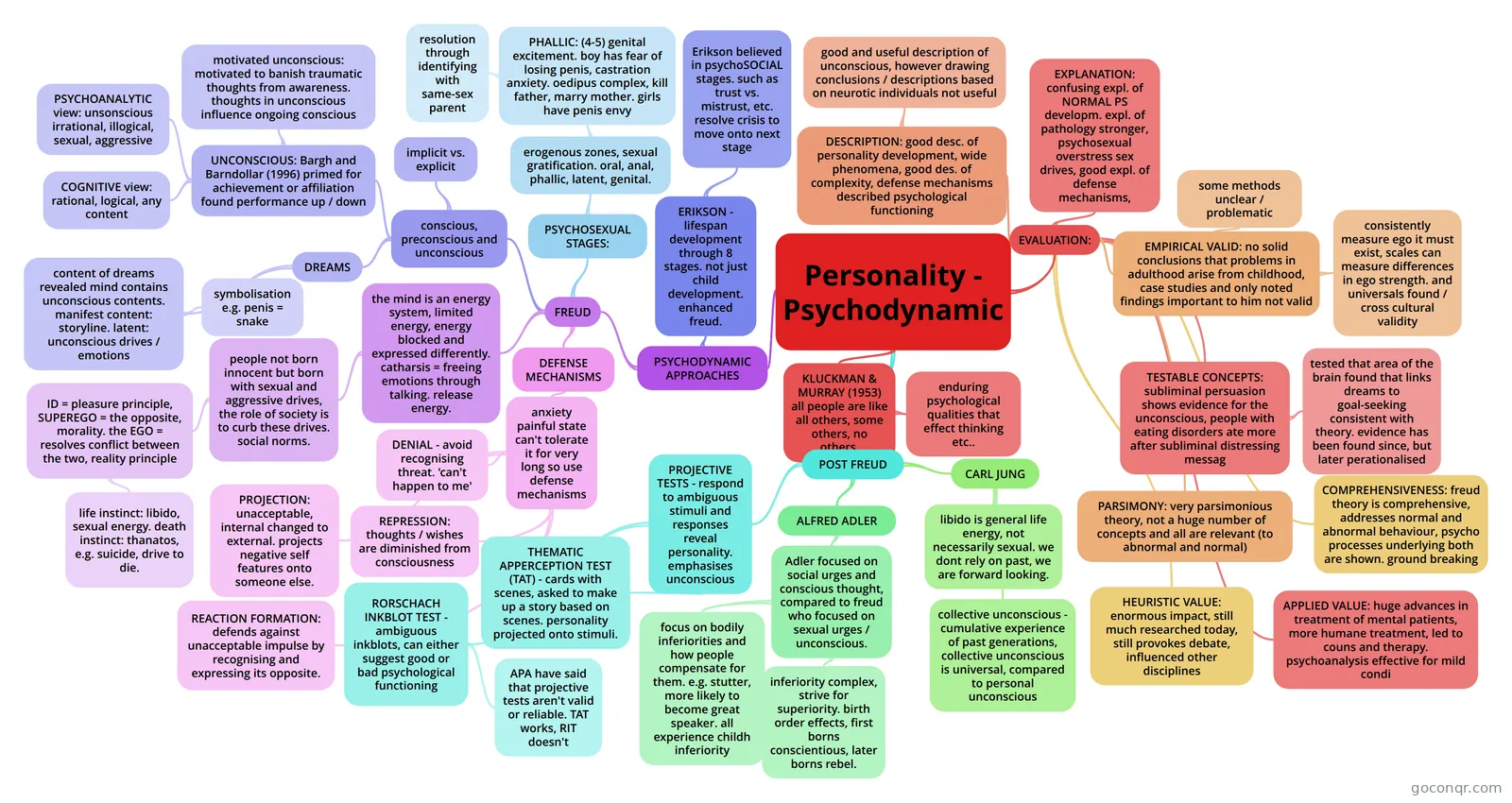
Mind map: Psychodynamic approach to personality
Inhalt der Mindmap
Personality - Psychodynamic
KLUCKMAN & MURRAY (1953) all people are like all others, some others, no others.
- enduring psychological qualities that effect thinking etc..
PSYCHODYNAMIC APPROACHES
- FREUD
- the mind is an energy system, limited energy, energy blocked and expressed differently. catharsis = freeing emotions through talking. release energy.
- people not born innocent but born with sexual and aggressive drives, the role of society is to curb these drives. social norms.
- ID = pleasure principle, SUPEREGO = the opposite, morality. the EGO = resolves conflict between the two, reality principle
- life instinct: libido, sexual energy. death instinct: thanatos, e.g. suicide, drive to die.
- ID = pleasure principle, SUPEREGO = the opposite, morality. the EGO = resolves conflict between the two, reality principle
- people not born innocent but born with sexual and aggressive drives, the role of society is to curb these drives. social norms.
- conscious, preconscious and unconscious
- UNCONSCIOUS: Bargh and Barndollar (1996) primed for achievement or affiliation found performance up / down
- PSYCHOANALYTIC view: unsonscious irrational, illogical, sexual, aggressive
- COGNITIVE view: rational, logical, any content
- motivated unconscious: motivated to banish traumatic thoughts from awareness. thoughts in unconscious influence ongoing conscious
- DREAMS
- content of dreams revealed mind contains unconscious contents. manifest content: storyline. latent: unconscious drives / emotions
- symbolisation e.g. penis = snake
- content of dreams revealed mind contains unconscious contents. manifest content: storyline. latent: unconscious drives / emotions
- implicit vs. explicit
- UNCONSCIOUS: Bargh and Barndollar (1996) primed for achievement or affiliation found performance up / down
- DEFENSE MECHANISMS
- anxiety painful state can't tolerate it for very long so use defense mechanisms
- DENIAL - avoid recognising threat. 'can't happen to me'
- PROJECTION: unacceptable, internal changed to external. projects negative self features onto someone else.
- REACTION FORMATION: defends against unacceptable impulse by recognising and expressing its opposite.
- REPRESSION: thoughts / wishes are diminished from consciousness
- anxiety painful state can't tolerate it for very long so use defense mechanisms
- PSYCHOSEXUAL STAGES:
- erogenous zones, sexual gratification. oral, anal, phallic, latent, genital.
- PHALLIC: (4-5) genital excitement. boy has fear of losing penis, castration anxiety. oedipus complex, kill father, marry mother. girls have penis envy
- resolution through identifying with same-sex parent
- PHALLIC: (4-5) genital excitement. boy has fear of losing penis, castration anxiety. oedipus complex, kill father, marry mother. girls have penis envy
- erogenous zones, sexual gratification. oral, anal, phallic, latent, genital.
- the mind is an energy system, limited energy, energy blocked and expressed differently. catharsis = freeing emotions through talking. release energy.
- ERIKSON - lifespan development through 8 stages. not just child development. enhanced freud.
- Erikson believed in psychoSOCIAL stages. such as trust vs. mistrust, etc. resolve crisis to move onto next stage
- FREUD
POST FREUD
- PROJECTIVE TESTS - respond to ambiguous stimuli and responses reveal personality. emphasises unconscious
- RORSCHACH INKBLOT TEST - ambiguous inkblots, can either suggest good or bad psychological functioning
- APA have said that projective tests aren't valid or reliable. TAT works, RIT doesn't
- THEMATIC APPERCEPTION TEST (TAT) - cards with scenes, asked to make up a story based on scenes. personality projected onto stimuli.
- RORSCHACH INKBLOT TEST - ambiguous inkblots, can either suggest good or bad psychological functioning
- ALFRED ADLER
- Adler focused on social urges and conscious thought, compared to freud who focused on sexual urges / unconscious.
- focus on bodily inferiorities and how people compensate for them. e.g. stutter, more likely to become great speaker. all experience childh inferiority
- inferiority complex, strive for superiority. birth order effects, first borns conscientious, later borns rebel.
- Adler focused on social urges and conscious thought, compared to freud who focused on sexual urges / unconscious.
- CARL JUNG
- libido is general life energy, not necessarily sexual. we dont rely on past, we are forward looking.
- collective unconscious - cumulative experience of past generations, collective unconscious is universal, compared to personal unconscious
- PROJECTIVE TESTS - respond to ambiguous stimuli and responses reveal personality. emphasises unconscious
EVALUATION:
- DESCRIPTION: good desc. of personality development, wide phenomena, good des. of complexity, defense mechanisms described psychological functioning
- good and useful description of unconscious, however drawing conclusions / descriptions based on neurotic individuals not useful
- EXPLANATION: confusing expl. of NORMAL PS developm. expl. of pathology stronger, psychosexual overstress sex drives, good expl. of defense mechanisms,
- EMPIRICAL VALID: no solid conclusions that problems in adulthood arise from childhood, case studies and only noted findings important to him not valid
- some methods unclear / problematic
- consistently measure ego it must exist, scales can measure differences in ego strength. and universals found / cross cultural validity
- TESTABLE CONCEPTS: subliminal persuasion shows evidence for the unconscious, people with eating disorders ate more after subliminal distressing messag
- tested that area of the brain found that links dreams to goal-seeking consistent with theory. evidence has been found since, but later perationalised
- COMPREHENSIVENESS: freud theory is comprehensive, addresses normal and abnormal behaviour, psycho processes underlying both are shown. ground breaking
- PARSIMONY: very parsimonious theory, not a huge number of concepts and all are relevant (to abnormal and normal)
- HEURISTIC VALUE: enormous impact, still much researched today, still provokes debate, influenced other disciplines
- APPLIED VALUE: huge advances in treatment of mental patients, more humane treatment, led to couns and therapy. psychoanalysis effective for mild condi
- DESCRIPTION: good desc. of personality development, wide phenomena, good des. of complexity, defense mechanisms described psychological functioning
Informationen
- Beschreibung
- Personality - NOT NEEDED Mindmap am Personality - Psychodynamic, erstellt von becky.waine am 29/04/2013.
- Erstellt von
- becky.waine
- Aufrufe
- 246
- Tags
- Bewertung