
Mindmap
Ethics
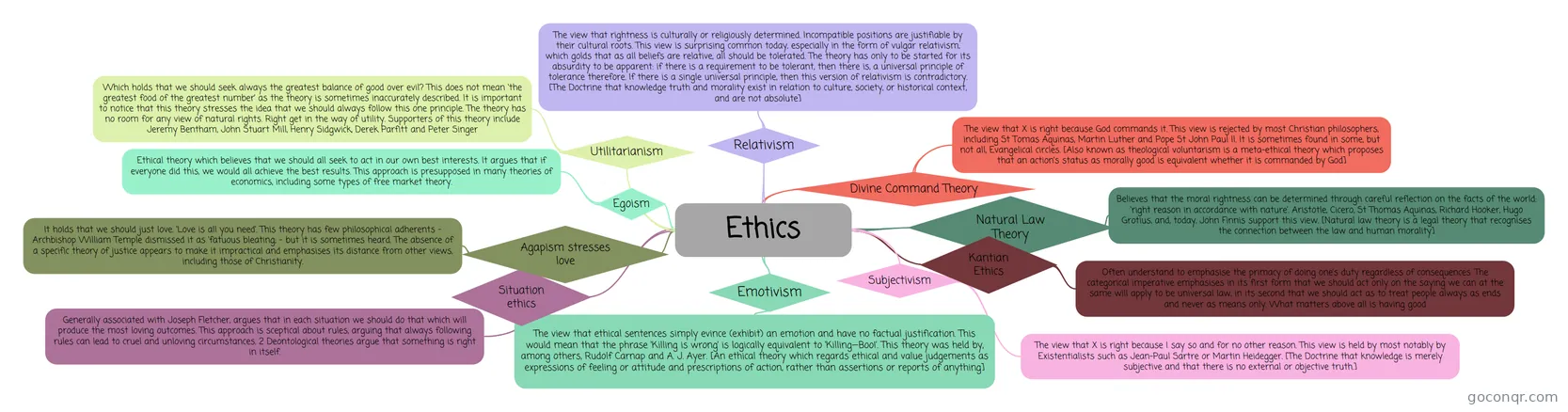
Mind map: Ethics
Inhalt der Mindmap
Ethics
Emotivism
- The view that ethical sentences simply evince (exhibit) an emotion and have no factual justification. This would mean that the phrase ‘Killing is wrong’ is logically equivalent to ‘Killing—Boo!’. This theory was held by, among others, Rudolf Carnap and A. J. Ayer. [An ethical theory which regards ethical and value judgements as expressions of feeling or attitude and prescriptions of action, rather than assertions or reports of anything]
Subjectivism
- The view that X is right because I say so and for no other reason. This view is held by most notably by Existentialists such as Jean-Paul Sartre or Martin Heidegger. [The Doctrine that knowledge is merely subjective and that there is no external or objective truth.]
Relativism
- The view that rightness is culturally or religiously determined. Incompatible positions are justifiable by their cultural roots. This view is surprising common today, especially in the form of vulgar relativism, which golds that as all beliefs are relative, all should be tolerated. The theory has only to be started for its absurdity to be apparent: if there is a requirement to be tolerant, then there is, a universal principle of tolerance therefore. If there is a single universal principle, then this version of relativism is contradictory. [The Doctrine that knowledge truth and morality exist in relation to culture, society, or historical context, and are not absolute]
Divine Command Theory
- The view that X is right because God commands it. This view is rejected by most Christian philosophers, including St Tomas Aquinas, Martin Luther and Pope St John Paul II. It is sometimes found in some, but not all, Evangelical circles. [Also known as theological voluntarism is a meta-ethical theory which proposes that an action’s status as morally good is equivalent whether it is commanded by God]
Natural Law Theory
- Believes that the moral rightness can be determined through careful reflection on the facts of the world: ‘right reason in accordance with nature’. Aristotle, Cicero, St Thomas Aquinas, Richard Hooker, Hugo Grotius, and, today, John Finnis support this view. [Natural law theory is a legal theory that recognises the connection between the law and human morality]
Utilitarianism
- Which holds that we should seek always the greatest balance of good over evil? This does not mean ‘the greatest food of the greatest number’ as the theory is sometimes inaccurately described. It is important to notice that this theory stresses the idea that we should always follow this one principle. The theory has no room for any view of natural rights. Right get in the way of utility. Supporters of this theory include Jeremy Bentham, John Stuart Mill, Henry Sidgwick, Derek Parfitt and Peter Singer
Egoism
- Ethical theory which believes that we should all seek to act in our own best interests. It argues that if everyone did this, we would all achieve the best results. This approach is presupposed in many theories of economics, including some types of free market theory.
Situation ethics
- Generally associated with Joseph Fletcher, argues that in each situation we should do that which will produce the most loving outcomes. This approach is sceptical about rules, arguing that always following rules can lead to cruel and unloving circumstances. 2 Deontological theories argue that something is right in itself.
Kantian Ethics
- Often understand to emphasise the primacy of doing one’s duty regardless of consequences. The categorical imperative emphasises in its first form that we should act only on the saying we can at the same will apply to be universal law, in its second that we should act as to treat people always as ends and never as means only. What matters above all is having good
Agapism stresses love
- It holds that we should just love. ‘Love is all you need’. This theory has few philosophical adherents – Archbishop William Temple dismissed it as ‘fatuous bleating; - but it is sometimes heard. The absence of a specific theory of justice appears to make it impractical and emphasises its distance from other views, including those of Christianity.
Informationen
- Beschreibung
- TYPES OF ETHICS AND EXPLANATIONS
- Erstellt von
- Lily Morrison
- Aufrufe
- 1
- Tags
- Bewertung