
Mindmap
Jekyll and Hyde - Themes
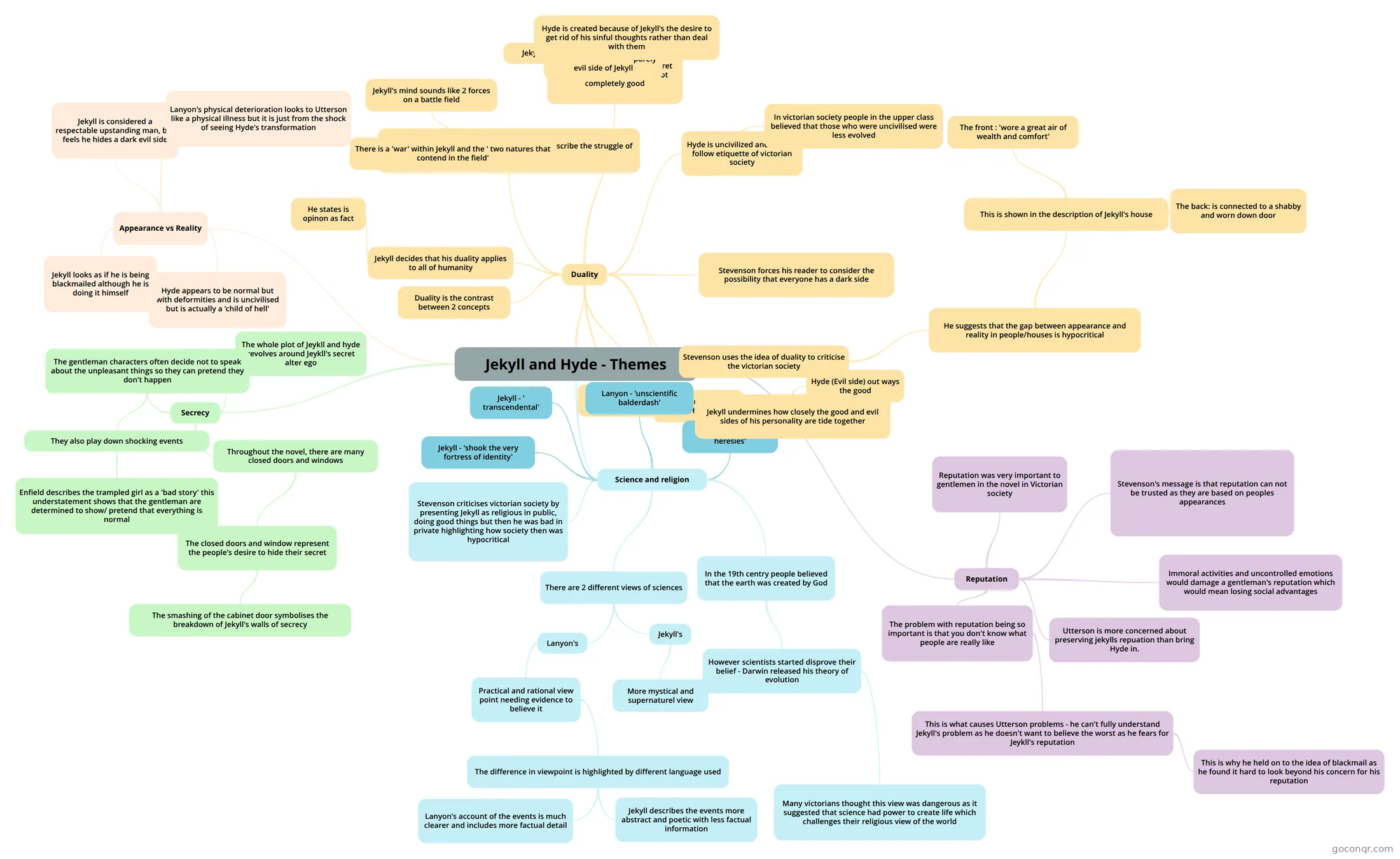
Mind map: Jekyll and Hyde themes
Inhalt der Mindmap
Jekyll and Hyde - Themes
Reputation
- Immoral activities and uncontrolled emotions would damage a gentleman's reputation which would mean losing social advantages
- Reputation was very important to gentlemen in the novel in Victorian society
- Utterson is more concerned about preserving jekylls repuation than bring Hyde in.
- Stevenson's message is that reputation can not be trusted as they are based on peoples appearances
- The problem with reputation being so important is that you don't know what people are really like
- This is what causes Utterson problems - he can't fully understand Jekyll's problem as he doesn't want to believe the worst as he fears for Jeykll's reputation
- This is why he held on to the idea of blackmail as he found it hard to look beyond his concern for his reputation
- This is what causes Utterson problems - he can't fully understand Jekyll's problem as he doesn't want to believe the worst as he fears for Jeykll's reputation
Duality
- Jekyll decides that his duality applies to all of humanity
- He states is opinon as fact
- Duality is the contrast between 2 concepts
- Evil is personified in Hyde
- Jekyll is a mix of good and evil
- Stevenson uses the language of the battle to describe the struggle of the 2 different natures
- There is a 'war' within Jekyll and the ' two natures that contend in the field'
- Jekyll's mind sounds like 2 forces on a battle field
- There is a 'war' within Jekyll and the ' two natures that contend in the field'
- Jekyll undermines how closely the good and evil sides of his personality are tide together
- Hyde (Evil side) out ways the good
- Without Hyde, Jekyll lives a good life, but he is an 'ordinary secret sinner' showing that he is not completely good
- In contrast Hyde is the purely evil side of Jekyll
- Jekyll calls Hyde 'my devil'
- Hyde is created because of Jekyll's the desire to get rid of his sinful thoughts rather than deal with them
- In contrast Hyde is the purely evil side of Jekyll
- Hyde is uncivilized and doesn't follow etiquette of victorian society
- In victorian society people in the upper class believed that those who were uncivilised were less evolved
- Stevenson forces his reader to consider the possibility that everyone has a dark side
- Stevenson uses the idea of duality to criticise the victorian society
- He suggests that the gap between appearance and reality in people/houses is hypocritical
- This is shown in the description of Jekyll's house
- The front : 'wore a great air of wealth and comfort'
- The back: is connected to a shabby and worn down door
- This is shown in the description of Jekyll's house
- He suggests that the gap between appearance and reality in people/houses is hypocritical
- Jekyll decides that his duality applies to all of humanity
Appearance vs Reality
- Jekyll is considered a respectable upstanding man, but feels he hides a dark evil side
- Hyde appears to be normal but with deformities and is uncivilised but is actually a 'child of hell'
- Jekyll looks as if he is being blackmailed although he is doing it himself
- Lanyon's physical deterioration looks to Utterson like a physical illness but it is just from the shock of seeing Hyde's transformation
Secrecy
- The whole plot of Jeykll and hyde revolves around Jeykll's secret alter ego
- The gentleman characters often decide not to speak about the unpleasant things so they can pretend they don't happen
- They also play down shocking events
- Enfield describes the trampled girl as a 'bad story' this understatement shows that the gentleman are determined to show/ pretend that everything is normal
- They also play down shocking events
- Throughout the novel, there are many closed doors and windows
- The closed doors and window represent the people's desire to hide their secret
- The smashing of the cabinet door symbolises the breakdown of Jekyll's walls of secrecy
- The closed doors and window represent the people's desire to hide their secret
Science and religion
- There are 2 different views of sciences
- Lanyon's
- Practical and rational view point needing evidence to believe it
- The difference in viewpoint is highlighted by different language used
- Lanyon's account of the events is much clearer and includes more factual detail
- Jekyll describes the events more abstract and poetic with less factual information
- The difference in viewpoint is highlighted by different language used
- Practical and rational view point needing evidence to believe it
- Jekyll's
- More mystical and supernaturel view
- Lanyon's
- In the 19th centry people believed that the earth was created by God
- However scientists started disprove their belief - Darwin released his theory of evolution
- Many victorians thought this view was dangerous as it suggested that science had power to create life which challenges their religious view of the world
- However scientists started disprove their belief - Darwin released his theory of evolution
- Jekyll - 'shook the very fortress of identity'
- Lanyon - 'unscientific balderdash'
- Lanyon - 'scientific heresies'
- Jekyll - ' transcendental'
- Stevenson criticises victorian society by presenting Jekyll as religious in public, doing good things but then he was bad in private highlighting how society then was hypocritical
- There are 2 different views of sciences
Informationen
- Beschreibung
- Mindmap am Jekyll and Hyde - Themes, erstellt von lily billy am 16/10/2016.
- Erstellt von
- lily billy
- Aufrufe
- 1.661
- Bewertung