
Mindmap
Biology 3
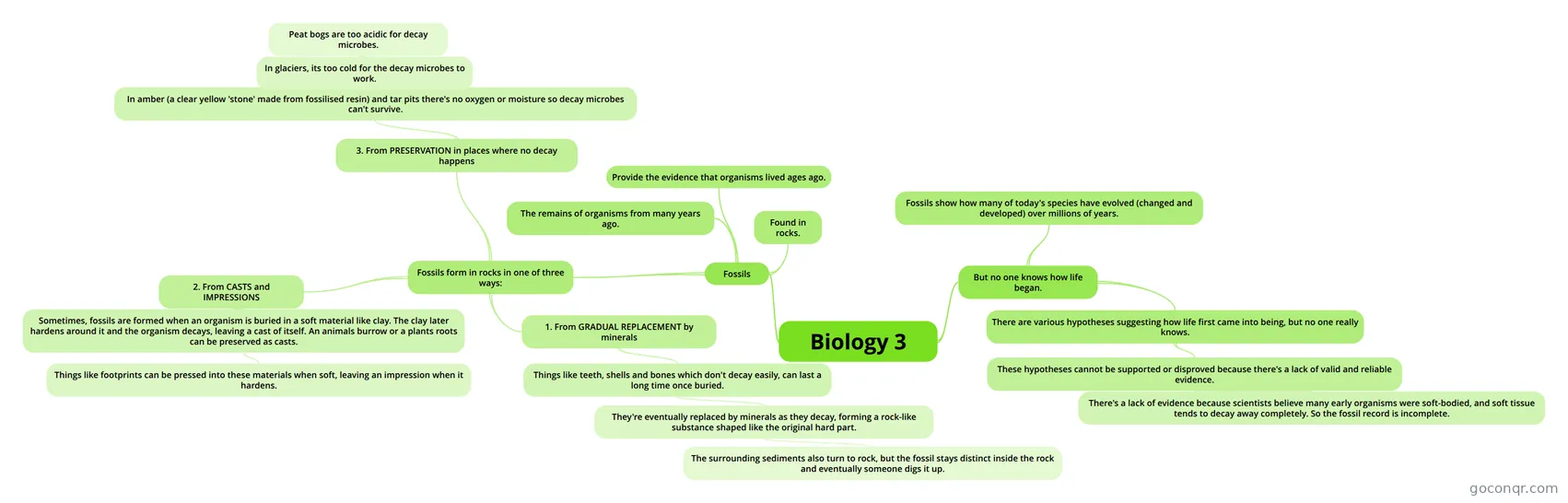
Mind map: Biology 3 fossils
Inhalt der Mindmap
Biology 3
Fossils
- The remains of organisms from many years ago.
- Found in rocks.
- Provide the evidence that organisms lived ages ago.
- Fossils form in rocks in one of three ways:
- 1. From GRADUAL REPLACEMENT by minerals
- Things like teeth, shells and bones which don't decay easily, can last a long time once buried.
- They're eventually replaced by minerals as they decay, forming a rock-like substance shaped like the original hard part.
- The surrounding sediments also turn to rock, but the fossil stays distinct inside the rock and eventually someone digs it up.
- They're eventually replaced by minerals as they decay, forming a rock-like substance shaped like the original hard part.
- Things like teeth, shells and bones which don't decay easily, can last a long time once buried.
- 2. From CASTS and IMPRESSIONS
- Sometimes, fossils are formed when an organism is buried in a soft material like clay. The clay later hardens around it and the organism decays, leaving a cast of itself. An animals burrow or a plants roots can be preserved as casts.
- Things like footprints can be pressed into these materials when soft, leaving an impression when it hardens.
- Sometimes, fossils are formed when an organism is buried in a soft material like clay. The clay later hardens around it and the organism decays, leaving a cast of itself. An animals burrow or a plants roots can be preserved as casts.
- 3. From PRESERVATION in places where no decay happens
- In amber (a clear yellow 'stone' made from fossilised resin) and tar pits there's no oxygen or moisture so decay microbes can't survive.
- In glaciers, its too cold for the decay microbes to work.
- Peat bogs are too acidic for decay microbes.
- In glaciers, its too cold for the decay microbes to work.
- In amber (a clear yellow 'stone' made from fossilised resin) and tar pits there's no oxygen or moisture so decay microbes can't survive.
- 1. From GRADUAL REPLACEMENT by minerals
But no one knows how life began.
- Fossils show how many of today's species have evolved (changed and developed) over millions of years.
- There are various hypotheses suggesting how life first came into being, but no one really knows.
- These hypotheses cannot be supported or disproved because there's a lack of valid and reliable evidence.
- There's a lack of evidence because scientists believe many early organisms were soft-bodied, and soft tissue tends to decay away completely. So the fossil record is incomplete.
- These hypotheses cannot be supported or disproved because there's a lack of valid and reliable evidence.
Informationen
- Beschreibung
- Mindmap am Biology 3, erstellt von hannahgilmour am 20/04/2014.
- Erstellt von
- hannahgilmour
- Aufrufe
- 9
- Bewertung
Mehr zu Evidence for Evolution