
Mindmap
Tissues, Organs and Organ Systems
Inhalt der Mindmap
Tissues, Organs and Organ Systems
Organs in Animals
- Tissues
- Cells differentiate so that they can carry out different functions; differentiation is the process by which cells become specialised
- A tissue is a group of similar cells that work together to carry put a particular function
- There are three different types of tissue
- Muscular; contracts to produce movement
- Glandular tissue; produces substances such as enzymes and hormones
- Epithelial tissue; covers some parts of the body
- There are three different types of tissue
- A tissue is a group of similar cells that work together to carry put a particular function
- Cells differentiate so that they can carry out different functions; differentiation is the process by which cells become specialised
- Organs
- Organs are made up of tissues
- An organ could contain several different types of tissue for example the stomach
- Muscular tissues in the stomach churns the food and other contents of the stomach
- Glandular tissues in the stomach produces digestive juices including acid and enzymes
- Epithelial tissue in the stomach to cove the inner and outer surfaces of the stomach
- An organ could contain several different types of tissue for example the stomach
- Organs are made up of tissues
- Organ systems
- Organ systems are groups of organs that carry out a particular function
- In the body these include: the nervous system, the respiratory system, the reproductive system and the digestive system
- The digestive system, for example, is made up of the following organs:
- Pancreas and salivary glands; to produce digestive juices
- Stomach; to digest food
- Liver; to produce bile
- Small intestine; to digest and absorb food
- Large intestine; to absorb water from undigested food and produce faeces
- The digestive system, for example, is made up of the following organs:
- In the body these include: the nervous system, the respiratory system, the reproductive system and the digestive system
- Organ systems are groups of organs that carry out a particular function
- Tissues
Organs in plants
- Tissues
- There are three types of tissue in a plant
- Epidermal tissue; covers the plant
- Mesophyll; carries out photosynthesis
- Xylem and Phloem; transport of substances around the plant (like veins)
- There are three types of tissue in a plant
- Organs
- Examples of organs in plants include:
- Roots
- Stems
- Leaves
- Leaves are adapted to absorb sunlight for photosynthesis in the following ways
- Chlorophyll; to absorb sunlight
- Large surface area; to absorb more light
- Stomata; to let carbon dioxide diffuse into the leaf
- Thin; short distance for carbon dioxide to diffuse into the leaves
- Network of veins; To support the leaf and transport water and carbohydrates
- Leaves are adapted to absorb sunlight for photosynthesis in the following ways
- Examples of organs in plants include:
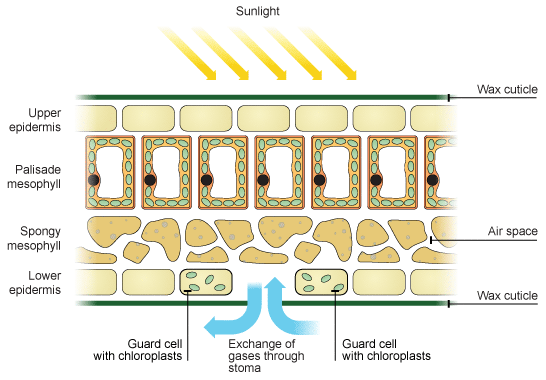
- The leaf
- The internal structure of a leaf allows efficient photosynthesis
- Thin, waxy cuticle; protects leaf without blocking out light
- Thin, transparent epidermis; allows more light to reach the palisade cells
- Layer of palisade cells at the top; to absorb light
- Many chlorplasts in the palisade cells; increases absorption of light
- Spongy mesophyll, air spaces in the leaf allow carbon dioxide to diffuse through the leaf and increase surface area
- The internal structure of a leaf allows efficient photosynthesis
- Tissues
Bilder und Dateien der Mindmap
Informationen
- Beschreibung
- GCSE Biology (Additional GCSE) Mindmap am Tissues, Organs and Organ Systems, erstellt von seth.bragg am 24/04/2014.
- Erstellt von
- seth.bragg
- Aufrufe
- 37
- Bewertung