
Mindmap
Labour, capital, investment and capacity
Inhalt der Mindmap
Labour, capital, investment and capacity
Investment
- Definition - any form of capital intended to contribute to future output
- Can be physical - land premises, and equipment - or human capital such as training and education
- Investment increases productivity->revenue and spending power raised->more investment
- Wages increase, which encourages labour-saving investment
- Technological changes make investment cheaper
- Increasing capital entails net investment - additions of extra equipment rather than just replacements
- Level of profit depends on level of investment; but some large corporations with abnormal profits may not reinvest
- Standards of living raise over time as capital becomes relatively cheaper as wealth increases
- It becomes worthwhile to equip workers with more equipment rather than use more workers - more capital intensive production
- New technologies may only be affordable to the biggest businesses
- Case for antitrust rules to spread the availability of technology?
Labour intensive process
- Some occupations remain labour intensive because of the nature of the work, mostly services such as medical care and hairdressing
- These tend to be small firms in more monopolistic markets, as labour intensive production will typically be on quite a small scale
- Some occupations remain labour intensive because of demand for craftsmanship and artistic flair - these small niche businesses may thrive alongside the larger ones
- Developing countries have little capital equipment, but labour is cheap. People have no disposable income to spend on capital, so employers keep these costs to a minimum and employ more people.
- Some occupations remain labour intensive because of the nature of the work, mostly services such as medical care and hairdressing
Market change
- Much capital is purpose-designed, meaning that when there are changes in demand it may be difficult for capital-intensive businesses to adapt
- They can get around this by ensuring their equipment is flexible, for example using computer aided manufacturing
- This, however, might increase overall costs
- They can get around this by ensuring their equipment is flexible, for example using computer aided manufacturing
- Labour intensive production is more flexible, as skills can be adapted easily. However, if markets shift away from products entirely, jobs are lost.
- Much capital is purpose-designed, meaning that when there are changes in demand it may be difficult for capital-intensive businesses to adapt
Technological change
- New technologies can facilitate capital intensive mass production, for example computers, which used to be a niche market but are now mass produced for all
- New technologies introduced -> new processes use more capital -> productivity rises -> costs fall -> prices fall -> sales increase -> new jobs are created
- Changing market structures
- New technologies can facilitate capital intensive mass production, for example computers, which used to be a niche market but are now mass produced for all
Capacity utilisation
- Investment and technological change increase the capacity of business and the economy
- How is investment performed? R&D through government or companies themselves?
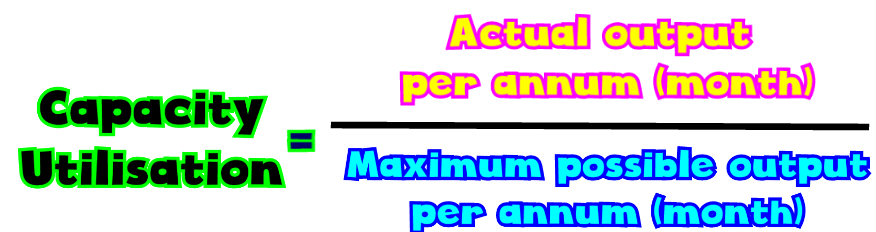
- Capacity utilisation measures how much of the maximum possible output is actually produced.
- If capacity is fully utilised, costs will be minimised but it may be difficult to respond to increases in demand.
- However, if slack is kept in the system average costs may rise which might be a problem in a highly competitive market
- If demand is insufficient, there will be under-utilised capacity. This means that fixed costs are shared across a lower level of output and therefore average fixed costs will rise
- A business may try to increase its productivity in this scenario by diversifying or using aggressive market strategies. If demand seems stuck below capacity, capacity will have to be cut.
- Link to marketing strategies
- High levels of unemployment suggest that the economy as a whole is working below capacity.
- Although not exactly the same as allocative efficiency, this idea can be used in conjunction with it
- A business may try to increase its productivity in this scenario by diversifying or using aggressive market strategies. If demand seems stuck below capacity, capacity will have to be cut.
- Investment and technological change increase the capacity of business and the economy
Efficiency
- Efficiency is achieved when best possible use is made of all the resources employed in production.
- Similar to allocative efficiency
- Efficient organisation of production processes should contribute to increase output per hour worked.
- Ultimately, higher productivity allows businesses to cut costs, reduce prices and become more competitive.
- However, will cutting costs always be the best pricing strategy?
- Efficiency is achieved when best possible use is made of all the resources employed in production.
Bilder und Dateien der Mindmap
Informationen
- Beschreibung
- A level Economics (Theme 2: The wider economic environment) Mindmap am Labour, capital, investment and capacity, erstellt von Harry Lewis am 14/03/2017.
- Erstellt von
- Harry Lewis
- Aufrufe
- 51
- Tags
- Bewertung