
Mindmap
Chemistry: Bonding structure and properties of matter
Inhalt der Mindmap
Chemistry: Bonding structure and properties of matter
Ions
- Made when electrons are transferred
- charged particles are ions, such as Cu2+
- Metals lose electrons to form positive ions
- Non metals gain electrons to form negative Ions
- Metals lose electrons to form positive ions
- When a non Metal and Metal react the metal loses an electron whilst the non metal gains electrons
- Oppositely charged ions are attracted together by strong electrostatic forces
- group 1,2 and 6,7 are most likely to form ions
- e.g. group 6 elements form -2 ions (as they gain 2 electrons
- IMPORTANT: ionic bonds Can be represented by cross and dot diagrams
- e.g. group 6 elements form -2 ions (as they gain 2 electrons
- group 1,2 and 6,7 are most likely to form ions
- Oppositely charged ions are attracted together by strong electrostatic forces
- Ionic Bonding
- charged particles are ions, such as Cu2+
- Ionic Bonds occur between Metals and non Metals (metal loses electrons non metal gains)
- Covalent bonding occurs between two non metals (molecules) this is where electrons are shared
- Ionic Compounds
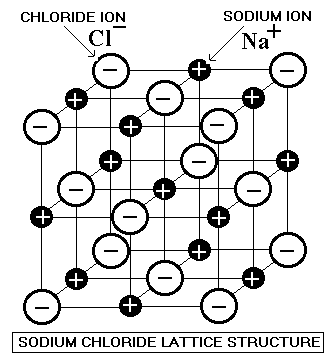
- Ionic Compounds have a GIANT IONIC LATTICE STRUCTURE
- Very strong electrostatic forces between ions
- Ionic structures have high Melting and Boiling points
- They don't conduct electricity when solid, but do when melted and dissolved in water as ions can move freely
- Ionic structures have high Melting and Boiling points
- Very strong electrostatic forces between ions
- Ionic Compounds have a GIANT IONIC LATTICE STRUCTURE
- Made when electrons are transferred
Covalent Bonding
- The SHARING of electrons (Only in outer Shell)
- When Non-Metal atoms bond they share electrons to form Covalent bonds
- Covalent bonds are very strong due to the strong electrostatic force between the positively charged nucleus and Shared electrons
- Covalent bonds often mean the atoms have full outer shells
- This makes them very stable (they are now a noble gas)
- Covalent bonds often mean the atoms have full outer shells
- Covalent bonds are very strong due to the strong electrostatic force between the positively charged nucleus and Shared electrons
- Each single covalent bond provides one electron
- When Non-Metal atoms bond they share electrons to form Covalent bonds
- Drawing Covalent Bonds
- Use dot and cross diagrams
- Draw electrons Overlapping between outer orbitals of two atoms
- These are useful as show which electrons have come from the covalent bonding
- e.g.
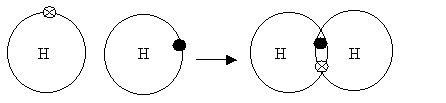
- Here hydrogen is sharing an electron with another hydrogen atom to make H2.
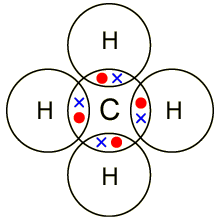
- Or the bonding of Methane (REMEMBER METHANE IS COVALENT AS TWO NON METALS ARE BONDING)
- e.g.
- Or the bonding of Methane (REMEMBER METHANE IS COVALENT AS TWO NON METALS ARE BONDING)
- Here hydrogen is sharing an electron with another hydrogen atom to make H2.
- e.g.
- These are useful as show which electrons have come from the covalent bonding
- Draw electrons Overlapping between outer orbitals of two atoms
- Use dot and cross diagrams
- The SHARING of electrons (Only in outer Shell)
Polymers (Long Chain of monomers)
- Polymers are essentially REPEATING UNITS
- All atoms in a polymer are joined by strong COVALENT bonds (Non metal bonding - sharing)
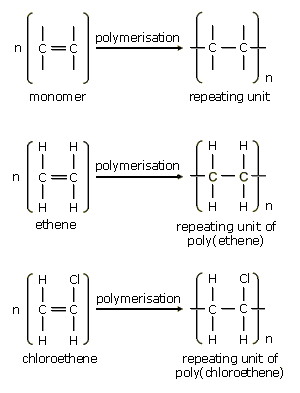
- We draw polymers by the smallest repeating unit:
- Like this:
- Double bond opens up
- The 'n' on the right shows it is a repeating unit
- We can use it to find the molecular formula (Not so important)
- The 'n' on the right shows it is a repeating unit
- Double bond opens up
- Like this:
- We draw polymers by the smallest repeating unit:
- All atoms in a polymer are joined by strong COVALENT bonds (Non metal bonding - sharing)
- Intermolecular forces between polymer molecules is larger than simple covalent molecules (so needs more energy to break them
- However their intermolecular forces aren't as strong as IONIC or COVALENT bonds (So lower boiling and melting points
- Polymers are essentially REPEATING UNITS
Giant Covalent Structures
- Giant covalent structures are macromolecules
- All atoms are bonded by strong covalent Bonds (sharing, non metals)
- Very HIGH melting and boiling points as a lot of energy is needed to break bonds
- They do not contain charged particles (Ions) so DO NOT conduct electricity
- Main examples are:
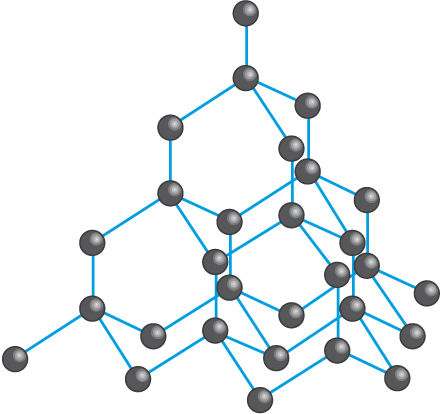
- Diamond (EACH CARBON ATOM FORMS 4 COVALENT BONDS)
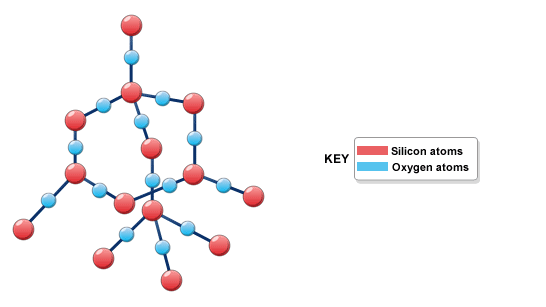
- Silicon Dioxide (What sand is Made of)
- each giant structure of silicon and oxygen is a grain of sand
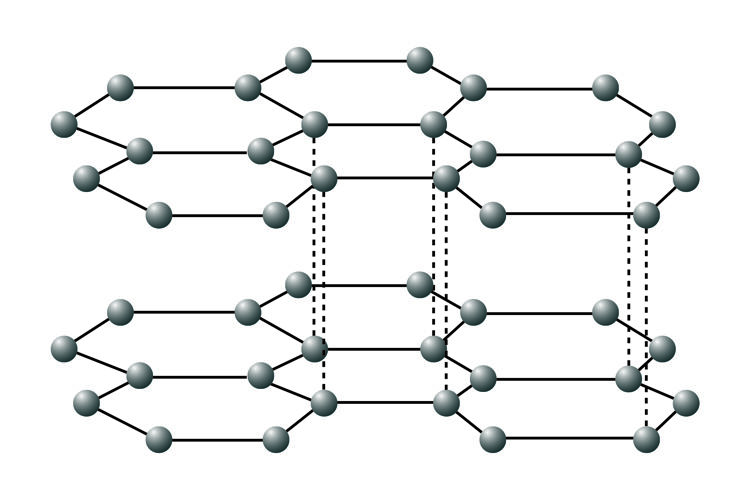
- And Graphite (DOES CONDUCT ELECTRICITY)
- Each carbon atom forms 3 covalent bonds, forming layers of hex(5)agons
- BUT - each carbon atom also has one delocalised electrons (so graphite conducts electricity)
- Allotropes of Carbon
- ALLOTROPES ARE DIFFERENT STRUCTURAL FORMS OF THE SAME ELEMENT IN THE SAME PHYSICAL STATE
- E.G. Diamond
- Diamond is made up of carbon atoms that form 4 covalent bonds.
- It has a high melting point due to strong COVALENT bonds
- It doesn't conduct Electricity
- It has a high melting point due to strong COVALENT bonds
- Diamond is made up of carbon atoms that form 4 covalent bonds.
- E.G. graphite
- Each carbon atom forms 3 COVALENT bonds
- ONLY 3 of carbons 4 outer electrons are used in bonding, so one is delocalised (MEANING GRAPHITE CONDUCTS ELECTRICITY)
- Can be used for lubrication as in layers (so soft and slippy)
- BECAUSE BONDS ARE HELD WEAKLY
- High melting point as strong bonds
- Each carbon atom forms 3 COVALENT bonds
- E.G. Graphene
- ONE LAYER OF GRAPHITE
- SHEET OF CARBON ATOMS JOINED IN HEXAGONS
- one atom thick (two dimensional compound)
- Network of covalent bonds make it very strong (but also very light)
- Also conducts electricity like Graphite due to DELOCALISED ELECTRONS
- SO COULD BE USED IN ELECTRONICS
- one atom thick (two dimensional compound)
- SHEET OF CARBON ATOMS JOINED IN HEXAGONS
- ONE LAYER OF GRAPHITE
- E.G. Diamond
- This diagram is missing Metallic Bonding, fullerenes and States of matter (revise these if needed)
- ALLOTROPES ARE DIFFERENT STRUCTURAL FORMS OF THE SAME ELEMENT IN THE SAME PHYSICAL STATE
- Allotropes of Carbon
- BUT - each carbon atom also has one delocalised electrons (so graphite conducts electricity)
- Each carbon atom forms 3 covalent bonds, forming layers of hex(5)agons
- Silicon Dioxide (What sand is Made of)
- Diamond (EACH CARBON ATOM FORMS 4 COVALENT BONDS)
- Main examples are:
- They do not contain charged particles (Ions) so DO NOT conduct electricity
- Very HIGH melting and boiling points as a lot of energy is needed to break bonds
- All atoms are bonded by strong covalent Bonds (sharing, non metals)
- Giant covalent structures are macromolecules
Bilder und Dateien der Mindmap
Informationen
- Beschreibung
- GCSE Chemistry Mindmap am Chemistry: Bonding structure and properties of matter, erstellt von Erin AS am 29/09/2017.
- Erstellt von
- Erin AS · Sep 2017
- Aktualisiert
- 29 Sep 2017
- Aufrufe
- 70
- Bewertung