
Mindmap
C1.2 Limestone And Building Materials
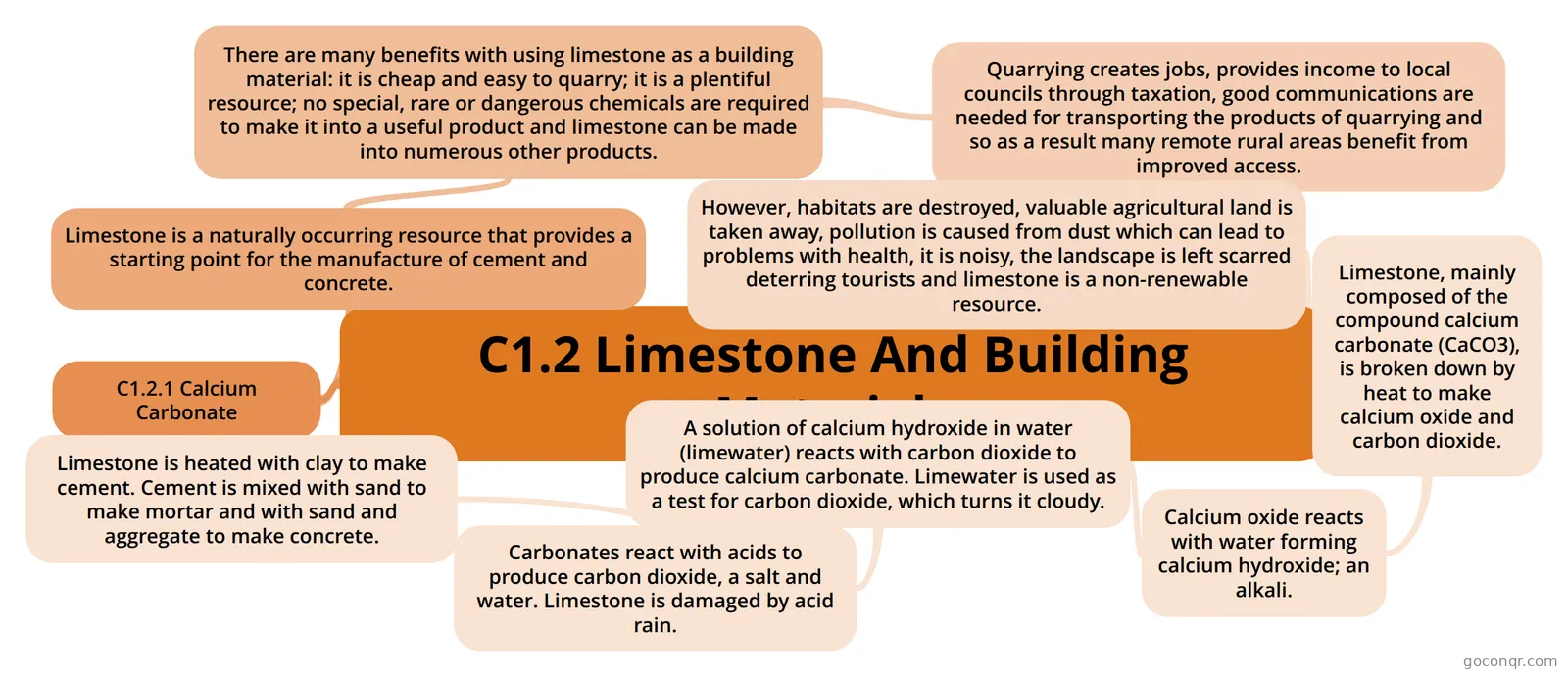
Mind map: Limestone and building materials
Inhalt der Mindmap
C1.2 Limestone And Building Materials
C1.2.1 Calcium Carbonate
- Limestone is a naturally occurring resource that provides a starting point for the manufacture of cement and concrete.
- There are many benefits with using limestone as a building material: it is cheap and easy to quarry; it is a plentiful resource; no special, rare or dangerous chemicals are required to make it into a useful product and limestone can be made into numerous other products.
- Quarrying creates jobs, provides income to local councils through taxation, good communications are needed for transporting the products of quarrying and so as a result many remote rural areas benefit from improved access.
- However, habitats are destroyed, valuable agricultural land is taken away, pollution is caused from dust which can lead to problems with health, it is noisy, the landscape is left scarred deterring tourists and limestone is a non-renewable resource.
- Limestone, mainly composed of the compound calcium carbonate (CaCO3), is broken down by heat to make calcium oxide and carbon dioxide.
- Calcium oxide reacts with water forming calcium hydroxide; an alkali.
- A solution of calcium hydroxide in water (limewater) reacts with carbon dioxide to produce calcium carbonate. Limewater is used as a test for carbon dioxide, which turns it cloudy.
- Carbonates react with acids to produce carbon dioxide, a salt and water. Limestone is damaged by acid rain.
- Limestone is heated with clay to make cement. Cement is mixed with sand to make mortar and with sand and aggregate to make concrete.
- Carbonates react with acids to produce carbon dioxide, a salt and water. Limestone is damaged by acid rain.
- A solution of calcium hydroxide in water (limewater) reacts with carbon dioxide to produce calcium carbonate. Limewater is used as a test for carbon dioxide, which turns it cloudy.
- Calcium oxide reacts with water forming calcium hydroxide; an alkali.
- Limestone, mainly composed of the compound calcium carbonate (CaCO3), is broken down by heat to make calcium oxide and carbon dioxide.
- However, habitats are destroyed, valuable agricultural land is taken away, pollution is caused from dust which can lead to problems with health, it is noisy, the landscape is left scarred deterring tourists and limestone is a non-renewable resource.
- Quarrying creates jobs, provides income to local councils through taxation, good communications are needed for transporting the products of quarrying and so as a result many remote rural areas benefit from improved access.
- There are many benefits with using limestone as a building material: it is cheap and easy to quarry; it is a plentiful resource; no special, rare or dangerous chemicals are required to make it into a useful product and limestone can be made into numerous other products.
- Limestone is a naturally occurring resource that provides a starting point for the manufacture of cement and concrete.
Informationen
- Beschreibung
- GCSE Chemistry (C1) Mindmap am C1.2 Limestone And Building Materials, erstellt von killthemoment am 19/07/2014.
- Erstellt von
- killthemoment
- Aufrufe
- 234
- Tags
- Bewertung