
Mindmap
Atomic Structure
Inhalt der Mindmap
Atomic Structure
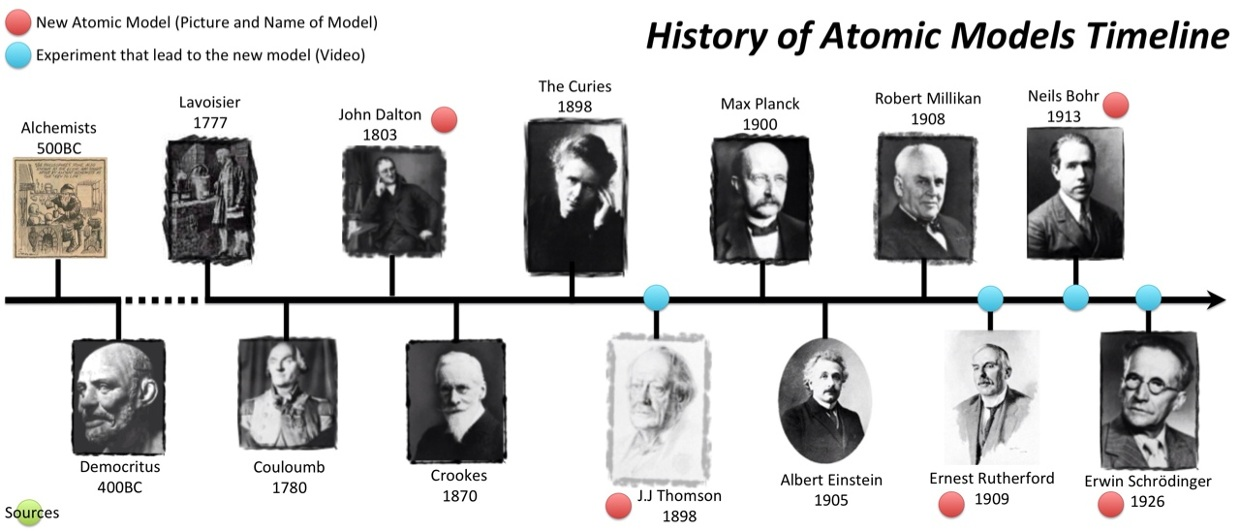
Democritus
- Claimed that matter could not be divided into smaller pieces
John Dalton
- Thought atoms are tiny solid ball, came up with atomic theory
- In 1805, John Dalton published his atomic theory
- All matter is made of tiny particles called atoms
- Atoms are tiny hard spheres that cannot be broken down into smaller parts
- Atoms cannot be created or destroyed
- Atoms in an element always have the equal amount of protons and elctrons
- In 1805, John Dalton published his atomic theory
- Thought atoms are tiny solid ball, came up with atomic theory
J.J Thomson
- Discovered electrons and also discovered atoms are made from positive and negative charged electrons
- Plum Pudding Model
- Discovered electrons and also discovered atoms are made from positive and negative charged electrons
Rutherford
- Discovered protons and the nucleus. He called positive particles "protons" and the centre of the atom the nucleus. He showed that atoms have positive particles in the nucleus and lots of empty space inside
- He found this out by firing alpha atoms at a sheet of gold as it is composed of only one element throughout. The alpha atoms were positively charged so when they hit the nucleus, they repelled. The majority went through completely which showed there was a lot of space that was empty.
- Discovered protons and the nucleus. He called positive particles "protons" and the centre of the atom the nucleus. He showed that atoms have positive particles in the nucleus and lots of empty space inside
Niels Bohr
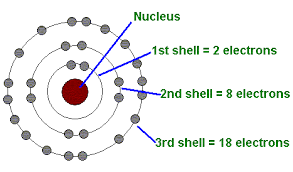
- Improved on Rutherford model and proposed that electrons move around in layers known as electron shells.
Chadwick
- Discovered particles with no charge and called it "Neutrons". Neutrons are also found in the nucleus.
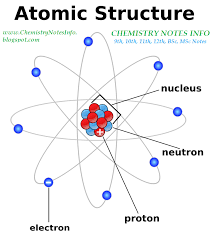
Atoms are made up of electrons together with heavier subatomic particle called protons, electron and neutrons, these particles have very, very small masses and electric charges
The actual mass of a proton is 1.67*10 g
- It is impossible to know where an electron is at any given time
The Modern Model
- The new atomic model has electrons moving around the nucleus in a cloud.
- The overall diameter of an atom can be 100,000 times
- The new atomic model has electrons moving around the nucleus in a cloud.
Subatomic Structures
- Proton
- +1 Positive relative charge
- Relative mass of 1
- +1 Positive relative charge
- Neutron
- 0 relative charge (no charge)
- Relative mass of 1
- 0 relative charge (no charge)
- Electron
- -1 Negative relative charge
- Relative mass of 1/1835 (negligible)
- -1 Negative relative charge
- Proton
Isotopes
- Isotopes are atoms of the same element; they have the same atomic number (number of protons), but a different relative mass number (number of neutrons are different)
- Relative Atomic Mass (RAM)
- The mass of an atom is incredibly small therefore we measure their mass relative to an atom of carbon-12. This isotope is used as a standard and is given a mass of exactly 12. The masses of all other atoms are compared to this, for example, the mass of helium-4 is one-third of that of carbon-12, so the relative mass is 4
- RAM is the mean mass of an element compared to carbon-12. Not always whole numbers, e.g. Cl 35.5 (chlorine) and Cu 63.5 (copper) The abundance of the two isotopes of chlorine are 75% Cl 35 and 25% Cl 37... (75 x 35) + (25 x 37) /100 2625+925/100 3550/100 Ar = 35.5
Bilder und Dateien der Mindmap
Informationen
- Beschreibung
- Year 9 Chemistry Mindmap am Atomic Structure, erstellt von Karina Terlecka am 29/10/2017.
- Erstellt von
- Karina Terlecka
- Aufrufe
- 0
- Verlauf
-
- Erstellt von Tony Huang · 11 Okt 2017
- Kopiert von Karina Terlecka · 29 Okt 2017
- Bewertung