
Mindmap
International Relations
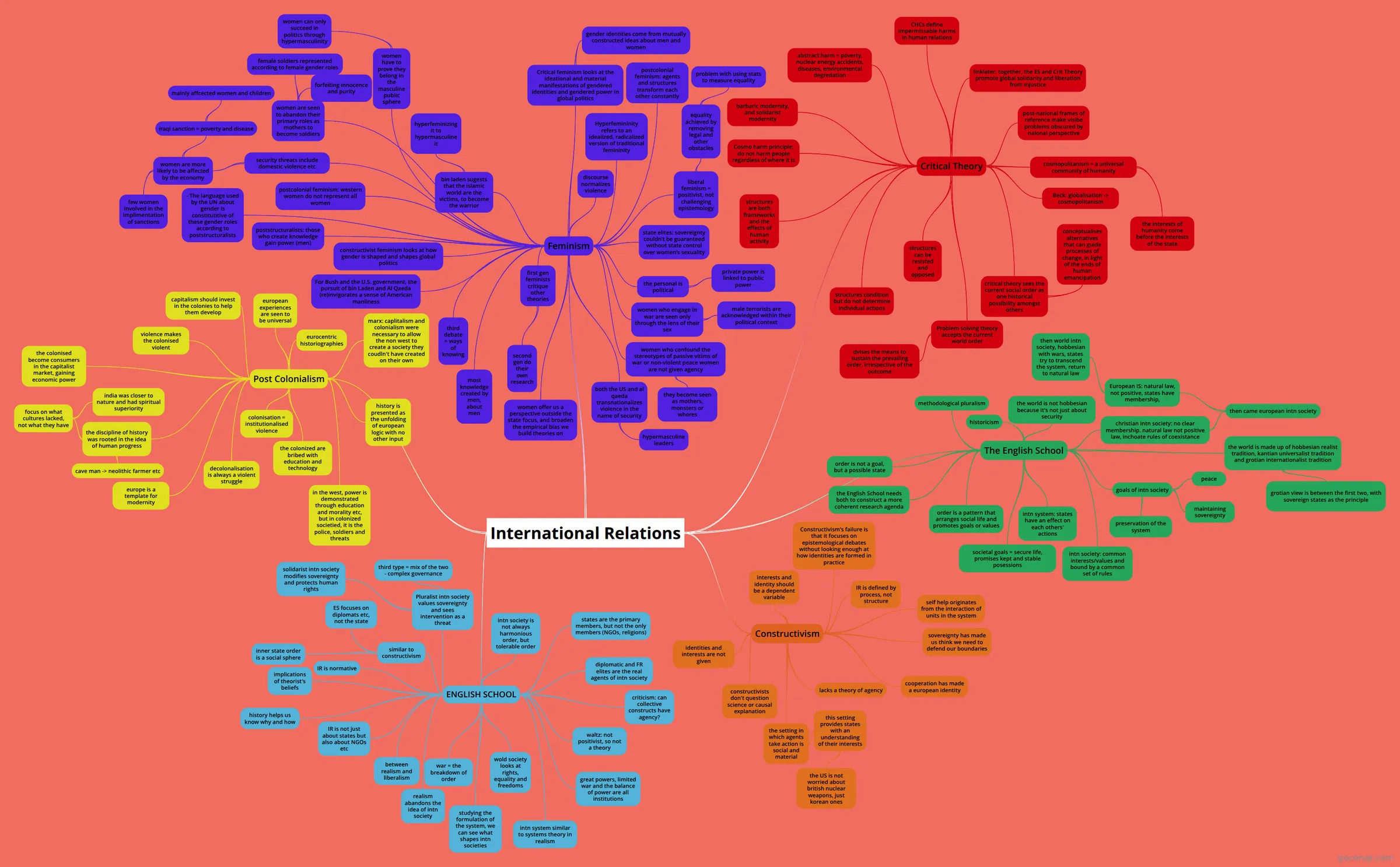
Mind map: International relations theories
Inhalt der Mindmap
International Relations
ENGLISH SCHOOL
- between realism and liberalism
- realism abandons the idea of intn society
- war = the breakdown of order
- great powers, limited war and the balance of power are all institutions
- waltz: not positivist, so not a theory
- criticism: can collective constructs have agency?
- IR is not just about states but also about NGOs etc
- history helps us know why and how
- implications of theorist's beliefs
- IR is normative
- similar to constructivism
- inner state order is a social sphere
- ES focuses on diplomats etc, not the state
- diplomatic and FR elites are the real agents of intn society
- states are the primary members, but not the only members (NGOs, religions)
- intn society is not always harmonious order, but tolerable order
- Pluralist intn society values sovereignty and sees intervention as a threat
- solidarist intn society modifies sovereignty and protects human rights
- third type = mix of the two - complex governance
- studying the formulation of the system, we can see what shapes intn societies
- intn system similar to systems theory in realism
- wold society looks at rights, equality and freedoms
Constructivism
- lacks a theory of agency
- the setting in which agents take action is social and material
- this setting provides states with an understanding of their interests
- the US is not worried about british nuclear weapons, just korean ones
- this setting provides states with an understanding of their interests
- constructivists don't question science or causal explanation
- cooperation has made a european identity
- sovereignty has made us think we need to defend our boundaries
- IR is defined by process, not structure
- self help originates from the interaction of units in the system
- Constructivism's failure is that it focuses on epistemological debates without looking enough at how identities are formed in practice
- interests and identity should be a dependent variable
- identities and interests are not given
The English School
- order is not a goal, but a possible state
- order is a pattern that arranges social life and promotes goals or values
- societal goals = secure life, promises kept and stable posessions
- intn system: states have an effect on each others' actions
- intn society: common interests/values and bound by a common set of rules
- goals of intn society
- preservation of the system
- maintaining sovereignty
- peace
- the world is made up of hobbesian realist tradition, kantian universalist tradition and grotian internationalist tradition
- grotian view is between the first two, with sovereign states as the principle
- christian intn society: no clear membership. natural law not positive law, inchoate rules of coexistance
- then came european intn society
- European IS: natural law, not positive, states have membership,
- then world intn society, hobbesian with wars, states try to transcend the system, return to natural law
- European IS: natural law, not positive, states have membership,
- then came european intn society
- the world is not hobbesian because it's not just about security
- methodological pluralism
- historicism
- the English School needs both to construct a more coherent research agenda
Critical Theory
- structures are both frameworks and the effects of human activity
- structures condition but do not determine individual actions
- structures can be resisted and opposed
- Problem solving theory accepts the current world order
- dvises the means to sustain the prevailing order, irrespective of the outcome
- critical theory sees the current social order as one historical possibility amongst others
- conceptualises alternatives that can guide processes of change, in light of the ends of human emancipation
- Beck: globalisation -> cosmopolitanism
- cosmopolitanism = a universal community of humanity
- the interests of humanity come before the interests of the state
- post-national frames of reference make visibe problems obscured by naional perspective
- linklater: together, the ES and Crit Theory promote global solidarity and liberation from injustice
- CHCs define impermissable harms in human relations
- Cosmo harm principle: do not harm people regardless of where it is
- abstract harm = poverty, nuclear energy accidents, diseases, environmental degredation
- barbaric modernity, and solidarist modernity
Post Colonialism
- the discipline of history was rooted in the idea of human progress
- cave man -> neolithic farmer etc
- focus on what cultures lacked, not what they have
- india was closer to nature and had spiritual superiority
- europe is a template for modernity
- decolonalisation is always a violent struggle
- colonisation = institutionalised violence
- in the west, power is demonstrated through education and morality etc, but in colonized societied, it is the police, soldiers and threats
- the colonized are bribed with education and technology
- the colonised become consumers in the capitalist market, gaining economic power
- violence makes the colonised violent
- capitalism should invest in the colonies to help them develop
- european experiences are seen to be universal
- history is presented as the unfolding of european logic with no other input
- marx: caplitalism and colonialism were necessary to allow the non west to create a society they coudln't have created on their own
- eurocentric historiographies
- the discipline of history was rooted in the idea of human progress
Feminism
- both the US and al qaeda transnationalizes violence in the name of security
- hypermasculine leaders
- women who confound the stereotypes of passive vitims of war or non-violent peace women are not given agency
- they become seen as mothers, monsters or whores
- women who engage in war are seen only through the lens of their sex
- male terrorists are acknowledged within their political context
- women offer us a perspective outside the state focus, and broaden the empirical bias we build theories on
- the personal is political
- private power is linked to public power
- state elites: sovereignty couldn’t be guaranteed without state control over women’s sexuality
- postcolonial feminism: agents and structures transform each other constantly
- Hyperfemininity refers to an idealized, radicalized version of traditional femininity
- discourse normalizes violence
- bin laden sugests that the islamic world are the victims, to become the warrior
- hyperfeminizing it to hypermasculine it
- For Bush and the U.S. government, the pursuit of bin Laden and Al Qaeda (re)invigorates a sense of American manliness
- third debate = ways of knowing
- most knowledge created by men, about men
- first gen feminists critique other theories
- second gen do their own research
- liberal feminism = positivist, not challenging epistemology
- equality achieved by removing legal and other obstacles
- problem with using stats to measure equality
- equality achieved by removing legal and other obstacles
- Critical feminism looks at the ideational and material manifestations of gendered identities and gendered power in global politics
- gender identities come from mutually constructed ideas about men and women
- constructivist feminism looks at how gender is shaped and shapes global politics
- poststructuralists: those who create knowledge gain power (men)
- - The language used by the UN about gender is constitutitive of these gender roles according to poststructuralists
- postcolonial feminism: western women do not represent all women
- security threats include domestic violence etc
- women are more likely to be affected by the economy
- iraqi sanction = poverty and disease
- mainly affcected women and children
- few women involved in the implimentation of sanctions
- iraqi sanction = poverty and disease
- women are more likely to be affected by the economy
- women are seen to abandon their primary roles as mothers to become soldiers
- female soldiers represented according to female gender roles
- forfeiting innocence and purity
- women have to prove they belong in the masculine public sphere
- women can only succeed in politics through hypermasculinity
- both the US and al qaeda transnationalizes violence in the name of security
Informationen
- Beschreibung
- Politics Mindmap am International Relations, erstellt von Jessica Leech am 29/11/2017.
- Erstellt von
- Jessica Leech
- Aufrufe
- 0
- Bewertung